World Science Day: what is the role of science and the university today?
Celebrated annually on November 10, World Science Day serves as a reminder that science is not merely about new discoveries or cutting-edge technologies. It is the very foundation of societal progress, helping us understand the world, solve complex problems, and shape future solutions. The aim of this day is to highlight the importance of science to the development of society and to strengthen the dialogue between researchers and the public.
So, how is the role of science changing today? Which research fields are shaping the future? And why should students get involved in research while still studying? On this occasion, we asked VILNIUS TECH researchers to share their perspective on the role of science yesterday, today, and tomorrow.
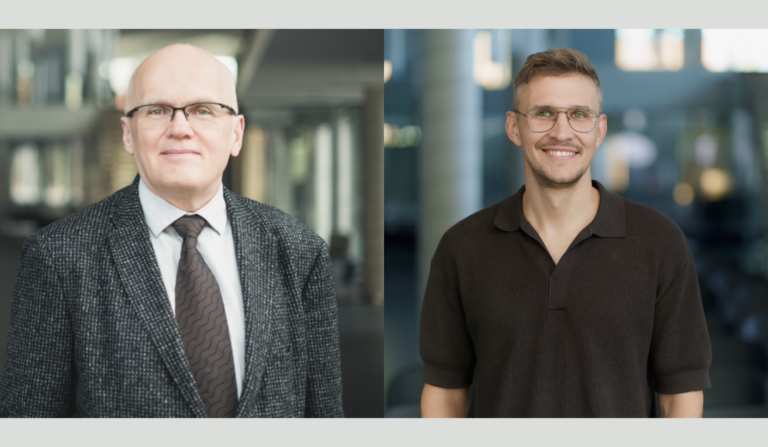
Insights are shared by Professor at the Department of Information Systems, Faculty of Fundamental Sciences (FMF), and Chief Research Fellow at the Department of Information Technologies – Habil. Dr. Antanas Čenys, and FMF Vice-Dean for Research and Project Development, Dr. Eimantas Ramonas.
A University Is Inconceivable Without Science
According to the former Vice-Rector for Research, Prof. Habil. Dr. A. Čenys, although scientific and technological progress has accelerated rapidly in recent decades, the fundamental meaning of science within the university has remained unchanged: to train specialists and raise the general level of public education—neither of which is possible without modern scientific research.
"The university is the place where people are prepared to utilize the latest achievements in science and technology across all areas of societal development. In order to understand the newest technologies, one must take part in creating them; and to be able to prepare such specialists, it is essential to involve them directly in scientific research," says the professor.
For this reason, both researchers emphasize the importance of student involvement in scientific activities. As Prof. Habil. Dr. A. Čenys notes, merely using the latest technologies is not enough to truly understand them—it is necessary to be part of their development process. That is precisely why integrating students into research is an inseparable part of the university’s mission.
According to Dr. E. Ramonas, an early introduction to science allows students to understand how new technologies and innovations are born—not just by sitting in a lecture hall or lab listening to a lecturer, but by experiencing it firsthand. Furthermore, this involvement helps students gain clarity on their interests and career direction.
"Getting a taste of scientific research during your studies and realizing that you enjoy it gives you a competitive edge in your future career, as you start building experience earlier than graduation. On the other hand, trying out such activities in your first years and discovering that a particular field does not interest you at all allows you to pivot and search for your path elsewhere," explains the Vice-Dean.
Nevertheless, stepping into the world of science presents young researchers with certain challenges. Dr. E. Ramonas highlights two main issues: the fast pace of life and an extraordinarily broad field of potential research.
"Due to the rapid rhythm of life, it is difficult for young researchers to focus on just one or two directions where they can deepen their competencies and become experts. Today, there are more opportunities to get involved in science than ever before, but it is precisely this abundance of choice that often makes it difficult to decide which way to go," he explains.
A Faculty Responding to Today’s Challenges
Speaking of technological advancement, Artificial Intelligence (AI) is increasingly applied in science, which, according to Dr. E. Ramonas, is fundamentally altering the research process.
"With the help of artificial intelligence, it is possible to gather required data from open-access sources much faster, perform preliminary analyses, and evaluate the feasibility of planned research. This helps scientists manage their time and limited resources far more efficiently," the Vice-Dean notes.
The researcher also emphasizes another aspect: AI is not merely a tool that accelerates processes, but an object of study in itself, meaning that a significant portion of research at FMF is centered directly around it.
Dr. Eimantas Ramonas points to several other key research areas currently being actively pursued at the faculty: data analytics, cybersecurity, and data-driven decision-making. Mathematical modeling research utilizing quantum computing methods is also underway, which in the future could help analyze complex systems at unprecedented speeds.
Additionally, the faculty conducts biotechnology research in life sciences, focused on improving food quality and studying cellular processes—ranging from research utilizing microorganisms to studying cancer cells.
Creative technology fields are no less important. Research into animation, game engines, and virtual and augmented reality solutions seeks to enable broader, more diverse entertainment options.
Science as an Opportunity to Change the World
When asked what science means to him personally, Prof. Habil. Dr. A. Čenys answers concisely: "For me, it is an opportunity to understand the world around us and strive to improve it."
Among the most inspiring scientific breakthroughs of recent years, he highlights artificial intelligence and medical achievements.
"In my personal opinion, recent years have been dominated by achievements in artificial intelligence, whose scale, rate of development, and impact across various spheres of life are simply incredible. However, medical breakthroughs are no less impressive. One of the clearest examples is the COVID-19 vaccine, developed in record time, which demonstrated what can be achieved when the global scientific community mobilizes its efforts. Still, artificial intelligence stands out because its impact spans virtually every aspect of human society," says Prof. Habil. Dr. A. Čenys.
Although it is difficult to predict exactly what science will look like in ten years, both researchers agree that artificial intelligence, data analytics, and interdisciplinary research will inevitably shape the future directions of science.
On the occasion of World Science Day, both researchers share a message for the younger generation:
"Stay active and have the courage to take on things we haven't done before," wishes Prof. Habil. Dr. A. Čenys.
And for those considering Master's or PhD studies, Dr. E. Ramonas advises not to dismiss the opportunity to take that step:
"To students who have given even a passing thought to master's studies, I would suggest not overthinking it and just going for it. Upon finishing a bachelor's degree, fatigue often takes over, but after a short rest comes the realization of how much you have already learned and how much still remains undiscovered. That is precisely when the most crucial question arises: what else do I not know yet?"
More