Partnership between Yancheng Institute of Technology and VGTU continues

April 25, 2019

Vilnius Gediminas Technical University (VGTU) and Yancheng Institute of Technology from China continue the development of bilateral cooperation. On 19 April, management team of Yancheng Institute of Technology visited VGTU to sign a partnership agreement on further development of strategic interinstitutional cooperation. The main focus of this partnership agreement is double degree programmes for future civil engineering and architecture professionals.

Representatives of both universities discussed the possibilities to start an international four-year bachelor double degree programme in civil engineering with two years of studies in China and two years – in Lithuania, and a possibility to design a joint degree programme later. The guests were also interested in VGTU’s expertise and competence in finance; thus, they visited the Faculty of Business Management. Financial Engineering programme is offered at Yancheng Institute of Technology as well and, therefore, the guests wanted to learn more about the structure and courses of the programme at VGTU, and what employment opportunities does this programme provide. 

The guests visited the Faculty of Civil Engineering, research centre and the Technology Centre for Building Information and Digital Modelling. Representatives of the delegation wanted to learn more about innovations in digital construction, the latest trends and VGTU’s experience in the field. Assoc. Prof. Dr. Vladimir Popov welcomed the guests and introduced the activities of the Technology Centre for Building Information and Digital Modelling, talked about research in the field and presented innovations that use BIM technologies in the construction sector.

During the visit to VGTU’s Faculty of Architecture, five-year studies in architecture with a double degree option were discussed. Currently, architecture studies in China take five years to earn a bachelor degree. Meanwhile, in Lithuania five-year studies lead to a master’s degree. The representatives of both parties analysed a possibility to organise a five-year study programme with two years in China and three years at VGTU (Lithuania), and a prospect to earn bachelor and master diplomas which are recognized in Europe. 

In addition to discussions about cooperation on programme level, the guests were also interested in training visits of their teaching staff at VGTU, especially in the areas of civil engineering, digital construction and finance. Moreover, the parties talked about admission of doctoral students from China who could apply the knowledge gained in Lithuania in Chinese education institutions.
 

Galerija

Related news

Elsevier Training: Scientific Publishing, Journal Selection and Scopus Insights
We invite VILNIUS TECH students, academic staff, and employees to participate in a series of free online training sessions organized by Elsevier, one of the world's leading providers of scientific publishing and information solutions. During these training sessions, participants will learn how to successfully publish research, choose the most suitable journal for their work, gain insights into Scopus evaluation criteria, and make effective use of advanced scientific information search tools. Elsevier Author Workshop – How to Feel Confident on the Publishing Journey Date and time: November 13 | 13:00 Learn how to navigate the scientific publishing journey, from choosing the right journal to understanding peer review and editorial decisions. The webinar will also explore research ethics, responsible AI use, and Elsevier resources that support researchers at every stage of their work. Registration   Editors Session with Elsevier Date and time: November 18 | 11:30 T In this session, participants will learn how the Scopus database selects and evaluates journals for inclusion, ensuring their quality and reliability. The webinar will cover journal evaluation criteria, the submission process, and key information for journal editors seeking to have their publications indexed in Scopus. Registration   How to Find the Right Journal: Strategies and Tools That Can Help Authors Date and time: November 24 | 11:30 This training session will help researchers identify the most suitable journal for their publication. Participants will learn about key journal selection criteria, how to identify leading journals in their field, and how to use Elsevier tools and solutions to make informed publishing decisions and increase the visibility of their research. Registration   Mastering Scopus Advanced Search Date and time: November 26 | 11:30 This session will introduce advanced Scopus search capabilities, enabling participants to build precise and sophisticated queries using additional search fields and search operators. Attendees will learn how to structure complex searches effectively, make the most of advanced database features, and improve the efficiency and accuracy of scientific information retrieval. Registration
More
VILNIUS TECH contributes to the development of virtual production teaching methodologies in Europe
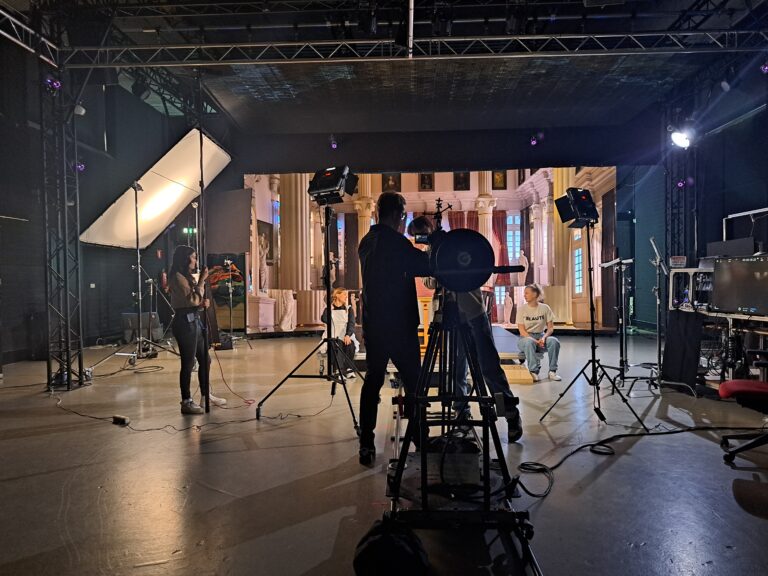
From Hollywood blockbusters to video game development, Virtual Production technologies are rapidly transforming workflows across the creative industries. To ensure that these technologies are effectively integrated into higher education, lecturers and students from the VILNIUS TECH Department of Graphic Systems participated in creative workshops organized within the international VPSN 2.0 (Virtual Production Studio Network 2) project in the Netherlands. VPSN 2.0 is an international educational and research initiative that brings together five European higher education institutions: VILNIUS TECH (Lithuania), Breda University of Applied Sciences (Netherlands), The Animation Workshop (Denmark), Howest University of Applied Sciences (Belgium), and Hamm-Lippstadt University of Applied Sciences (Germany). The main objective of the project is to develop and improve teaching methodologies that enable the effective integration of Virtual Production technologies into higher education curricula. Creative workshops and advanced virtual production technologies In May and October 2026, two international creative workshops were organized at Breda University of Applied Sciences. During these workshops, participants gained hands-on experience with a range of Virtual Production technologies. According to the Head of the Multimedia and Computer Design Laboratory, Ernestas Čepulionis, the workshops focused on creating virtual filming environments using state-of-the-art tools: “Using the Unreal Engine game engine, three-dimensional scenes, assets, and animations were created, while the entire virtual environment was streamed in real time to LED screens. Motion Capture (MoCap) technology enabled dynamic adaptation of the displayed content according to real camera movements. In addition, Gaussian Splatting technology and generative artificial intelligence solutions made it possible to create highly realistic digital filming environments.” Through these activities, participants not only explored the latest technological solutions but also evaluated their potential for educating future specialists in creative technologies, media production, and audiovisual content creation. International collaboration and a joint creative project The first workshop brought together representatives from all partner institutions. VILNIUS TECH was represented by Associate Professor Dr. Tomas Mitkus from the Department of Graphic Systems and Ernestas Čepulionis, Head of the Multimedia and Computer Design Laboratory. Together with lecturers from partner universities, they developed a collaborative creative project that resulted in a short film. Working in international teams, participants explored the practical application of Virtual Production technologies and discussed how these tools and workflows could be integrated into university-level courses and study programmes. One of the key conclusions was that Virtual Production professionals require more than technical expertise. Equally important are communication skills, the ability to work in interdisciplinary teams, and adaptability to rapidly evolving creative and technological processes. Fostering student creativity and competencies The second workshop, held in October 2026, focused on student-led creative projects. Each partner institution delegated one lecturer and two students, who worked in international teams to develop projects using the Virtual Production technologies previously explored by the academic staff. Lecturers observed the creative process and evaluated how effectively students were able to understand technological principles, apply them in practice, and exploit their creative potential. At the same time, the project partners analyzed which teaching approaches and practical assignment formats are most effective in developing competencies required by the industry. How will the project improve study quality? The experience and research data gathered during both workshops will contribute to the ongoing development of Virtual Production teaching methodologies. The project outcomes will support universities in sharing best practices, strengthening international collaboration, and integrating Virtual Production technologies more effectively into higher education programmes across Europe. VPSN 2.0 not only fosters collaboration among European universities but also helps ensure that VILNIUS TECH students gain experience with cutting-edge Virtual Production technologies and develop competencies that are increasingly becoming industry standards within the creative sector. More information about the VPSN 2.0 project and its activities can be found on the project's official website: https://www.vpstudionetwork.com/vpsn-2-0-train-the-trainer/ To learn more about the results of the creative workshops and get a behind-the-scenes look at the production of the short film, watch the video below: https://youtu.be/M3rZpcM5sgs Articale prepared by Dr. Tautvydas Kvietkauskas. Article prepared based on information provided by Associate Professor Dr. Tomas Mitkus of the Department of Graphic Systems and Ernestas Čepulionis, Head of the Multimedia and Computer Design Laboratory.
More