Professor from the University of Rochester in the USA visited VGTU

January 2, 2017
On 19-23 December, professor John Liobe from the University of Rochester (the USA) visited VGTU's Faculty of Electronics and the Laboratory of Micro and Nano-electronics Systems Design and Research.
 
The professor specialises in CMOS, CCD sensor matrices and design of integrated circuits. He wrote a great number of scholarly articles and implemented many projects with the U.S. Department of Defence, the U.S. Department of Energy, CORNING, KODAK, INTEL and other well-known U.S. companies.
 
During a meeting with VGTU community at the Faculty of Electronics the guest presented his projects with the U.S. Department of Defence, met with doctoral students, and told about the opportunities for internships and training visits at the University of Rochester. Professor Liobe invited doctoral students to use the excellent opportunities provided by the Erasmus Plus programme and visit the University of Rochester or join the projects the University is working on.
 
Professor Liobe also visited the new VGTU's Laboratory of Micro and Nano-electronics Systems Design and Research, which is located in the science and technology park "Saulėtekio slėnis" (Sunrise Valley). He was impressed with the laboratory's equipment and the possibilities it provides. The professor noted that it is here – at such labs – the high-tech ideas and micro / nano-electronics systems' start-ups are to be born. The meeting laid the ground for several ideas on further, more intensive cooperation.
 
VGTU's creativity and innovation centre "LinkMenų fabrikas" was also appreciated by J. Liobe, who thought that it is an excellent place for students from various study fields to meet for joint activities and start-ups. It is an excellent example, that is worth bringing back to his university. The University of Rochester also has a similar space for engineering students studying in the fields of electronics, mechanics, transport engineering. But bringing in students from management and creative industries adds a totally new dimension to such centres, and could increase the success of start-ups significantly.
 
It was the second professor's visit to Lithuania. He was quite pleasantly surprised with the progress that VGTU has made since his last visit in 2014: the new building for VGTU's administrative staff, laboratories in the "Saulėtekio slėnis", a lot of international students. On the departure, the guest was joking, that possibly upon his return in several years he might find things at VGTU which are not yet present at the most prestigious universities in the United States.


Related news

29th Young Scientists’ Conference “Science – Future of Lithuania. Economics and Management”
On October 20, the VILNIUS TECH Faculty of Business Management will organise the 29th Young Scientists’ Conference “Science – Future of Lithuania. Economics and Management”, bringing together young researchers, members of the academic community and professionals from various fields.   Conference Programme The conference will consist of two parts: 12:20–13:50 Plenary session held in person in the first-floor lobby of the VILNIUS TECH S1 building. 16:30–18:30 Master's students’ presentations held online in separate study programme sessions.   Plenary Session Speakers The plenary session will cover topics related to project management, strategy implementation and the use of data in decision-making. The following speakers will deliver presentations: Mantas Kapočius (UAB “DIPA”) will deliver a presentation titled “Efektyvus projektų valdymas DI priemonėmis”. Ingrida Pocevičiūtė (Environmental Projects Management Agency) will present “Nuo strategijos iki rezultato: APVA patirtis”. Chris Krul (Bloomberg L.P., United Kingdom) will deliver a presentation titled “Reading the World Through Data: How Information Shapes Financial Decisions”.   Master's Students’ Research Presentations During the second part of the conference, Master's students will present their research and findings online. All participants who deliver presentations will receive certificates of participation. The best presentations, developed into scientific articles, may be published in the scientific journal “Science – Future of Lithuania”, subject to peer review. Links to join the online conference sessions will be published closer to the event date.   Chair of the Scientific and Organising Committee Assoc. Prof. P. Šūmakaris Tel.: +370 5 274 4885 Email: paulius.sumakaris@vilniustech.lt Secretary of the Scientific and Organising Committee M. Vitkauskaitė-Duoblienė Tel.: +370 5 274 4889 Email: marina.vitkauskaite-duobliene@vilniustech.lt More
More
Lithuanian Technology Transfer Experts Explore AI and New Commercialisation Opportunities in Tallinn
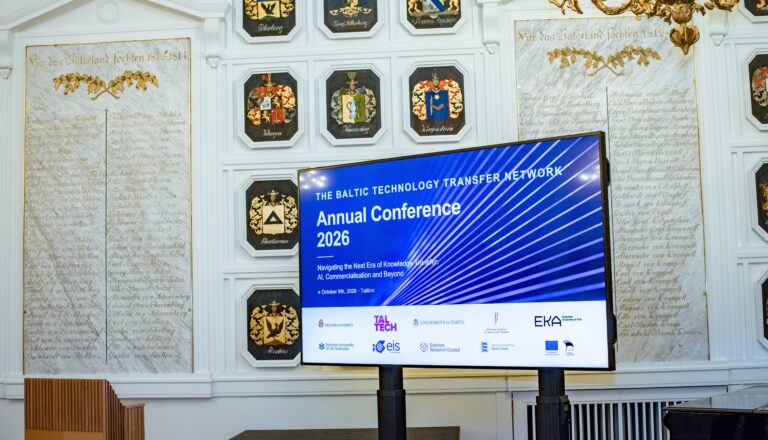
On 8–9 October, Lithuanian technology transfer experts joined their Baltic and Nordic counterparts in Tallinn for the Baltic Technology Transfer Network Annual Conference 2026, titled “Navigating the Next Era of Knowledge Transfer: AI, Commercialisation and Beyond.” Held at the historic Estonian Statehood House, the two-day event brought together professionals to explore how artificial intelligence (AI), intellectual property (IP) management and evolving regulatory frameworks are shaping the future of research commercialisation. Lithuania was represented by members of the Lithuanian Knowledge and Technology Transfer Network (TTO Lithuania), including Justina Adomaitytė, Research and Innovation Expert at VILNIUS TECH, alongside experts from Kaunas University of Technology (KTU), Vilnius University, the Lithuanian University of Health Sciences and Vytautas Magnus University. Artificial Intelligence in Technology Transfer: Opportunities and Challenges One of the conference's central themes was the growing role of AI in technology transfer. Experts explored how AI-powered tools can help technology transfer offices (TTOs) identify the commercial potential of research more efficiently, while also addressing legal, intellectual property and data protection challenges associated with their adoption. The discussion featured Dr Florian Kirschenhofer, Head of Start-ups and Investments at Max Planck Innovation (Germany); Rene Väli, AI expert at AIRE/TalTech; and Tea Park, legal and data protection expert at Walless. The session was moderated by Renato Calzone, Head of the Technology Transfer Office at Eindhoven University of Technology (the Netherlands), who also shared practical insights into transforming research outcomes into commercial value. Strengthening the Baltic Spin-off Ecosystem Another highlight was the panel discussion “What Does It Take to Build a Successful University Spin-off in the Baltics?”, moderated by Anu Honkalinna from Aalto University (Finland). Representing Lithuania, Greta Žėkienė, Intellectual Property Management Project Manager at KTU, shared the university's experience in establishing and developing academic spin-offs. Together with representatives from TalTech (Estonia) and the Institute of Solid State Physics (Latvia), she discussed common challenges in research commercialisation, investor engagement and the development of supportive innovation infrastructure. “Although the Baltic countries have strong research potential, bringing technologies successfully to market requires more than a clear legal framework. Technology transfer offices need to think and act like start-ups themselves — responding quickly, exploring innovative approaches and finding the most suitable commercialisation pathways. Sharing experiences with our Baltic colleagues helps us address common challenges and develop practical solutions,” emphasised Žėkienė. From Intellectual Property Strategy to Hands-on Experience The conference also addressed the complexities of State Aid regulations in technology transfer agreements, with Dr Florian Kirschenhofer examining their practical implications for research commercialisation. A particularly engaging part of the programme was an interactive strategy game in which technology transfer professionals worked through realistic commercialisation scenarios. Participants analysed intellectual property, negotiated strategic decisions and explored ways to protect and bring research-based innovations to market. The hands-on format encouraged knowledge sharing and offered fresh perspectives on navigating the challenges of technology transfer. Building a Stronger Baltic Technology Transfer Network The Tallinn conference continued the tradition of annual Baltic technology transfer meetings launched in Vilnius in 2025. These gatherings provide an important opportunity to strengthen regional cooperation, exchange expertise and develop shared approaches to turning scientific discoveries into market-ready technologies and successful businesses. As AI continues to transform the innovation landscape, collaboration between universities, research institutions and industry remains essential to unlocking the commercial potential of Baltic research. The conference was organised by TTO Estonia in cooperation with the Estonian Patent Office, Enterprise Estonia and the Estonian Research Council, with co-funding from the European Union.
More