The new VILNIUS TECH chaplain: "I will assist anyone who wants to talk"

June 17, 2024
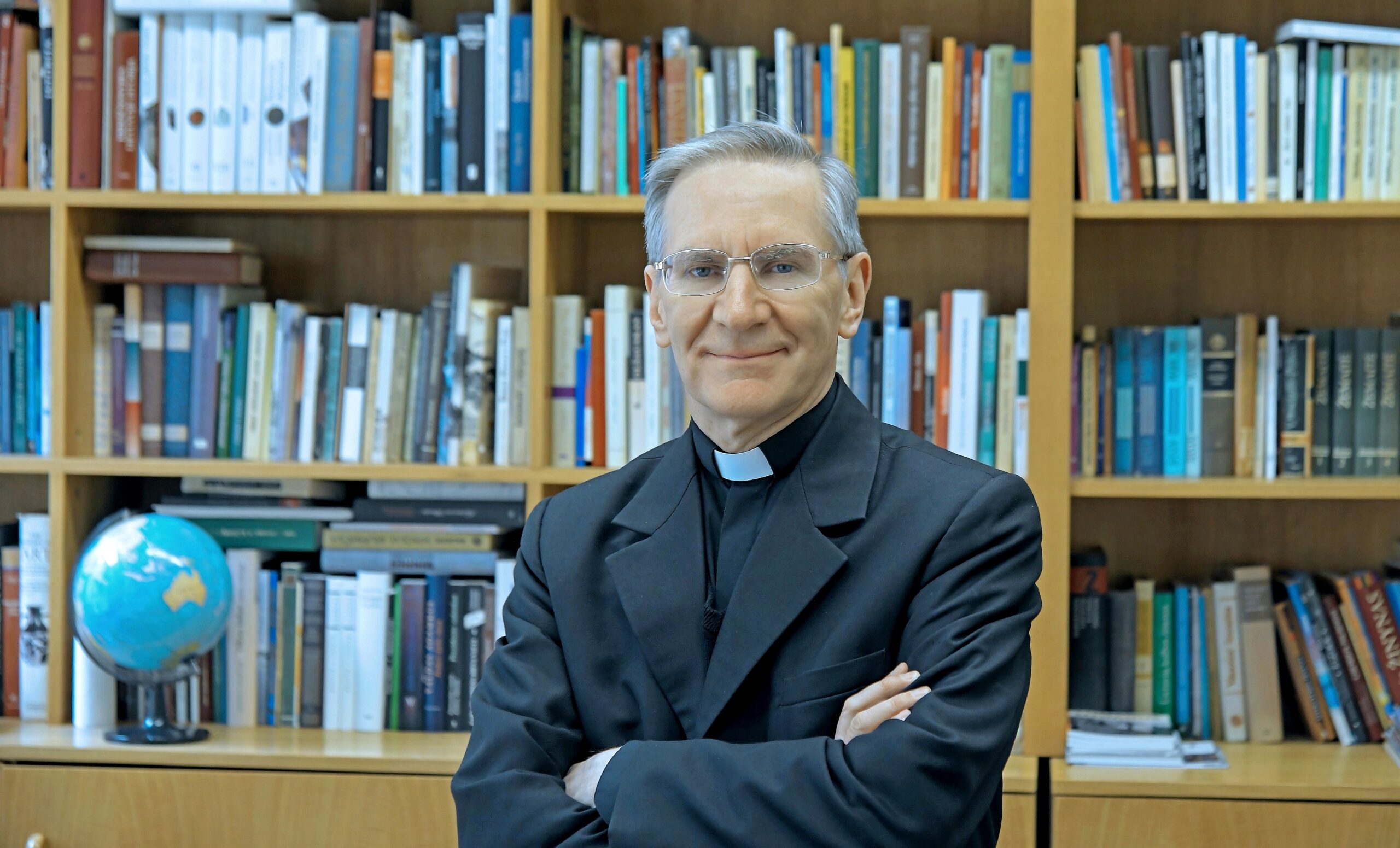
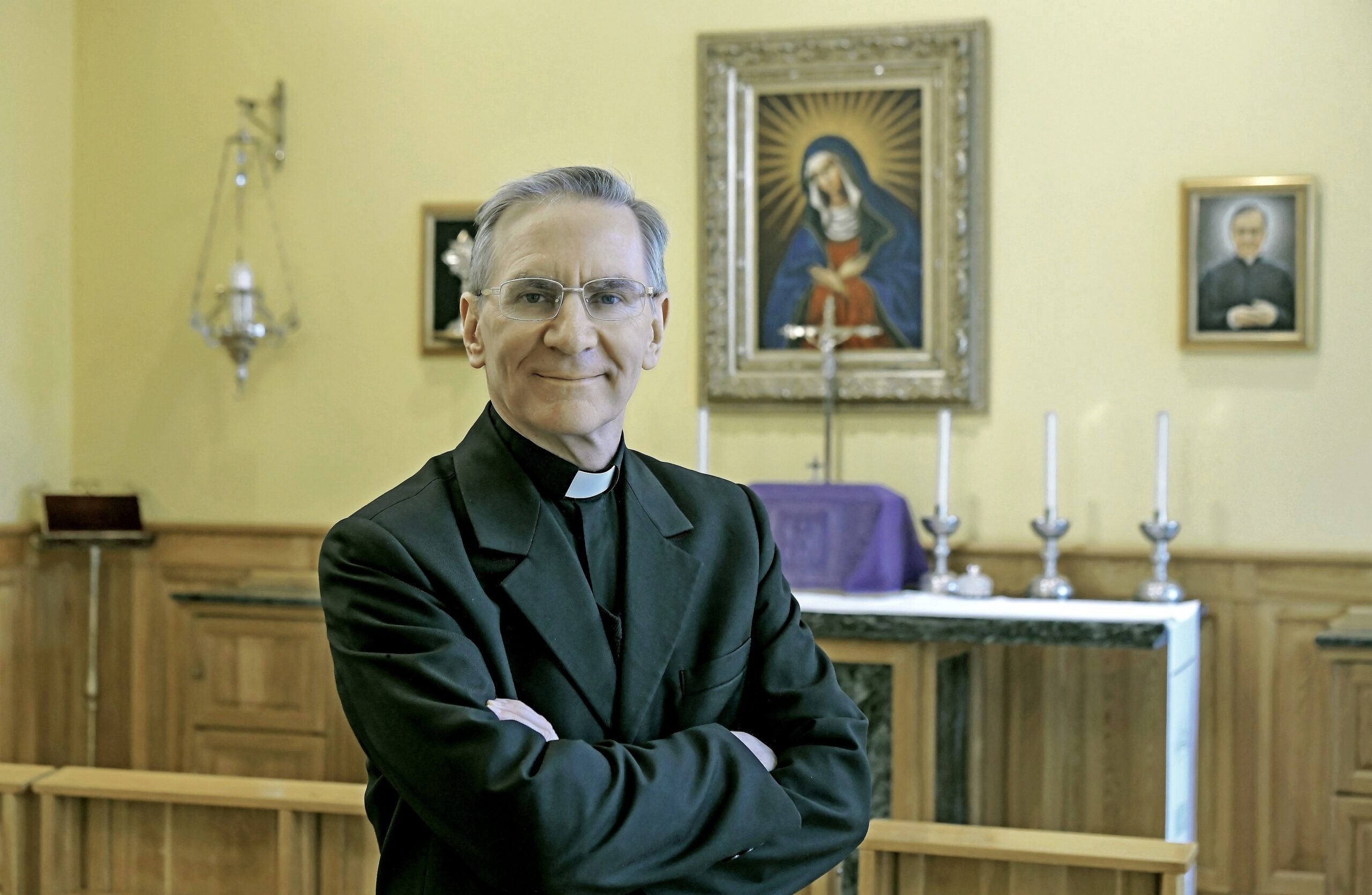
This year Father Andres Lavin was appointed as the new chaplain of Vilnius Gediminas Technical University (VILNIUS TECH). The priest, who will be welcoming students and university staff, has special plans for the community.

In Lithuania – on a mission

Father A. Lavin, originally from the Chilean capital Santiago, has been living in Lithuania for 27 years. Initially, after completing th studies of economics, he worked as an economist for 6 years, but later, he felt the calling to become a priest, which one day led him to Lithuania.

"With the fall of the Berlin Wall, the Soviet Union, the Lithuanian Catholic Church began inviting institutions from other countries. The then Archbishop of Vilnius, Cardinal Juozas Audrys Backis, invited the Opus Dei prelature, to which I belonged, to come to Lithuania. I had previously told my then boss, the bishop, that I would gladly go somewhere to do missionary work, to help people, so I was offered this opportunity," the priest explains.

Upon arriving in Lithuania, one of the biggest challenges for A. Lavin was the Lithuanian language. Adjusting to the climate was not difficult, but to be able to speak the language took him several years after which he could gradually work as a priest.

The priest saw Lithuanians as a very devout nation with many heroes of faith. He attributes this to the long period of Soviet occupation when the churches were closed and people, especially city dwellers, could not publicly confess their faith, receive sacraments, or celebrate religious holidays, so they had to seek different spiritual support.

Healing soul illnesses

The new VILNIUS TECH chaplain, A. Lavin, will soon start receiving community members who want to talk to him. According to the priest, this can help people deal with soul illnesses.

"A person's soul can get sick just like the body. These illnesses include a tendency toward selfishness, laziness, and we all (including me) have them. Since everything in a person is connected, we cannot say that only the body is sick, only the head, psyche, or only the soul. Sometimes physical pain can turn into a soul illness, and vice versa. So I am ready to accept anyone who wants to talk about anything – studies, family, dreams, future, difficulties," the priest invites.

A. Lavin also sincerely hopes to help young future creators, who nowadays increasingly face psychological challenges. The priest observes that contemporary youth around the world more and more often experience various fears, anxiety, depression, and this suffering is compounded by a sense of loneliness and a changed perception of God.

"Today, a computer is a young person's best friend. As time goes on, when a teenager encounters life's problems, they feel lonely, especially when they want to communicate but don't know how or with whom; they communicate in the virtual space, on social networks," the priest says.

The priest is convinced that without knowing how to communicate with each other, especially with loved ones, young people no longer know how to communicate with God. A. Lavin gives an example that as a child grows up, they observe their parents and compare them to a higher power.
"The child sees that the father is good and thinks that God is even better. If they see that the father is merciful, they automatically understand that God is even more merciful and so on. However, when children, for various reasons, do not see such examples in their families, they begin to perceive God as some kind of controller who demands something," the priest reflects.

To talk to the new chaplain, you can do so by email (alavini@gmail.com), call +370 694 276 85, or visit the Church of the Holy Cross (S. Daukanto St. 1, Vilnius) on Mondays and Fridays from 14:00 to 16:00.

The article was prepared by Milda Mockunaite-Vitkiene, the internal communication projects manager of the Public communication directorate at VILNIUS TECH.
 

Photos by Aleksas Jaunius


Galerija
Related news

New doctoral dissertation
VILNIUS TECH Library invites you to follow the published new dissertations. The dissertation „Research and application of machine learning methods for migraine attack prediction“ prepared at VILNIUS TECH by Viroslava Kapustynska. The dissertation was prepared in 2021–2026. Scientific consultant – Prof. Dr Šarūnas Paulikas. The dissertation was defended at the public meeting of the Dissertation Defense Council of the Scientific Field of Electrical and Electronic Engineering in the Aula Doctoralis Meeting Hall of Vilnius Gediminas Technical University at 2 p.m. on 9 June 2026. Migraine is a complex neurological disorder characterized by strong inter- and intra-individual variability, which makes early forecasting difficult using only clinical observations. Wearable biosensors combined with machine learning offer new opportunities to detect subtle physiological changes that may precede migraine attacks and to develop individualized prediction models. This dissertation investigates migraine analysis and next-day prediction using physiological recordings collected under real-life monitoring conditions. Data were obtained with the Empatica Embrace Plus wearable device and include electrodermal activity, pulse rate, skin temperature, and movement-related signals. The analysis focuses on nocturnal recordings, since the night period provides a more stable physiological context with fewer external disturbances. Nights were standardized using sleep-based contextual selection and consistent night-level rules. The experimental framework is organized in two stages. In the first stage, a window-level binary classification task is used as an exploratory methodological analysis to examine how design choices influence model performance. Night recordings are segmented into analysis frames ranging from 5 to 120 minutes, statistical features are extracted, and the influence of signal preprocessing and feature representation is evaluated across several classifier families, including Random Forest, XGBoost, histogram-based gradient boosting, support vector machines, and k-nearest neighbors. In the second stage, the research evaluates next-day migraine prediction based on whole-night recordings. This stage refines the experimental methodology to obtain more reliable estimates of predictive performance under a stricter validation framework. The analysis focuses on the effect of temporal aggregation while comparing the same classifier families under consistent evaluation conditions. The results demonstrate considerable variability across participants in achievable prediction performance and optimal modeling configurations. Shorter analysis frames generally preserve informative short-term physiological changes, whereas longer windows tend to smooth these variations. Signal preprocessing shows a window-dependent effect and does not consistently improve performance. Overall, the results highlight the importance of temporal resolution, rigorous validation, and individualized modeling for wearable-based migraine prediction systems. Doctoral dissertation readers can search via VILNIUS TECH Virtual Library.
More
Expert Evaluation: VILNIUS TECH’s Progress Exceeded Expectations
VILNIUS TECH has received a highly positive assessment from international experts. In their recently published conclusions, it is noted that since the 2022 institutional evaluation, the university has achieved significant, evidence-based progress across all four evaluation areas: governance, quality assurance, studies and research activities, and impact on regional and national development. In 2022, VILNIUS TECH was granted a seven-year accreditation. At that time, the expert panel provided the university with 19 recommendations for further improvement. The latest progress review concludes that the university responded to these recommendations responsibly, systematically, and constructively, and that the implemented changes have become part of long-term institutional development. „We are pleased that external experts have highly evaluated the progress achieved by VILNIUS TECH across all four assessment areas. It was noted that the university demonstrates a mature quality culture, a strategic vision, and the ability to consistently sustain growth and increase its impact on society. This ensures that we are entering the next institutional evaluation period with a strong position,“ says Nora Skaburskienė, Director of the Studies Directorate. International experts particularly highlighted the consistently strengthened system of strategic management, the quality culture, active collaboration with business and alumni, leadership within the ATHENA European Universities Alliance, the development of new interdisciplinary study programmes, and significant progress in innovation and technology transfer. The rapid expansion of lifelong learning activities was also noted — VILNIUS TECH has broadened its micro-credential offerings, strengthened partnerships with social and business partners, and is creating favourable conditions for knowledge commercialization and startup development. According to the expert panel, the university has already moved beyond the stage of merely responding to recommendations and is now ready to purposefully leverage its accumulated potential to achieve even higher performance results. In summarizing the evaluation, the experts concluded that VILNIUS TECH is entering the next phase of institutional assessment with a solid foundation for continued successful development.
More