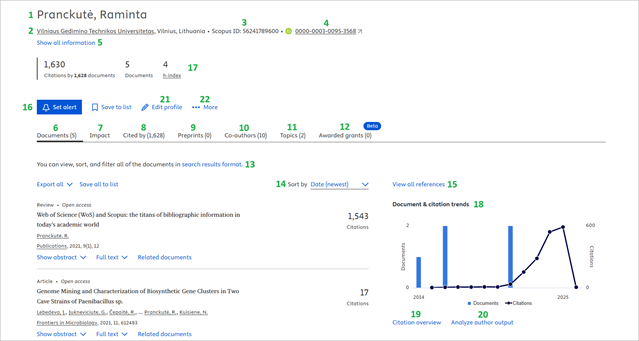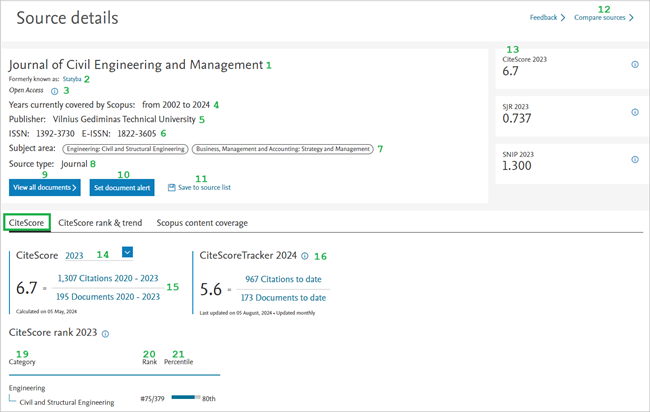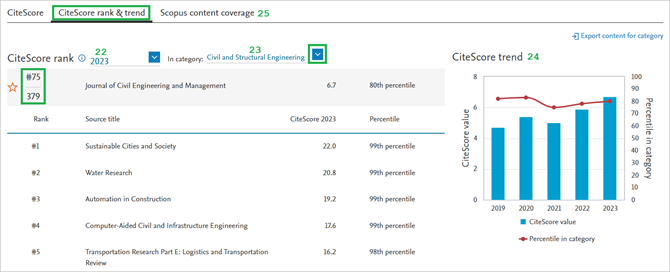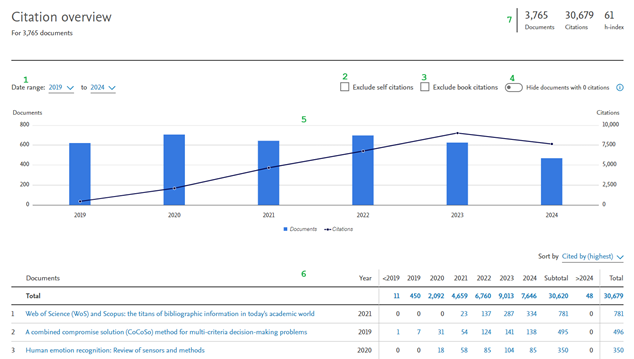


VILNIUS TECH community members can employ a full access to Scopus database.
Important! The full access to the database is available only when connecting from local University’s network. In order to use Scopus from external network, VPN service or personal Scopus user account (more information in “General Information” -> “Scopus User Account”) is required.
Scopus – is an international, globally recognized multidisciplinary bibliographic database (DB), which was launched in 2004, and is owned by Elsevier company, also known as one of the major publishers of scientific literature.
Learn about Scopus DB and the possibilities it provides in a short video guide >>>
Scopus – is the main competitor to the Web of Science (WoS) DB, which up till now is considered as a “golden standard” of bibliometric data. Regarding the type and purpose, these DBs are similar, since they both are bibliographic, selective, multidisciplinary, and commercial. Only literature sources of the highest quality, selected by the strict criteria and periodically revised, are indexed in these databases.
Bibliographic databases are used for science assessment, as well as for other everyday tasks.
The majority of the academic community members (researchers, lecturers, and students) use bibliographic databases mainly for two purposes:
- Searching for the most relevant literature for studies, research, and preparation of graduation works or lectures;
- Choosing a journal for publishing.
When using a database for literature search purposes, it is worth remembering that Scopus (as well as WoS) is a bibliographic database, which means that it contains only the abstracts and metadata of publications, not the publications themselves. For open access publications (and publications accessible to the user according to the literature resources subscribed by the institution) links to their full texts are provided.
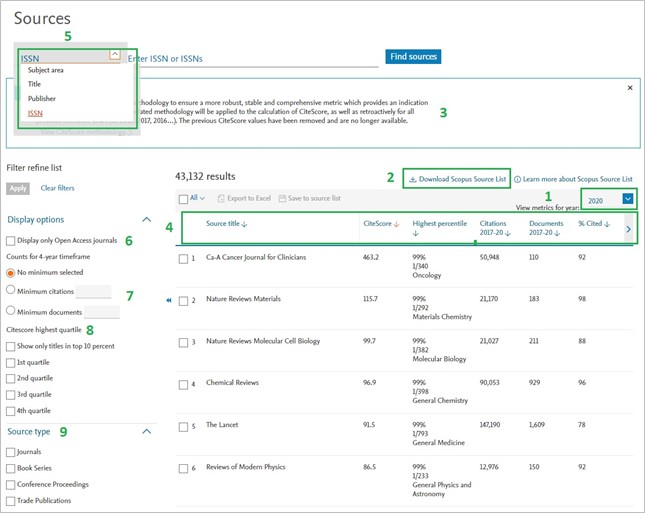
Yet, nowadays bibliographic databases are commonly used because of the journal citation indicators they provide for evaluating indexed sources (usually – journals). These metrics are important when choosing a journal for publication or deciding on subscriptions. However, they are also applied in assessing the quality of publications. In principle, this is not a good practice, as citation indicators describe the average citation rate of a whole source (a journal), and are therefore intended to assess the quality of the journal, not an individual publications published in it.
Databases provide various alternative (altmetric) quality indicators for the assessment of publications. Scopus DB provides PlumX metrics of publication usage.
Detailed information on all indicators of publications, authors, institutions and sources (journals) displayed in Scopus, as well as information about their calculation and application can be found in Research Metrics Guidebook.
Additionally, bibliographic DBs can be useful for assessing the most relevant research topics and the latest trends, also for discovering experts in a particular scientific field or opportunities for potential collaboration.
Scopus Academy courses for researchers and students can help to achieve the aforementioned goals more efficiently by taking advantage of all the possibilities provided by Scopus DB.