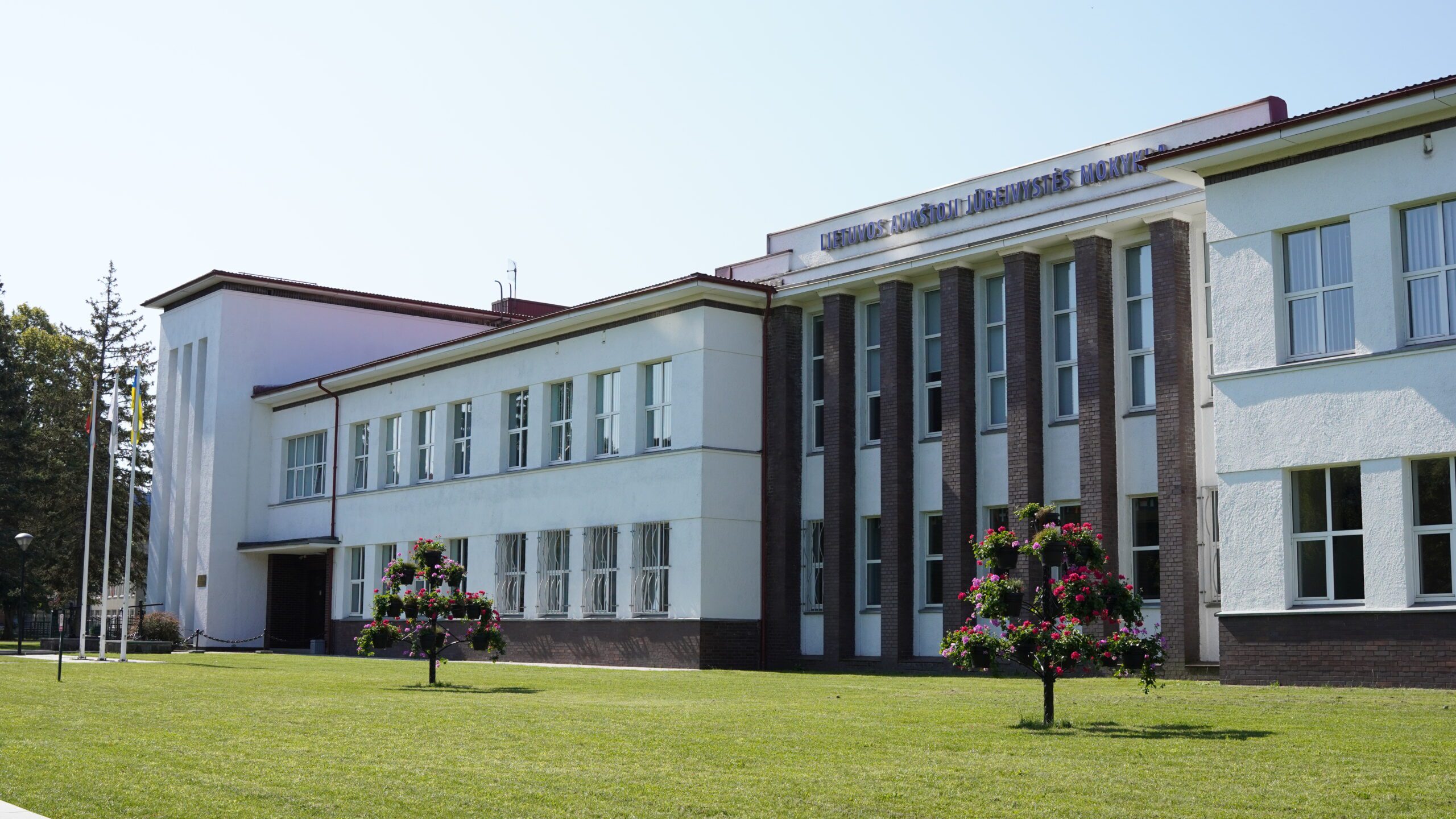
A new faculty established at VILNIUS TECH – The Lithuanian Maritime Academy

September 30, 2024
From tomorrow the Lithuanian maritime academy (LAJM) will become the eleventh faculty of Vilnius Gediminas Technical University (VILNIUS TECH). From this day on we will not only prepare transport specialists for air and land but also now water, which will contribute to the development of a maritime and engineering state as well as enhance competitiveness in international markets.

“We are excited to embark on this academic year as one VILNIUS TECH team, nurturing new generations of talents in air, land, and water transport – the creators of the future. Together, we will develop innovative solutions for Lithuania and the world, strengthen leadership in engineering, technology, and innovation, and actively participate in the international scientific community. Unity is one of our strategic values, and we will complement each other with our unique experiences,” says VILNIUS TECH Rector Prof. Dr. Romualdas Kliukas.

The merger process will affect all community members in one way or another. It is understandable that this may cause concerns among employees. According to Agne Sipaviciute, senior specialist of the VILNIUS TECH Human resources directorate, it is important to understand that employee integration does not end with the joining of the Lithuanian maritime academy to Vilnius Gediminas technical university. We still have a long way to go, where one of the most important factors will be mutual cooperation and the willingness to help each other. One of the university's strategic values is unity, which refers to the synergy of applying different technologies, disciplines, groups, and solutions, as well as the constant desire to collaborate and find common ground.

After the merger, four maritime engineering and maritime technology study programs will continue their work – Maritime navigation, Maritime transport logistics technology, Operation of ship power plants, and Operation of ship electrical equipment.

With Lithuania starting to build a marine wind farm, there is an increasing demand for new specialists – marine wind turbine and engineering experts, as well as engineers capable of managing complex engineering and technological loading processes for port cargo terminals.

In response to business needs, new accredited study programs in marine wind engineering; port and shipping engineering management will be created at LJA. Professional development programs for specialists will also be implemented, on top of existing study programs being supplemented with relevant specialisations in this field.

“The merger is a positive step for the Lithuanian maritime academy to further develop traditional maritime programs and create new ones, which would contribute to the formation of Lithuania’s maritime strategy and ensuring the country's energy independence. VILNIUS TECH’s presence in the coastal region will provide young people with broader options for study choice and continuity, not only in Vilnius but also in Klaipeda,” says LJA Director Vaclav Stankevic.

Future graduates of the Lithuanian maritime academy will receive professional bachelor’s diplomas from Vilnius Gediminas technical university (VILNIUS TECH).

To enhance the study and training infrastructure, a new Centre for marine engineering and renewable energy competence is planned to be built. It will include a training base for working safely at sea and at height, equipped with a swimming pool, trampolines, and working areas for climbers, as well as laboratories for marine wind, solar, and hydrogen energy, and a testing ground for surface as well as underwater drones.

An investment plan has been created for the implementation of the reorganisation titled “Increasing the quality, efficiency, and international competitiveness of highly qualified water transport sector specialists by merging the Lithuanian maritime academy with Vilnius Gediminas technical university,” which will allocate about 5 million euros from the Economic recovery and resilience fund for its implementation.

LAJM and VILNIUS TECH established a Transport engineering and logistics science and study cluster in 2022, aimed at training highly qualified transport and logistics specialists, conducting joint transport engineering research, and implementing regional development as well as the concept of Lithuania as a maritime state.

The result of the cluster’s activities will be new opportunities for university graduates to study in VILNIUS TECH's master's programs, expanding international collaboration, and intensifying research in marine technologies. Graduates of maritime engineering and maritime technology programs can choose the Maritime transport engineering and logistics specialisation within the Transport engineering master's program, with some subjects prepared and taught by LAJM instructors and researchers. Graduates in management and informatics will be offered the Transport engineering economics and logistics master's program.

Galerija

Related news

New VILNIUS TECH eBook
Nauja VILNIUS TECH elektroninė knyga: Kristina Stankevičiūtė, Jūratė Černevičiūtė, Stasys Mostauskis, Liutauras Labanauskas, Marius Salynas Reflecting Popular Culture: Theories and Research (Reflektuojant popkultūrą: teorijos ir tyrimai)Collected Monograph The book is written in Lithuanian This book is the first volume of the planned five-volume monograph series Popular Culture in Lithuania. Its principal aim is to examine the understanding of the phenomenon of popular culture and the nature of its perception as they are relevant in the Lithuanian context, thereby establishing a theoretical foundation for the further analysis of the field of popular culture, which is intended to be presented in the subsequent volumes of the series. The overall objective of the monograph series is to chart the field of popular culture in Lithuania and to survey its current situation, assessing both its historical development and possible prospects for future research. The first volume presents theoretical discussions outlining the concept of popular culture as a phenomenon, its philosophical, aesthetic, and industrial characteristics, and its history of emergence. These discussions are grounded in the traditional conception of popular culture as standing in opposition to serious or high culture. Taken together, the contributions may be broadly described as belonging to a field of academic research oriented toward the theoretical reflection on popular culture. The volume is intended for researchers and students in the field of cultural studies, as well as for all those interested in processes within the cultural sphere. eBook edition >>> * VILNIUS TECH extends complimentary access to its entire library of e-books to members within the university community. Institutional users are granted cost-free access to the e-books by logging onto the University's computer network, whether on-site or remotely through a Virtual Private Network (VPN). To facilitate offline reading without an internet connection, it is requisite to install the IPC Reader offline application. Users can subsequently download the desired e-books while connected to the institutional network and read them offline at their convenience. For additional details concerning e-books, please refer to the provided link >>>
More
New doctoral dissertation
VILNIUS TECH Library invites you to follow the published new dissertations. The dissertation „A framework for assessing food loss and waste along the food supply chain: the case of Lithuania“ prepared at VILNIUS TECH by Ovidija Eičaitė. The dissertation was prepared in 2025–2026. Scientific consultant – Dr Tomas Baležentis. The dissertation was defended at the public meeting of the Dissertation Defence Council of the Scientific Field of Economics in the Aula Doctoralis Meeting Hall of Vilnius Gediminas Technical University at 10 a.m. on 11 June 2026. Food loss and waste (FLW) represents a global challenge with serious environmental, economic, and social implications. It contributes to inefficient use of resources, increased greenhouse gas emissions, and financial losses across the food supply chain (FSC), while also undermining efforts to achieve food security. To address this issue, the United Nations (UN) set Sustainable Development Goal 12.3, which aims to halve food waste at the retail and consumer level by 2030 and reduce food loss in production and supply chains. Achieving this goal requires a comprehensive assessment of FLW and systematic data collection across all stages of the FSC. This dissertation develops and applies a framework for assessing FLW across the key stages of the Lithuanian FSC. The framework clearly defines FLW, determines the scope of the assessment, and establishes a methodological approach for measuring and analysing FLW based on primary data collection using questionnaire-based surveys in primary production, the food industry, and retail trade, as well as food waste diaries in households. The application of the developed framework delivers the first comprehensive FLW estimates for primary production, the food industry, and households in Lithuania, while also providing more precise food waste estimates for retail trade than previously available. The results show that estimates of food loss in primary production vary substantially across products, ranging from 0.1% for milk to 20.1% for beets. Environmental factors and stringent consumer or buyer standards are the main contributors to crop losses, while diseases represent the main cause of livestock losses. The food industry generates an estimated 10.9 thousand tonnes of edible food loss annually, corresponding to approximately 4 kg per capita, mainly due to inefficiencies in processing operations and product non-compliance with commercial standards. Retail trade generates 36.4 thousand tonnes of food waste each year, equivalent to about 13 kg per capita, largely driven by product expiration and spoilage. Household food waste averages 74.5 kg of edible food per capita per year, with common causes including spoilage, over-preparation, and over-serving. The estimates generated in this research establish a baseline for FLW across the key stages of the Lithuanian FSC, enabling monitoring of changes and supporting more refined and comparable assessments over time. They also provide an empirical basis for formulating and evaluating measures aimed at reducing FLW. Doctoral dissertation readers can search via VILNIUS TECH Virtual Library.
More