A View Through the Eyes of Satellites: Why Monitoring Earth is Essential

February 4, 2025
In today’s world, where we face growing challenges related to climate change, urbanization, and resource management, satellite-based Earth observation has become an indispensable tool. This technology allows us to gather real-time information about our planet without physical contact with observed objects. But how does it work, and how is satellite monitoring used in Lithuania?

How Does Space-Based Monitoring Work?

According to Dr. Jūratė Sužiedelytė Visockienė, professor at the Department of Geodesy and Cadastre of VILNIUS TECH’s Faculty of Environmental Engineering, remote sensing can be simply described as satellites orbiting Earth and scanning its surface by detecting various electromagnetic wave reflections. These signals are then processed and analyzed, allowing scientists to view Earth from a new perspective—and even uncover some of its hidden secrets.

There are two main types of remote sensing:

  • Passive sensors use sunlight as an energy source and capture optical images similar to those taken with a regular camera.
  • Active sensors, such as synthetic aperture radar (SAR) systems, emit their own energy and record the reflected signals. This makes it possible to monitor Earth even at night or through cloud cover.
"Currently, there are around 30 space agencies worldwide operating 258 Earth observation satellite missions, with a total of 767 integrated sensors onboard various satellite platforms. This demonstrates the importance and rapid development of this field," explains Dr. Sužiedelytė Visockienė. Some satellites are designed to explore space, while others focus on monitoring Earth. Meanwhile, communication and navigation satellites enable services such as internet access, GPS navigation, and television broadcasting.

What Are Satellites Observing in Lithuania?

In Lithuania, satellites are used to monitor agricultural land, assess crop conditions, and even predict harvest yields. Additionally, they help authorities verify whether farmers are accurately reporting their cultivated land areas.

"In Lithuania, satellite data is used to check whether farmers correctly declare their crop areas, grow the crops they listed in their declarations, and mow their grasslands on time," notes the researcher.

Satellites are also valuable in studying wetland formation in water bodies smaller than 60 hectares. "Wetlands can develop due to agricultural activities—such as plowing too close to water bodies or excessive fertilizer use, which leads to water eutrophication and, eventually, swamp formation. Since current monitoring programs focus on larger lakes and rivers, satellite data helps track smaller bodies of water and determine when intervention is needed. In Lithuania, the process of wetland expansion is quite active, and efforts should be made to slow it down," she explains.

Another major concern in Lithuania is deforestation. Satellite monitoring makes it possible to track forest coverage across the country and helps landowners detect illegal logging on their properties. Additionally, satellites can assess tree health, all in real time.

By analyzing satellite imagery, researchers can classify land use and monitor how landscapes change over time—an essential aspect of environmental management and conservation.
 

Example: Layered Analysis of Territories

From Hogweed to a Nuclear Power Plant

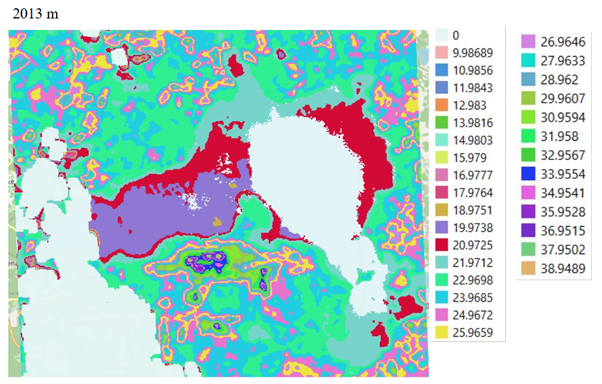
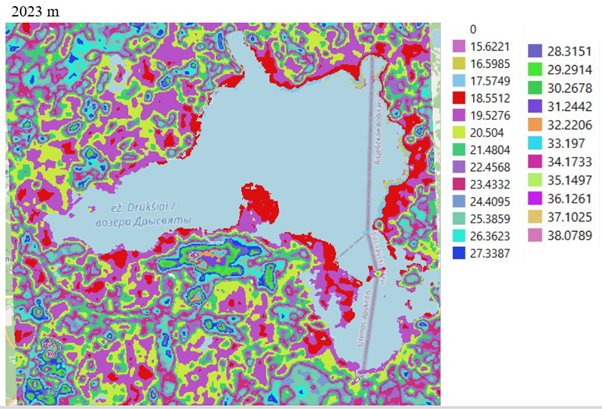
Currently, a team of researchers, led by Dr. Jūratė Sužiedelytė Visockienė, is studying how the closure of the Ignalina Nuclear Power Plant in 2010 has affected the nearby Lake Drūkšiai. This body of water was previously used to cool the plant’s reactors, which resulted in an increase in water temperature along its shores.

"Higher water temperatures significantly disrupt coastal ecosystems, affecting vegetation, flora, and fauna. Our goal is to compare how the plant’s closure has influenced the lake’s ecosystem and whether the water temperature has finally stabilized. Since we have satellite data spanning over two decades, we can compare past and present conditions," explains Professor Sužiedelytė Visockienė, Head of the Department of Geodesy and Cadastre.

However, there is one challenge—the analysis of optical satellite data is hindered by frequent cloud cover, making it difficult to find clear, unobstructed images for accurate comparison.
 

Lake Drūkšiai in 2013
 
Lake Drūkšiai in 2023

Another Remarkable Study – Mapping the Spread of Giant Hogweed in Lithuania

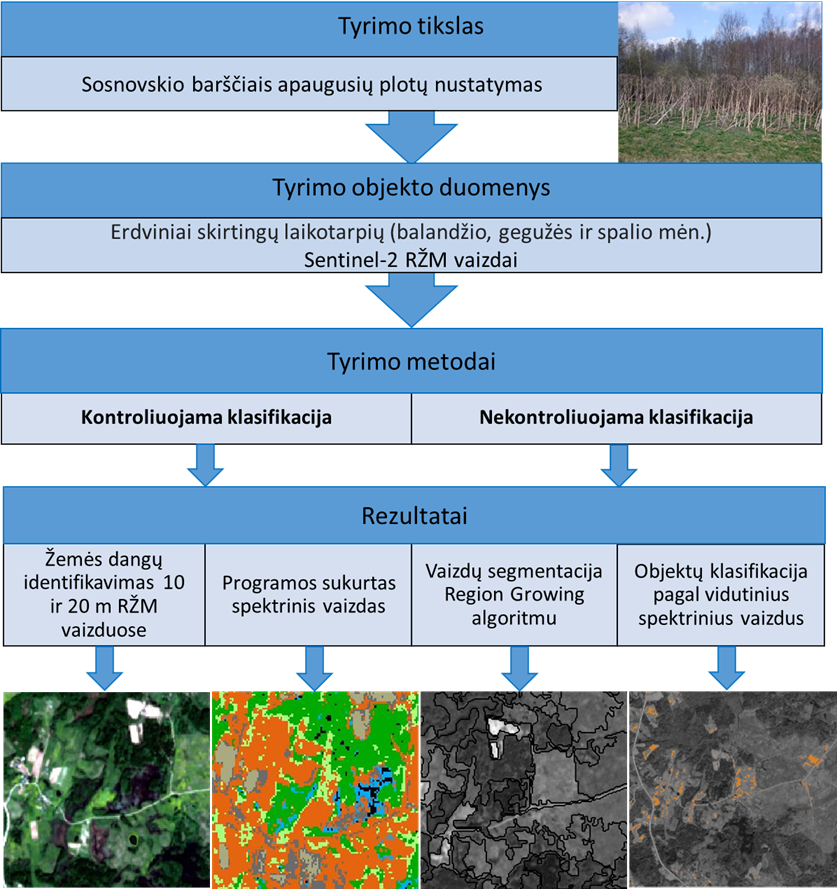
One particularly impressive research project involved creating a map of Giant Hogweed (Heracleum sosnowskyi) distribution in Lithuania. “The spread of Giant Hogweed is a serious problem, so it’s crucial to monitor where these invasive plants are growing and take action. In spring, their leaves have a very distinct bright green color. By identifying the specific electromagnetic wavelength of this shade, we were able to classify the entire territory of Lithuania and determine where Giant Hogweed is present,” explains the researcher.
 

Study on the Spread of Giant Hogweed

Another important aspect of this research was the connection between the spread of this invasive plant and abandoned land. As part of the study, researchers also monitored how the amount of such neglected areas in Lithuania is changing over time.

"Overall, the situation in Lithuania is not too bad—abandoned land makes up only about one percent of the country. However, these areas still present opportunities. They could be left as natural habitats for nesting birds, reforested, or even repurposed for energy needs, such as wind and solar farms," explains Prof. Dr. Jūratė Sužiedelytė Visockienė.
 

Classification Results: a) Overall segmentation result b) Areas covered with Giant Hogweed, classification value 845.9 (orange color) c) Merged land classes, classification value 950 (gray color) d) Merged objects (Giant Hogweed marked in orange)

And these are just a few examples of what is being monitored in Lithuania. Just like in the rest of the world, satellite data plays a crucial role in ecology and environmental protection—helping to track climate change, air and water pollution, biodiversity shifts, natural disasters and their aftermath, abandoned land, and changes in Earth's surface temperature.

Satellite observations also provide valuable insights into urban development, demographic shifts, and the adoption of new technologies. "This is especially important for implementing sustainable urban planning concepts. Remote sensing is becoming increasingly useful in shaping smart and efficient urban development trends. These technologies allow real-time monitoring of land use changes, temperature variations, elevation levels, air pollution, and the effects of climate change," adds Prof. Dr. Jūratė Sužiedelytė Visockienė from VILNIUS TECH.

Galerija

Related news

Lithuania’s Technology Transfer Network “TTO Lithuania” Becomes a Member of the Prestigious European NAAC Committee
A significant international recognition has been awarded to Lithuania’s science and innovation community. TTO Lithuania—the national collaboration platform uniting Lithuanian Technology Transfer Offices (TTOs)—has officially become a member of the National Associations Advisory Council (NAAC), a governing body of the European knowledge and technology transfer association ASTP. This achievement marks another important step in Lithuania’s continued integration into Europe’s highest-level knowledge transfer and innovation governance structures. In its official welcome letter, ASTP emphasized that TTO Lithuania’s membership will strengthen the voice of Lithuania’s innovation community and provide opportunities to contribute actively to the development of European Union innovation policies. Vilma Purienė, Director of the Knowledge and Technology Transfer Centre at VILNIUS TECH and current Chair of the TTO Lithuania network, has been appointed as Lithuania’s official representative to the committee.   What Is NAAC and Why Does It Matter for Lithuania? The National Associations Advisory Council (NAAC) is one of ASTP’s key governance bodies, currently bringing together 35 national associations from 28 European countries. The committee serves as a vital link between European-level initiatives, regional technology transfer offices, and local innovation ecosystems. By becoming a full member of NAAC, TTO Lithuania gains strategic opportunities in four key areas:   Representation and Visibility Each national association is represented in the committee by one official delegate. From now on, the interests and perspectives of Lithuania’s knowledge and technology transfer professionals will be represented alongside those of Europe’s leading innovation nations.   Advisory Role in European Innovation Policy NAAC members provide direct advice to ASTP’s Executive Board on European and EU policy matters related to innovation, knowledge commercialization, and technology deployment. This enables Lithuania not only to learn from international best practices but also to share its own experiences, achievements, and emerging trends with the broader European innovation community.   Influence on Governance NAAC holds the unique right to nominate candidates directly to the ASTP Executive Board, ensuring that the perspectives of national associations remain an integral part of strategic decision-making processes.   Participation in Decision-Making As a member of the council, TTO Lithuania gains voting rights within the organization, allowing it to participate directly in the adoption of key resolutions and the submission of proposals.   A Step Towards Deeper European Integration NAAC members collaborate actively throughout the year. The council typically holds five to six meetings annually, including four online sessions and up to two in-person gatherings. These meetings address the most pressing issues in knowledge transfer, review developments in regulatory frameworks, and foster the creation of joint initiatives and projects. TTO Lithuania’s accession to the council opens new opportunities for specialists from Lithuanian universities, research institutes, and technology transfer organizations to engage more closely in international processes, strengthen their professional expertise, and help ensure that Lithuanian scientific discoveries and innovations reach global markets more effectively. This milestone further reinforces Lithuania’s position within the European innovation ecosystem and highlights the growing recognition of the country’s contributions to knowledge transfer, research commercialization, and innovation-driven growth.
More
New doctoral dissertation
VILNIUS TECH Library invites you to follow the published new dissertations. The dissertation „Analysis and modeling of deformations induced by the extrusion of fiber-reinforced polymers“ prepared at VILNIUS TECH by Mahmoud Samy Mahmoud Mohammed Farh. The dissertation was prepared in 2021–2026. Scientific consultant – Prof. Dr Viktor Gribniak. The dissertation was defended at the public meeting of the Dissertation Defense Council of the Scientific Field of Materials Engineering in the Aula Doctoralis Meeting Hall of Vilnius Gediminas Technical University at 2 p.m. on 10 June 2026. Additive manufacturing via fused filament fabrication (FFF) enables the creation of geometrically complex components. Yet, its use in structural and semi‑structural applications remains limited by anisotropic mechanical response, defect sensitivity, and fabrication‑induced residual stresses that cause warpage and geometric inaccuracy. This dissertation investigates polylactic acid (PLA)- based materials manufactured by FFF, including neat and partially recycled PLA, continuously reinforced PLA, and short-fiber-reinforced composites, to develop an integrated experimental-computational methodology for evaluating mechanical efficiency and predicting process-induced distortion. The research object comprises the mechanical, thermal, viscoelastic, microstructural, and thermo‑mechanical characteristics of these materials. The dissertation develops a unified approach linking reinforcement strategy, material structure, thermal history, mechanical performance, and warpage behavior. The adopted methodology combines quasi‑static tensile and flexural testing, thermomechanical characterization, scanning electron microscopy, and finite-element simulations. Continuous aramid reinforcement developed in this study for FFF increases the load-bearing capacity of the tension specimens by 67%. Still, reinforcement efficiency was limited by toolpath continuity, interfacial defects, and the absence of in‑process fiber tensioning. Short‑fiber-reinforced composites exhibit distinct fiber‑type‑dependent behavior: carbon‑filled PLA increases stiffness, while wood‑filled PLA enhances crystallinity, stiffness retention near the glass‑transition temperature, toughness, and dimensional fidelity. Wood‑fiber reinforcement reduces edge warpage by 43% and carbon fiber by 14.3% under identical conditions. A staged thermo‑mechanical simulation framework is developed to model printing, cooling, and detachment, transferring residual stress and distortion fields into subsequent mechanical simulations. The ABAQUS model for neat PLA predicts warpage with an average error of 8.2–10.6%, whereas a Digimat workflow captures the deformation in short‑fiber-reinforced PLA with an error of 14.3–17.9%. The latter predictions were obtained for the first time. The dissertation consists of an introduction, three main chapters, general conclusions, and references. The First Chapter provides a literature review of FFF of reinforced polymers, including material combination and modeling strategies. The Second Chapter specifies the chosen materials, test program, and thermo mechanical modeling concept. The Third Chapter evaluates experimental and numerical results, integrating mechanical, thermal, microstructural, and simulation based findings. The General Conclusions summarize the dissertation work, which is supported by four publications, including three articles in Web of Science indexed journals with impact factors, and four conference presentations. Doctoral dissertation readers can search via VILNIUS TECH Virtual Library.    
More