
A partnership between science and business gave rise to the idea of solving a real-world problem—removing heavy metal contamination in cold climates.
VILNIUS TECH’s Center of Competence for Smart and Climate-Neutral Manufacturing Processes, Materials, and Technologies, together with Saloua Biyada—a researcher at the Civil Engineering Research Center and a lecturer in the Department of Chemistry and Bioengineering—and the company „NKA Consulting,“ won a competitive doctoral position in collaboration with a company organized by the Lithuanian Science Council.
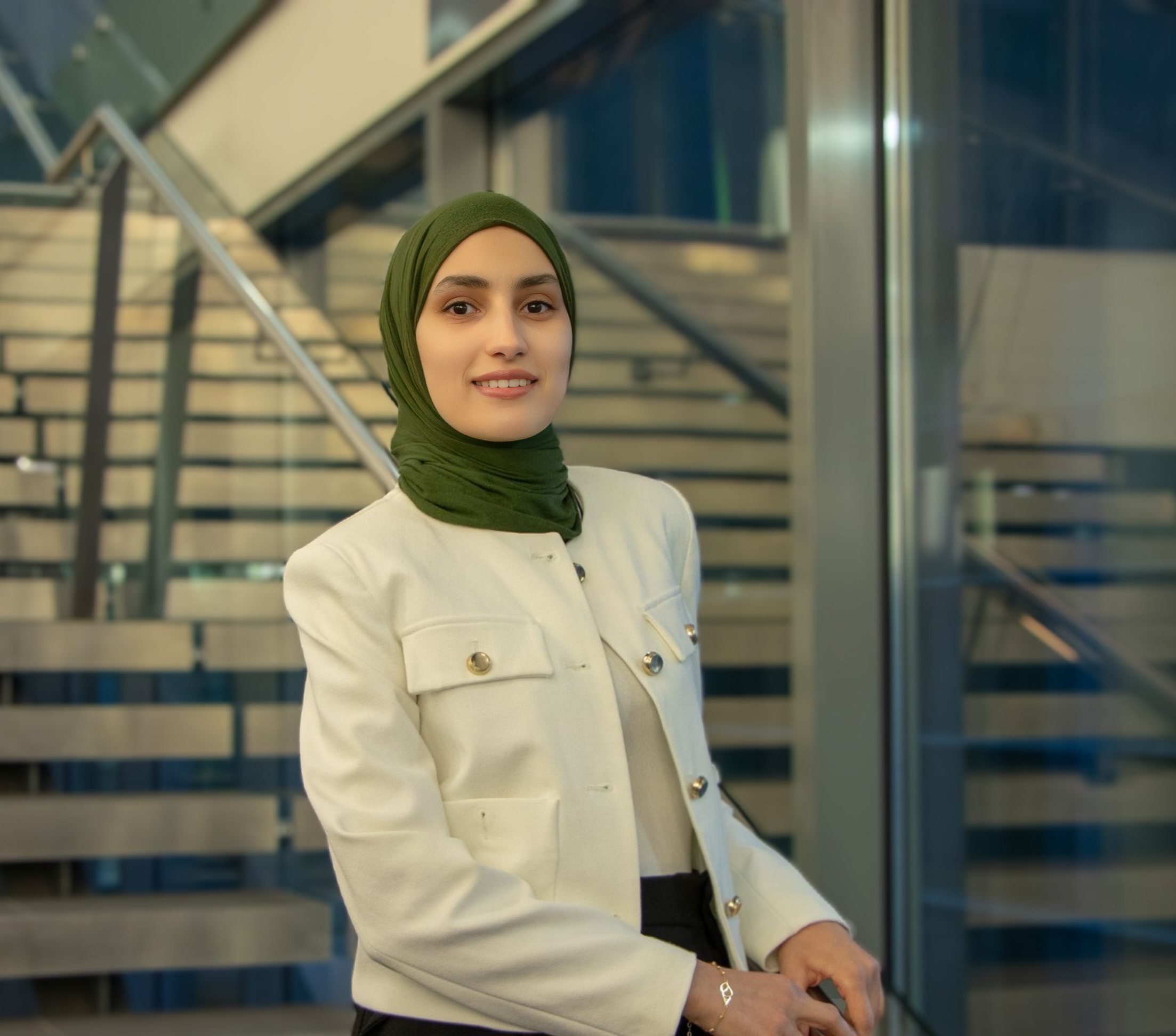
Saloua Biyada
In the field of technological sciences, this is the only competitive doctoral position in partnership with a company awarded in all of Lithuania this year. The topic proposed by the researcher—„Remediation of ecosystems contaminated with petroleum hydrocarbons and heavy metals using a psychrophilic microbial consortium isolated from harsh environmental conditions“—received the highest scores from the experts.
A challenge that conventional technologies cannot overcome
Areas contaminated with petroleum products are typically remediated through bioremediation—using microorganisms that break down the pollutants. This sustainable and cost-effective technology has been in use worldwide for many years. However, in cold-climate regions such as the Baltic states, it faces a major obstacle: at low temperatures, the solubility of petroleum products decreases, and the activity of soil microorganisms drops. During the cold season, the microbial community essentially „goes into hibernation,“ so remediation
S. Biyada’s research will be dedicated to addressing this very problem. The planned study aims to isolate new psychrophilic (cold-loving) microorganisms from harsh environments, investigate their ability to degrade petroleum hydrocarbons and remove heavy metals from the environment, and optimize the process so that remediation is effective even at low temperatures. Biological remediation of oil spills is widely studied internationally, but most research relies on mesophilic microorganisms, which become ineffective in cold conditions; therefore, the proposed approach to identifying effective psychrophilic microbial consortia is fundamentally new.
From the Laboratory to the Real Market
The researcher’s ultimate goal is to develop commercially viable bioaugmentation products and a suite of technological solutions that function in mixed (multi-contaminant) environments under Baltic climatic conditions. Thus, from the very beginning, the research has been focused not only on generating new knowledge but also on a concrete, market-ready solution.
In evaluating the topic, experts awarded the highest score for its scientific novelty and relevance and gave the maximum rating for the feasibility of the research, noting that VILNIUS TECH provides the necessary infrastructure for chemical, microbiological, and molecular biology research infrastructure, access to real contaminated soil samples, and the entire research cycle—from the isolation of microorganisms to the analysis of their mechanisms of action.
Too Few Competitive Ph.D. Positions in Collaboration with Companies
This achievement is encouraging, but according to Simonas Barsteiga, head of the Competence Center for Smart and Climate-Neutral Production Processes, Materials, and Technologies, it also highlights a broader problem. In 2026, the Lithuanian Science Council funded 70 national competitive doctoral positions across Lithuania, but only 16 were allocated for doctoral studies in collaboration with companies—and in the field of technological sciences—which is most closely aligned with Lithuania’s manufacturing and industry—only a single position was allocated for the entire country, which VILNIUS TECH won.

Simonas Barsteiga
S. Barsteiga says that the inconsistent and unsystematic allocation of competitive doctoral positions resembles a lottery rather than the systematic cultivation of an innovation ecosystem.
„Why were there 20 competitive doctoral positions in collaboration with companies in 2025, but only 16 this year? Why was only one spot allocated this year for companies in the field of technological sciences, when 10 applications were submitted in partnership with companies, whereas in 2025, three spots were allocated even though only eight applications were submitted?
I don’t see a systematic approach, or perhaps there’s something I’m missing. When analyzing publicly available information, I don’t see any consistency or direction. And then there’s the industrial doctoral program—which has been shrouded in obscurity—that Lithuania has been talking about intensively for about 10 years. Without a systematic approach and a clear direction, we are, in one way or another, „robbing“ our own industry. Although Lithuania is characterized by rapid economic growth, without resolving fundamental problems in the innovation ecosystem—such as the meager development of research-based innovations and the low share of R&D spending—the country faces the threat of the middle-income trap. It is difficult to understand how companies are supposed to plan strategically and navigate the current competitive doctoral program system. After all, applied technological sciences represent the future of high-value-added industry. Yes, our industry still operates largely on a contract basis, but it is precisely through competitive doctoral programs in collaboration with companies that we can have a real impact on industry—and, in turn, on the economy. It is precisely these doctoral projects that can transform a laboratory discovery into a market-ready, higher-value product that creates added value for the Lithuanian economy.
It is precisely these doctoral projects that can bring a laboratory discovery closer to a market-ready, higher-value product that creates added value for the Lithuanian economy,“ says S. Barsteiga.
In his opinion, the government should consistently increase the number of competitive doctoral programs in collaboration with companies overall.
„We cannot allow the number of positions in the field of technology to decrease or a situation to arise where there is only one position for the entire country. We must increase the number of spots every year—this is a direct investment in fostering the industrial innovation ecosystem and strengthening the country’s long-term industrial competitiveness,“ S. Barsteiga is convinced.
In the longer term, according to the head of the competence center, most doctoral positions should be based on a real problem faced by industry or society. Only such research—which knows exactly which specific challenge it is addressing—will enable Lithuanian science and business to compete successfully on an international scale.
„We secured the only competitive doctoral position in the technological sciences in partnership with a company in Lithuania—and we’re proud of that. But this is also a clear signal: if the entire country is allocated only one such position in the technological sciences, we are limiting our own future. Applied technological science is the engine of industry. I urge the government to allocate more competitive doctoral positions in collaboration with companies and to systematically increase their number each year, and I urge the entire Lithuanian scientific community to be bolder in formulating research topics based on real-world industrial problems. I believe that in the future, the only research that will be competitive is the kind that knows what problem it is solving,“ says S. Barsteiga
„The opportunity to work on real-world contaminated soil projects alongside an industry partner means that our discoveries won’t just remain in reports and articles—they’ll become working technology,“ says S. Biyada, head of the competitive doctoral program in collaboration with the company.