• University
  • News and events

Alumnus T. Dauskurdas: “The knowledge gained at university provided a solid foundation for continuous improvement”

July 11, 2025
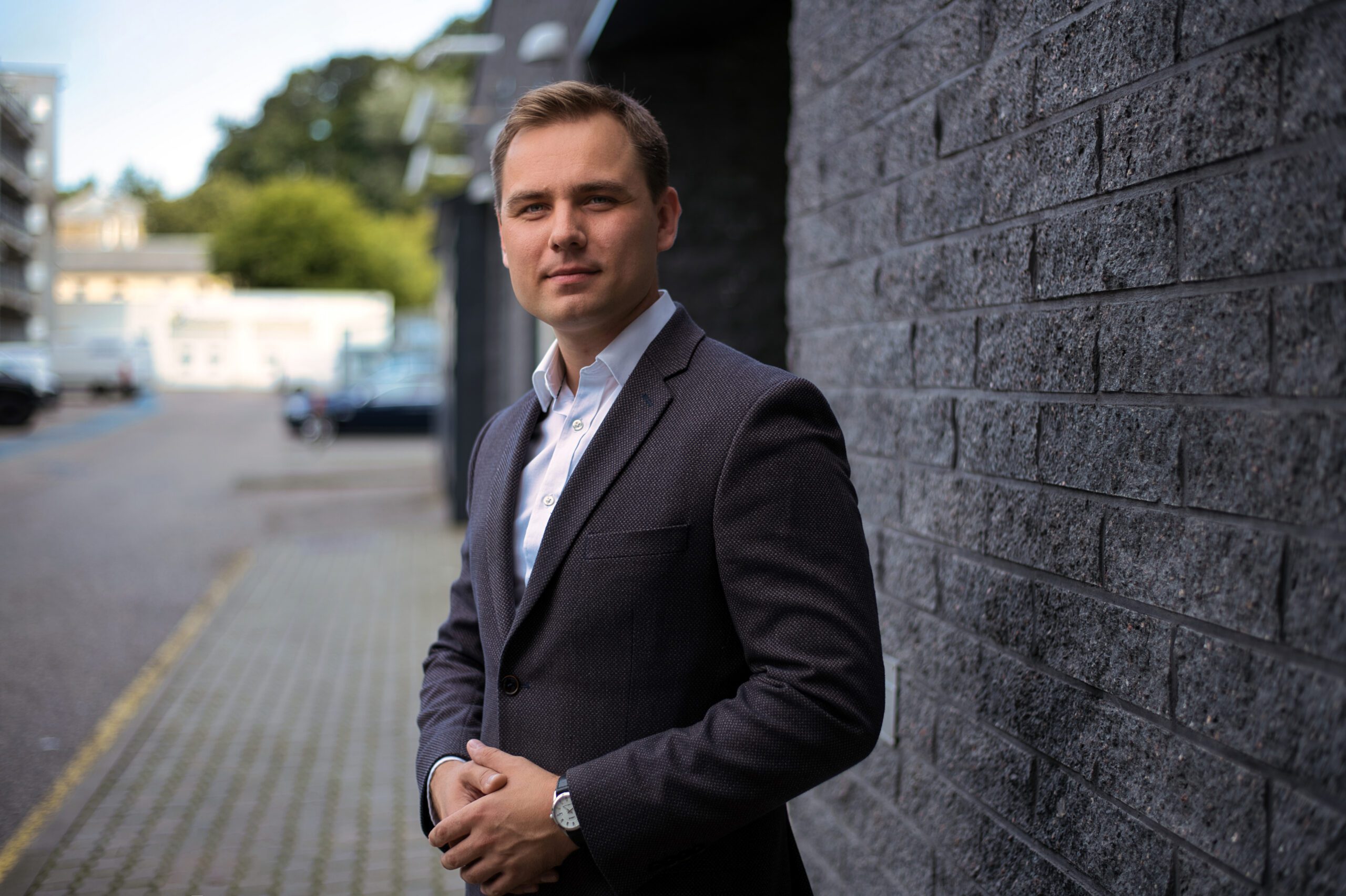
Every year, VILNIUS TECH prepares many talented graduates for the labor market, whose achievements bring recognition to the university beyond Lithuania. One of them is Tomas Dauskurdas, Sustainability Manager at the asset management company “Lords LB Asset Management.”
Today, the VILNIUS TECH alumnus is not only a professional in his field but also an active member of the Alumni Club, who contributes through his active involvement in the development of young specialists.
“While studying at school, I developed a liking for natural sciences, so studies in the technology field were an obvious choice for me. When I was considering bachelor’s studies, VILNIUS TECH was the only university I wanted to go to. I had already chosen a specialty area before that. After deciding to pursue a master’s degree, I further developed my already specialized knowledge. Since I already knew the university environment and lecturers, continuing studies at VILNIUS TECH was a natural choice,” says T. Dauskurdas.
According to the VILNIUS TECH alumnus, the Bachelor’s in Building Energy and Master’s in Building Energy Engineering studies attracted him due to their versatility, and the knowledge gained during the studies was very useful for reaching career heights. The studies provided a solid engineering foundation, which over time could be supplemented with specific skills. Equally important was that the study program covered not only technical aspects but also environmental protection, energy efficiency, sustainability principles, and basics of digital modeling. This is relevant in today’s labor market and especially important when working in the sustainable business sector.
“I studied at university in English. I think this added extra charm to the studies – I studied together with students from different countries, which allowed me to better understand what it means to learn and work in an international community. It was interesting not only to delve into the subject matter but also to observe how students from different cultures solved tasks, discussed among themselves, and collaborated on team projects,” says T. Dauskurdas.
Talking about his workday at the asset management company “Lords LB Asset Management,” sustainability manager T. Dauskurdas emphasizes that the company works with real estate and renewable energy funds, which entailed both building sustainability issues and solar as well as wind power plant projects.
“I start my workday by reviewing sustainability data – energy consumption, emissions, water, waste indicators. I prepare Environmental, Social, and Governance (ESG) reports, coordinate the implementation of the sustainability strategy, and work on building certification and climate risk assessment. I closely collaborate with fund managers, project engineers, and consultants, advise company employees on environmental protection, social responsibility, and governance issues, monitor the sustainability progress of the company and managed funds, and provide suggestions how to make improvements. My goal is to ensure that the funds’ activities are not only profitable but also responsible towards the environment and society,” notes T. Dauskurdas.
The VILNIUS TECH alumnus shares that the analytical thinking, problem-solving, and critical evaluation skills developed during his studies help him make decisions faster, assess situations more effectively, and propose well-founded solutions. Moreover, theoretical knowledge provides a foundation for continuous improvement and makes it easier to generate new ideas.
“Working in sustainability involves balancing requirements from different countries, coordinating specialists from various fields, or managing information and expectations that are not always clearly defined. For this reason, patience and the ability to communicate clearly and convincingly are very important in my work. If a challenge is complex, I always consult with colleagues – teamwork always helps to find the right solution faster,” shares the Sustainability Manager at “Lords LB Asset Management.”
According to the VILNIUS TECH alumnus, it is not difficult to find a job related to the acquired specialty in today’s labor market, especially if one acts purposefully and consistently. The demand for employees is high, particularly in engineering and technology fields, but it is important to understand that the first or second job may not necessarily offer the highest salary.
“The shortest path to start a career is simply to try to take on the offered job or internship because it will provide first real experience, help understand the specifics of the work, and start building professional connections. In the long run, it is experience and skills that will enable advancement to higher positions and better pay. Of course, one should not forget that you can always create a job yourself – initiate projects, propose your ideas, or seek opportunities to work independently. It’s easier and bolder to do this with like-minded people,” says Tomas Dauskurdas, Sustainability Manager at “Lords LB Asset Management.”

Galerija
Related news

Assoc. Prof. Dr T. Sledevic: „We aim to 'compress' the beekeeper's experience into an algorithm“
Bees are increasingly settling not only in gardens or rural homesteads, but also in cities – on building rooftops, in small courtyards and parks. Here, their lives unfold right alongside people, yet observing what is happening at the hive entrance is not always easy. VILNIUS TECH researchers are looking for a way to do this using technology – they are developing a system that can detect changes that would normally only be recognised by an experienced beekeeper. In the face of technological progress, there are hardly any areas that have not been touched by innovation in one way or another. And although beekeeping remains firmly rooted in traditions cultivated over centuries, researchers are looking for ways to modernise the field. One of them is Assoc. Prof. Dr Tomyslav Sledevic from the Department of Electronic Systems at the Faculty of Electronics of VILNIUS TECH, who studies bee behaviour at the hive entrance and analyses it using smart technologies. [caption id="attachment_136651" align="alignnone" width="2560"] Tomyslav Sledevič[/caption] „It all started with a simple hypothesis: if an experienced beekeeper can understand the condition of the entire hive by observing bee behaviour at the hive entrance, then computer vision and deep learning methods should be able to automate this behavioural analysis,“ says the researcher. The goal – to develop a bee behaviour recognition system The origins of this research date back to 2018, when Assoc. Prof. Dr T. Sledevic began training convolutional neural networks to recognise pollen carrying bees as well as to look for the optimal balance between speed and accuracy. The research has now become much broader: the aim is to develop a bee behaviour recognition system that could operate effectively on compact embedded computers located right next to the hive. „The main goal is to develop a bee behaviour recognition system that can analyse bee actions in the hive accurately and quickly. It also aims to optimise neural networks so that they can operate effectively on compact embedded computers located right next to the hive. At present, we are investigating how accurately and how quickly trained networks recognise a specific action in an image, especially when bees are densely clustered and obscure one another, and the action itself lasts for a very short time,“ explains the researcher. The system should recognise and track insects – bees, bees carrying pollen loads, drones and wasps – and determine their coordinates, direction, speed or behavioural class. Different types of bee behaviour are being studied: the intensity of bees entering and leaving the hive, ventilation, trophallaxis, cleaning the hive entrance and defensive reactions. Particularly useful for urban beekeeping The urban environment has its own particular characteristics for bee life. Due to the urban heat island effect, it is warmer here, so bees often start flying earlier in spring and remain active for longer in autumn. Urban vegetation is also more diverse and blooms throughout almost the entire season – in parks, gardens, trees growing along streets and even on balconies. Nevertheless, urban hives are often located on rooftops or in small courtyards, making remote monitoring particularly useful. An urban beekeeper often looks after several hives located in different places, so an automated system would allow the monitoring even when they are not nearby. Thus, the most important thing is not the behavioural recognition itself, but what it signals. „The hive entrance is like a window into the overall internal condition of the colony; by observing it, a beekeeper can predict a great deal without opening the hive. An automated system transfers part of this observation to a computer that can operate 24 hours a day and immediately alert the beekeeper when it detects an anomaly,“ explains Assoc. Prof. Dr T. Sledevic. Computer vision does not learn this intuitively, but by analysing statistical data: researchers prepare thousands of video frames in which a person marks where the bee and wasp are, where trophallaxis is taking place or where a defensive reaction is occurring. By „showing“ these examples to a deep learning network, it learns to recognise the same visual features that an experienced beekeeper recognises subconsciously. „Essentially, we are trying to 'compress' the accumulated experience of a beekeeper into an algorithm that becomes accessible even to a novice beekeeper who does not yet have such intuition,“ says the researcher. The vision for the future – a smart hive In the future, individual behaviour recognition modules could be combined into a single mobile system that would operate continuously on a compact computer located next to the hive. Upon detecting something unusual, it would immediately send a notification to the beekeeper's phone. However, a fully smart hive would not rely solely on visual monitoring. The view at the hive entrance does not reveal everything happening inside the hive, so in the future it could be complemented by scales, temperature and humidity sensors, as well as sound analysis. „This is still a vision for the future – for now, we are working on reliable recognition of individual behaviours and their optimisation for embedded systems, but these are precisely the fundamental building blocks from which a fully smart hive could be assembled in the future,“ says Assoc. Prof. Dr T. Sledevic. Prepared by: Giedre Gedeikyte, Head of External Communications Projects This article was published in the autumn 2026 issue of "Sapere Aude"
More