Architect Barbara Pampe: “A School is Not Just a Place for Learning, but Also a Living Space”

January 29, 2025
Schools in Lithuania are embracing change and opening their doors to professionals from various fields. But how many experts—and of what kind—are needed to create a school that meets all educational needs? The community at the Faculty of Architecture at Vilnius Gediminas Technical University (VILNIUS TECH) invited the public to join a discussion on educational spaces.

“Motivated and collaborative teachers and students could make a school work even under a bridge—but how do we create an environment that makes the learning process even more effective?” asks VILNIUS TECH associate professor Liutauras Nekrošius. Opening the event, he pointed out that while many schools operate in standard buildings, each of them delivers education in a unique way. This highlights the need for both indoor and outdoor space transformations to meet modern learning needs. “In the past, school communities weren’t asked what their school should look like. Now, we are taking the first steps in fostering collaboration between professionals from different fields to shape educational spaces.”

On International Education Day, educators, school founders, architects, and other engaged members of society gathered at the National Martynas Mažvydas Library to explore what school spaces should be like and how collaboration could help shape them. The event was also an opportunity for hands-on learning: VILNIUS TECH presented an interactive exhibition, Lithuania Goes to School, curated by Dr. Liutauras Nekrošius and Dr. Edita Riaubienė.

Architect Barbara Pampe, an expert in educational architecture and participatory design from Germany’s Montag Stiftung Jugend und Gesellschaft foundation, shared her experiences working on initiatives that encourage collaboration between school communities and architects. “Today, the traditional classroom is no longer the central space of a school. That doesn’t mean classrooms are no longer needed, but rather that we need a variety of open, multifunctional spaces. A school should offer different atmospheres and diverse ways to learn.”

Pampe also emphasized that as the concept of full-day schooling expands, schools are becoming not just places for learning but also living spaces. Children need to move, play, interact, and engage in different activities throughout the day. She stressed that this creates a growing demand for diverse spaces and activities, and that communities can play a key role in this transformation: “School design is often highly standardized. There’s a lack of deeper discussion about each school’s individual needs and the potential to involve the community in the design process.”

Vilnius is striving to set an example by actively using urban spaces for education. Unė Kaunaitė, head of Edu Vilnius, introduced the initiative Vilnius is a School, which encourages communities to take part in the learning process. “One of our latest additions is the Vilnius TV Tower, which was booked almost instantly for January 13th history lessons. Hearing a story in a classroom is one thing, but being at the actual location where history happened is something entirely different.”

“Surveys show that high school students value learning in a variety of environments. Younger children are naturally curious and eager to go to school, but as they grow older, their enthusiasm tends to decline. Lessons in different settings not only rekindle their interest but also help them explore potential career paths,” added the education expert.

The event concluded with a discussion between school leaders and architects, moderated by Dalia Stabrauskaitė, coordinator of the UNESCO Associated Schools Network in Lithuania. The conversation focused on the challenges of balancing openness and security in schools. Vaidas Bacys, principal of Dubysos Aukštupio School in Šiauliai District, joked that rural schools have advantages over city schools: “Our school is surrounded by nature, and we don’t even have fences. It serves as both a school and a community library, a gathering place.” He shared his current efforts to better utilize school grounds by creating private spaces for students seeking quiet during breaks.

Inga Vargalienė (Vilnius Barbora Radvilaitė Progymnasium) and Rūta Krasauskienė (Vilnius Žirmūnai Gymnasium) agreed with their colleagues but pointed out that balancing school openness with safety is a complex challenge. They noted that school reforms often stall due to long-term planning issues and financial constraints. Architect Eglė Matulaitytė (Processoffice) encouraged participants to start with small steps: “Even placing bookshelves in open spaces can make a difference in a school environment.”

We invite you to explore Barbara Pampe’s digital guide on school architecture, Planning and Building Schools, which provides open-access resources on educational spaces.

Event Organizers:

Faculty of Architecture, Vilnius Gediminas Technical University (VILNIUS TECH)
Lithuanian National Commission for UNESCO
National Martynas Mažvydas Library

Event Partner:

Goethe-Institut Lithuania

News Photos: Alekas Jaunius

Galerija

Related news

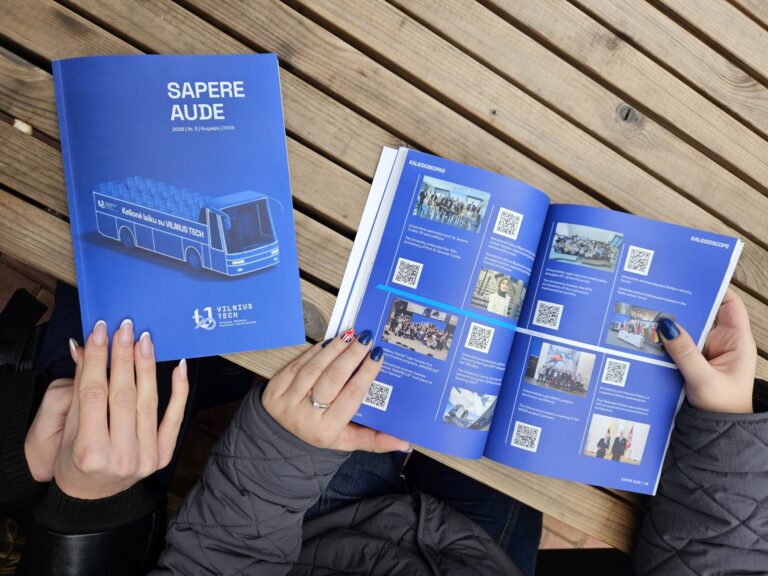
The new issue of Sapere Aude explores how scientists are shaping the cities
Artificial intelligence (AI), micromobility, the effects of climate change and smart infrastructure are transforming cities at an accelerating pace. This is why the autumn issue of Sapere Aude, VILNIUS TECH’s university magazine, focuses on „Cities and Technology“. The theme invites readers to see a city not merely as a physical space, but as a complex, constantly evolving system where science, engineering, data and human-driven innovation come together. Today, the future of cities is shaped by a wide range of disciplines, from transport engineering and urban planning to AI and communication research. The new issue of the magazine introduces researchers, students, alumni and other members of the university community whose work contributes to making cities safer, smarter and more sustainable. The issue opens with an interview with Prof. Dr. Simona Ramanauskaitė, the newly appointed Dean of the Faculty of Fundamental Sciences, who shares her perspective on the role of science, technology and the university in a rapidly changing world. One of the key themes of the issue is urban mobility and safety. Doctoral student Edita Juodvalkienė, supervised by Prof. Dr. Donatas Čygas, is preparing a dissertation on improving the traffic safety of electric scooters on urban streets. Meanwhile, alumnus Dominykas Eičinas is analysing suspension designs for micromobility vehicles. His final-year project has been submitted to a student research competition organised by the Ministry of Transport and Communications of the Republic of Lithuania. However, the challenges facing future cities extend far beyond transport. Gabriela Sokolovskaja, a graduate of the Architecture study programme at the Faculty of Architecture, explores how technology can help cities adapt to the challenges of climate change. In her final project, she examined how rainwater collection and reuse could become an integral part of climate-resilient urban planning and contribute to sustainable urban development. Smart technologies also play a vital role in shaping modern cities. Master’s student Laurynas Zalagas explores their application in urban infrastructure by developing solutions for monitoring street lighting systems using drones and AI. Other articles in the issue examine AI-based solutions for monitoring bee behaviour, human–AI interaction in visual communication, and the analysis of safe vessel passing in the Port of Klaipėda. Technological ideas within the university community are generated not only by researchers and students. The magazine also features young innovators from Ateities inžinerija (Future Engineering), a distance-learning programme whose projects explore solutions in environmental protection, design, transport and green energy. Their work demonstrates how engineering thinking and creativity can help address real-world societal challenges while students are still at school. The autumn issue also features interviews with VILNIUS TECH alumni now working at Lithuania’s national broadcaster LRT, as well as an introduction to the newly established Tech Fund, its vision and objectives. The new issue of Sapere Aude invites readers to see the city as a living, constantly evolving system shaped by people, science and innovation. The cities we will live in tomorrow depend on the decisions being made today in university laboratories, lecture halls and research projects. Read the latest issue of Sapere Aude here.
More
US and Lithuanian science and technology leaders meet in Vilnius
World-class experts from NASA, the Massachusetts Institute of Technology (MIT), Johns Hopkins University, the US innovation ecosystem, and Lithuanian public institutions gathered in Vilnius for the Lithuanian-American Science and Innovation Forum. The event aimed to strengthen transatlantic cooperation, promote technological leadership, and ensure the competitiveness and resilience of innovation. Assoc. Prof. Dr Artūras Medeišis, Dean of the Faculty of Electronics at VILNIUS TECH, also took part in the forum. Opening the event, Lithuanian Minister of Foreign Affairs Kęstutis Budrys emphasised that Lithuania and the United States share many interests in conducting scientific research and ensuring its practical application. “Lithuania is already renowned for its world-class expertise in photonics and laser technologies, life sciences, cybersecurity, and digital innovation. Cooperation would only increase the added value created by our researchers,” the minister said. US Ambassador to Lithuania Kara C. McDonald echoed his remarks. [caption id="attachment_133886" align="alignnone" width="2560"] Gregory Mann[/caption] One of the keynote speakers, Gregory Mann, a representative of the US space agency NASA in Europe, spoke about America’s ambitious plans to return to the Moon. He also emphasised that Lithuania, with its scientific expertise and technological capabilities, could contribute to future missions not only to the Moon but also to Mars. A discussion on how to turn a scientific idea into a functioning technology and transform an existing technology into a product with a strong presence on international markets brought together Angelos Angelou, founder and CEO of International Accelerator, a US business accelerator for foreign-founded startups; Dr Adler Archer, a researcher at the prestigious Johns Hopkins University; Assoc. Prof. Dr Artūras Medeišis, Dean of the VILNIUS TECH Faculty of Electronics; Dominykas Milašius, Head of Delta Biosciences; and Reda Nausėdaitė, Deputy Director for Innovation and Development at the Center for Physical Sciences and Technology (FTMC). A. Medeišis emphasised that researchers can achieve significant results when they have a clear plan, ambition, and vision, particularly when supported by government initiatives that facilitate cooperation with institutions such as MIT. “One of the most common challenges in establishing sustainable connections and developing cooperation is the need for funding, particularly when it comes to transatlantic collaboration. Unfortunately, there are few funding instruments available to support international and cross-border cooperation. We have now established a consortium together with MIT and other Lithuanian universities that can provide seed funding to develop collaboration across the Atlantic. This funding helps establish partnerships and launch joint projects,” said the VILNIUS TECH representative. [caption id="attachment_134004" align="alignnone" width="2560"] Artūras Medeišis[/caption] Another distinguished guest at the conference was MIT Professor Markus Buehler, who delivered a presentation entitled Materials Intelligence: AI, Creativity and the Future of Scientific Discovery. “Materials have a certain kind of ‘intelligence’ encoded in them through their structures, hierarchies, and interactions across different scales,” Prof. Buehler explained, illustrating how this idea manifests itself in biological materials, artificial intelligence, scientific discovery, design, and creative work. The forum also featured Prof. Gediminas Urbonas, who has built an impressive career at MIT. The Lithuanian-American Science and Innovation Forum was part of the programme of Lithuania’s International Science Week, * (re)SEARCH 2026*. The event was organised by the Ministry of Foreign Affairs of the Republic of Lithuania in cooperation with the Center for Physical Sciences and Technology (FTMC) and the Lithuanian Consortium for Cooperation with MIT.
More