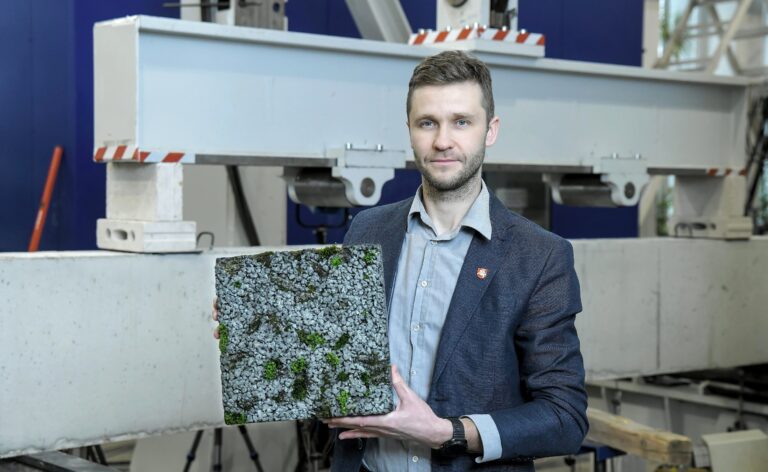
Currently, while constructing a more complicated building, the architecture and construction of the building are most often designed by different specialists. When engineers and architects are working separately, both the accuracy and the artic form or beauty, may suffer. In order to have all designing processes in one person’s hands, Vilnius Gediminas Technical University (VGTU) will start to prepare architectural engineers, able to harmonise everything: maths, visual view and aesthetics. It is the only Master’s degree program of such kind in all Baltic States.
When a project is developed by different professionals, they need to reach a compromise on each proposed decision or to implement various tasks as separate steps. Such a distribution of work makes the designing of complicated and original buildings especially difficult, because an architect’s vision should be based on the scientific knowledge as well as engineering possibilities.
"The experience of foreign countries shows: if architectural and structural design of a building is focused in one person’s hands, the project’s implementation time is shorter and the financial costs are smaller. In Lithuania the construction market is slowly maturing, better and more rational projects are being created, so in the future we will need architectural engineers, well trained in architecture, target structure and structural part,"- said Josifas Parasonis, one of the initiators of the new study program, head of Department of Architecture Engineering at VGTU.
In the new Master’s degree program, students will learn to work with the most advanced information modelling software – BIM (Building Information Modelling) system. This software allows to create and manage a virtual model building during all its life-cycle, from the initial concept of the project till its demolition.
According to J. Parasonis, the architecture engineering was available as a specialization of Master's degree in engineering, but changes in construction market and new digital construction technologies, which are coming to Lithuania, shaped higher professional requirements for the specialists. This has led to the independent Master’s degree study program in architectural engineering.
Although in the world there are over sixty high schools, where one can study architectural engineering, such diverse specialists with knowledge of architecture and design of structures, are prepared only in four U.S. and two South Korean universities.
There are two specializations in the study program: the architectural engineering of buildings, in which more attention is paid to the architectural and constructional parts of the building, and the design organization of buildings, where project leaders of the whole building are prepared.
When a project is developed by different professionals, they need to reach a compromise on each proposed decision or to implement various tasks as separate steps. Such a distribution of work makes the designing of complicated and original buildings especially difficult, because an architect’s vision should be based on the scientific knowledge as well as engineering possibilities.
"The experience of foreign countries shows: if architectural and structural design of a building is focused in one person’s hands, the project’s implementation time is shorter and the financial costs are smaller. In Lithuania the construction market is slowly maturing, better and more rational projects are being created, so in the future we will need architectural engineers, well trained in architecture, target structure and structural part,"- said Josifas Parasonis, one of the initiators of the new study program, head of Department of Architecture Engineering at VGTU.
In the new Master’s degree program, students will learn to work with the most advanced information modelling software – BIM (Building Information Modelling) system. This software allows to create and manage a virtual model building during all its life-cycle, from the initial concept of the project till its demolition.
According to J. Parasonis, the architecture engineering was available as a specialization of Master's degree in engineering, but changes in construction market and new digital construction technologies, which are coming to Lithuania, shaped higher professional requirements for the specialists. This has led to the independent Master’s degree study program in architectural engineering.
Although in the world there are over sixty high schools, where one can study architectural engineering, such diverse specialists with knowledge of architecture and design of structures, are prepared only in four U.S. and two South Korean universities.
There are two specializations in the study program: the architectural engineering of buildings, in which more attention is paid to the architectural and constructional parts of the building, and the design organization of buildings, where project leaders of the whole building are prepared.