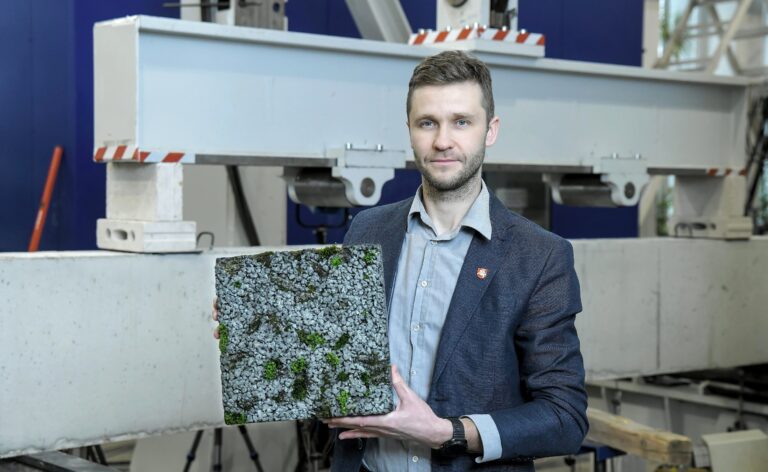
Assoc. Prof. Dr. A. Meškėnas: "Building partnerships is meaningful work"

December 22, 2025
In today’s world, VILNIUS TECH is not just an educational institution – it is a bridge connecting people, ideas, and opportunities. Collaboration at the university means the ability to work together with students, researchers, business representatives, and international partners. Here, not only is new knowledge acquired and fresh ideas born, but innovative projects are also implemented, creating added value for society.
 
Assoc. Prof. Dr. Adas Meškėnas, Vice-Rector for Strategic Partnerships, shares why collaboration is one of the most important aspects of the university’s activities.
 
– What does connectedness mean when collaborating with business and international partners?
 
– For us, connectedness means not only building relationships but also co-creating. The university brings together research, studies, business, and society into a single ecosystem where innovations are developed and pressing challenges are addressed. This is evident in joint R&D&I projects (Research, Development, Experimental Development, and Innovation) with Lithuanian companies, double-degree programs with foreign universities, and partnerships that allow students as well as researchers to operate on a global scale.
 
– How can the university act as a bridge between Lithuanian businesses and foreign innovation ecosystems?
 
– The university is a natural bridge as we have international networks, expertise, and infrastructure that allow Lithuanian businesses to access global innovations. By conducting joint research, organizing international conferences, and establishing competence centers, we can connect local companies with partners abroad, help them participate in European research programs, and attract talent.
 
– How does VILNIUS TECH select and develop strategic international partners? What criteria are most important today?
 
– The selection of strategic international partners is based on creating long-term value. The key criteria include research excellence, quality of education, and alignment of values. Partnerships should strengthen both sides and create real opportunities for students, researchers, and society.
 
– How does the university contribute to the international visibility and competitiveness of Lithuanian businesses?
 
– VILNIUS TECH contributes to the international visibility and competitiveness of Lithuanian businesses through the dissemination of science and innovation, involving companies in international projects, and developing talent. This enables businesses not only to reach new markets but also to create products that meet global standards.
 
– How do international alliances transform students’ experiences, both academically and professionally?
 
– The ATHENA (Advanced Technology Higher Education Network Alliance) alliance provides VILNIUS TECH students with opportunities to integrate into the European higher education area by offering joint study programs and micro-credentials recognized across Europe.
 
Joint lectures and intensive courses with international faculty enrich the curriculum. By working on real projects in innovative laboratories, students gain practical skills in digital and green transformation. The alliance also organizes international career fairs, discussions, and “Alumni Talks,” enhancing students’ international exposure and its value in the job market.
 
– How can the university help Lithuanian students become competitive in the global talent market?
 
– The university helps Lithuanian students become competitive in the global market through international study programs, the development of foreign language and cultural competencies, and project-based activities with global partners.
 
– What will the VILNIUS TECH international partner network look like in 10 years?
 
– In 10 years, VILNIUS TECH’s international partner network will be a dynamic ecosystem, encompassing not only universities but also technology centers, startups, and industry leaders.
 
VILNIUS TECH will become an international hub, connecting ideas and talent from around the world.
 
– You are actively working in the field of partnerships. What inspires you the most in this work? 
 
– The greatest motivation is the opportunity to build bridges between ideas and people. When I see that our partnerships open up new opportunities for our students and researchers, and allow businesses to discover something new through the university, I realize that we are doing meaningful work.

Galerija

Related news

Dear final year student, don't forget to receive your portfolio of competencies!
DEAR FINAL YEAR STUDENT, We would like to inform you that, along with your official university diploma, you have the opportunity to receive a printed PORTFOLIO OF COMPETENCIES. This is an official university-issued document recognizing the skills and competencies you have developed through activities for which VILNIUS TECH digital badges can be awarded. To explore the full range of VILNIUS TECH digital badges, please click here: https://www.badgecraft.eu/en/organisations/16808. To receive the Portfolio of Competencies, you must have at least 3 VILNIUS TECH digital badges in your badge wallet and ensure that you are registered with your full name (using Latin characters) on the badgecraft.eu platform or the BadgeWallet app. If you have collected badges using a different email address, please add your VILNIUS TECH email in the settings. If you already have at least three badges, register no later than June 11th, 2026 (inclusive) by completing this form FORM TO RECEIVE COMPETENCY PORTFOLIO for DIGITAL BADGES (2026) – Fill out form You will receive the printed Portfolio of Competencies along with your university diploma. A digital version (.pdf format) will also be sent to your email. DON’T HAVE ENOUGH BADGES? Many of them can be awarded “for the past.” All you need to do is log in to the VILNIUS TECH Digital Badge System, review your past activities, submit evidence, and wait for approval. Need a clearer plan? Visit https://www.badgecraft.eu/en/organisations/16808. Select the area of activity you were involved in. Check which digital badges you could qualify for. If eligible, log in (or create an account). Complete the tasks associated with the desired badges. * Wait for program administrators to approve (or reject) your evidence. Enjoy your new badges and check if you can earn even more through other badge programs. Collect all the VILNIUS TECH digital badges you’re entitled and get a proof of your activity. *If you see the “Start Mission” button, submit the required evidence, wait for approval, and your new badge will appear in your wallet! If the “Start Mission” button is not available, reply to this email and list all the badges (with links) that you believe you should receive. Include a brief description (1–2 sentences) indicating the year and nature of the activity. Badge program administrators will review your evidence and issue the badge if approved. For more information about the VILNIUS TECH digital badge system, visit: https://vilniustech.lt/studies/digital-badge-system/362195 If you have questions or need assistance, feel free to ask by replying to this email at badge@vilniustech.lt. VILNIUS TECH Digital Badge Team
More
New doctoral dissertation
VILNIUS TECH Library invites you to follow the published new dissertations. The dissertation „Investigation of recurrent neural networks-based methods for early fault detection and short-term power forecasting in wind energy applications“ prepared at VILNIUS TECH by Mindaugas Jankauskas. The dissertation was prepared in 2021–2026. Scientific consultant – Prof. Dr Artūras Serackis. The dissertation was defended at the public meeting of the Dissertation Defence Council of the Scientific Field of Electrical and Electronic Engineering in the Aula Doctoralis Meeting Hall of Vilnius Gediminas Technical University at 10 a. m. on 5 June 2026. The increasing role of wind energy in modern power systems creates a growing need for reliable turbine operation, accurate short-term power forecasting, and computationally efficient data-driven methods. This dissertation addresses two related problems: early fault detection in wind turbines using supervisory control and data acquisition (SCADA) time-series data, and short-term wind farm power forecasting using meteorological forecasts. The dissertation aims to develop and investigate data-driven methods that improve the accuracy, efficiency, and practical applicability of short-term wind power forecasting and early wind turbine fault detection using SCADA and meteorological forecast data. The first part of the dissertation develops and investigates a virtual-sensor-based method for condition monitoring and early fault detection in wind turbines using SCADA time-series data, including the selection of the most informative features and the evaluation of factors affecting prediction accuracy. The second part of the dissertation analyzes and optimizes recurrent neural-network structures for the virtual sensor by evaluating feature-sequence formation, training schemes, and alternative activation functions to increase accuracy and reduce the computational cost relevant for practical deployment. The third part of the dissertation develops and investigates a bidirectional long short-term memory (BiLSTM) based method for short-term wind farm power forecasting using meteorological forecast data, and evaluates the impact of different numerical weather prediction (NWP) sources and the suitability of an objective function with a normalized Nord Pool price multiplier for day-ahead energy production forecasts. The dissertation contributes to the fields of wind energy and artificial intelligence by proposing and validating data-driven methods for virtual sensing, residual-based early fault detection, recurrent-model optimization, computationally efficient activation-function selection, and economically meaningful short-term wind power forecasting. The research results have been published in three peer-reviewed scientific journals and one conference proceeding, and were presented at seven conferences and seminars. Doctoral dissertation readers can search via VILNIUS TECH Virtual Library.
More