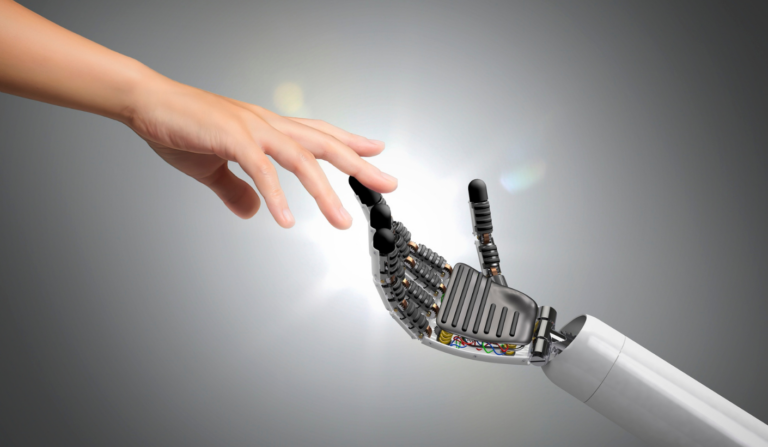
Why is technology becoming smarter, yet not always more human?
Today, artificial intelligence can already write texts, generate images, analyze information, and even make decisions on behalf of humans. Smart devices monitor our habits, and social media algorithms often predict what content we want to see better than we do ourselves. But as technology becomes increasingly advanced, is the quality of our lives truly improving? Or, alongside convenience, are we gradually relinquishing our autonomy?
Marking World Usability Day on November 12—celebrated this year under the theme of ethical artificial intelligence and a sustainable future—VILNIUS TECH Faculty of Creative Industries lecturer, artist, and researcher Vygandas Šimbelis invites us to rethink our relationship with technology. According to him, today’s greatest challenge is not designing an even smarter system, but ensuring that technological progress serves humanity, enhances human potential, and preserves our capacity for independent decision-making.
Smarter Technology Does Not Necessarily Mean a Better Life
Every day, we encounter more technologies promising to make our lives easier. AI assistants answer our questions, apps manage our schedules, and smart appliances automate the simplest household chores. However, according to Šimbelis, technological efficiency does not inherently make an innovation beneficial to humans.
“The intelligence of technology and its humanness are fundamentally different things. Technological progress, speed, and efficiency do not automatically lead to a deeper understanding of human beings, their needs, experiences, and life contexts,” the researcher argues.
Šimbelis’s scientific research focuses on humanizing technology. Its core purpose is to explore ways technology can not only optimize processes but also meaningfully enrich human experience. According to him, humanizing technology does not mean making machines appear more human-like. Rather, it is crucial that human needs, autonomy, creativity, and social context remain at the forefront of the design and development process.
“Today, we often discuss what artificial intelligence can do for us, but we rarely ask what should be left for humans to do themselves. This question is becoming increasingly vital as technology continues to assume tasks that previously required human knowledge, creativity, and judgment,” he observes.
Artificial Intelligence: Liberating or Creating Dependency?
AI can save time, process vast amounts of data in seconds, and unlock opportunities that seemed unimaginable just a few years ago. However, this raises a pressing question: as we automate more of our daily tasks, are we simultaneously eroding capabilities we once cultivated ourselves?
“Both outcomes are possible. Everything depends on the role we assign to technology. The fundamental question is: do we use AI as a tool, or are we beginning to outsource our thinking and decision-making faculties to it?” Šimbelis contemplates.
This dilemma is readily apparent in education and creative fields. For instance, AI can serve as an exceptional learning assistant for a student grappling with a complex concept. However, if that student merely accepts the generated answer without engaging with the material or forming an independent view, technology begins to supplant the learning process itself.
A similar dynamic unfolds in creative endeavors. AI can offer unexpected ideas, encourage experimentation across diverse mediums, and act as a creative partner. Yet over-relying on algorithmic suggestions risks flattening originality. According to Šimbelis, if AI output becomes the sole benchmark, we risk standardizing our imagination, resulting in homogenized creative work.
“True freedom in the technological era does not lie in rejecting technology outright. On the contrary, it lies in the ability to deliberately choose when and how to engage with it, to comprehend its underlying mechanisms, and to retain the right to disagree with the solution offered by an algorithm,” he states.
When Technology Begins to Command Our Attention
One of the clearest examples where technological progress diverges from human well-being is social media. Their algorithms analyze user behavior, predict interests, and deliver hyper-personalized content. At first glance, this feels convenient: we see more of what we enjoy. Yet this personalization carries a hidden cost.
“Social media algorithms are exceptionally optimized to capture and retain our attention, but attention retention is not equivalent to human well-being. A system may align seamlessly with a platform’s business model, yet be fundamentally counterproductive for the user,” Šimbelis points out. According to him, the more accurately algorithms anticipate our preferences, the higher the risk that we are shielded from differing perspectives and unexpected ideas in digital spaces.
This issue extends far beyond social media platforms. Persistent notifications, automated recommendations, and algorithmic curation create the illusion of convenience while subtly eroding our focus, critical evaluation skills, and intentional decision-making.
Another example can be seen in automated customer support systems. While they resolve routine inquiries rapidly, complex, non-standard issues often require the human user to conform to rigid system protocols.
“Instead of technology adapting to humans, humans are forced to learn how to speak the machine’s language. This exposes one of the most critical questions developers must ask: does this innovation truly make human life easier, or does it merely force people to adapt to ever-more-convoluted systems?” the researcher notes.
Smart Homes: Greater Convenience or Deeper Surveillance?
Technology is increasingly penetrating the most private corners of our domestic lives. Smart refrigerators, washing machines, robotic vacuum cleaners, and home automation systems promise to save time and streamline daily routines. Yet in exchange for convenience, we frequently forfeit far more than we realize: intimate data about our daily lives.
As Šimbelis explains, such devices collect granular data on our habits, consumption patterns, and daily movements. While this information is ostensibly used to optimize system performance, it raises profound concerns regarding privacy and human agency. “Are we genuinely freer when every movement of our everyday lives can be recorded, tracked, analyzed, and used to calibrate systems?” the researcher asks.
Technologies designed to save us time risk converting our most intimate living sanctuaries into data-harvesting environments. Therefore, it is critical for users to clearly understand what personal information they surrender to technological systems, how it is utilized, and what degree of control they ultimately retain.
“This dilemma highlights a broader paradox of contemporary technology: the more capable we become of measuring, analyzing, and forecasting human behavior, the more we risk losing sight of what cannot be quantified in numbers.”
Can Human Life Be Reduced to Data?
The data economy, algorithmic surveillance, and the reduction of human life to data streams are themes Šimbelis explores not only through scholarly research, but also within his artistic practice.
One such initiative is the project “Total Today,” where the artist investigates how intricate social and political realities are reduced to mere statistics. The project documents the daily casualty count of Russia's war against Ukraine, translating it into a physical work of art. Yet behind these statistics lie human lives, personal stories, and lost futures.
“Data allows us to analyze and interpret the world, but it can never fully represent the lived human experience. Through this artwork, I question what we lose when we try to compress human life, emotions, or intricate societal crises into metrics and statistical classifications.
This approach is equally relevant to artificial intelligence. Algorithms can process vast volumes of data, detect subtle patterns, and forecast behavior, but this does not mean they grasp the full depth and complexity of the human condition. Not everything that matters to a human being can be expressed through numbers,” the artist reflects.
Why Are Artists Essential in Shaping the Technologies of the Future?
We typically associate tech development exclusively with software developers, engineers, and data scientists. However, Šimbelis is convinced that creating technology that genuinely serves humanity requires the vital contributions of artists, designers, and social scientists. While technologists generally focus on making systems faster, more efficient, and more practical, artists raise entirely different questions: What values do these technologies encode? What power dynamics do they establish? What do they leave out, and how do they alter our conception of being human?
“In my view, art is not an illustration of technology or a showcase for its capabilities; it is an autonomous mode of critical inquiry and experimentation. By intersecting technology, art, and varied media, we can reveal the contradictions within existing systems, experiment with alternative experiences, rethink established norms, and envision realities that do not yet exist,” explains the VILNIUS TECH lecturer.
Design plays an equally pivotal role. According to the researcher, good digital design extends far beyond visually pleasing interfaces or intuitive button placements. It must address accessibility, transparency, privacy, diverse human needs, and the long-term societal consequences of technological adoption. Designing future technologies must therefore evolve into an interdisciplinary process where engineering rigor merges with creative thinking, ethics, and social responsibility.
The Ultimate Question: Not What Technology Can Do, But What It Changes
Although artificial intelligence capabilities continue to expand exponentially, Šimbelis remains convinced that technical progress alone is insufficient. What matters is not merely what we are capable of building, but how our choices impact human beings and society at large.
“The ethics of technology cannot be solved through engineering solutions alone—it demands that we critically re-evaluate our values, responsibilities, and relationship with the future. Instead of incessantly asking whether we can build a more advanced algorithm, we must more frequently ask whether that technology is truly necessary, whom it serves, and what ramifications it will bring,” he points out.
Ultimately, authentic technological progress should not be measured solely by speed, precision, or automated efficiency. What matters just as much is whether it expands human agency, preserves autonomy, nurtures creativity, and empowers conscious decision-making.
“The decisive question is not how much smarter we can make artificial intelligence, but what kind of society—and what kind of human relationship with technology—this progress ultimately creates,” concludes VILNIUS TECH Faculty of Creative Industries lecturer Vygandas Šimbelis.
The article was prepared by Gabija Velykytė, Vice-Dean for Communication at the VILNIUS TECH Faculty of Creative Industries.
More