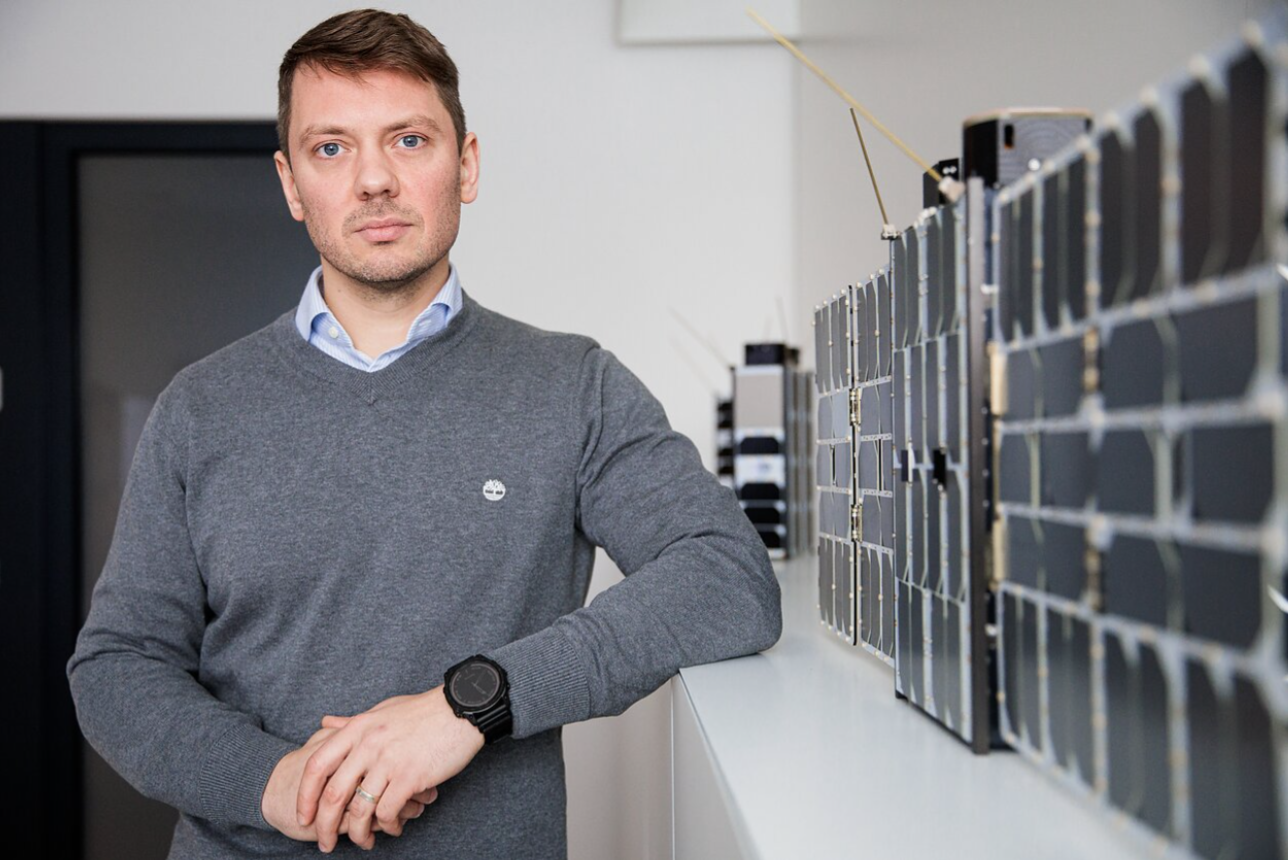
It seems like only recently, the idea of Lithuania as a full-fledged player and innovator in the European space industry would have surprised many. Yet, over the past decade, the situation has changed significantly, and behind many of these major shifts stands Vytenis Buzas – the creator of the first Lithuanian satellite, co-founder of the space technology company NanoAvionics, and head of the high-tech defense business Unmanned Defense Systems. The VILNIUS TECH alumnus asserts that while these achievements are gratifying, the most important thing remains the sense of purpose that his work provides.
Vytenis Buzas. Photogr. J. Stacevičius, source LRT.lt
From Games to Real Innovations
Today, the name Vytenis Buzas is well-known both to the general public and to professionals in the aviation and defense sectors. He is a visionary, an innovator, and a developer of high-end space and defense technologies who discovered his passion in childhood. Even then, he was deeply interested in aviation, space, construction kits, various modeling and creative activities, and later – computer games and flight simulators.
“At school, I was also most interested in physics and everything related to engineering and creation. I think that desire to understand how complex technical systems work and to create something of my own naturally led me to engineering and the field of advanced aviation and space technologies,” says V. Buzas, beginning his success story.
His first career step – choosing his field of study – was also very targeted: he chose the Aviation Mechanical Engineering program at the VILNIUS TECH Antanas Gustaitis Aviation Institute (AGAI). It seemed to him a place where one could not only gain theoretical knowledge and a strong technical foundation but also get hands-on experience with real projects and engineering culture.
“Here, I could experiment, test my ideas, and learn through practice. Many things started as curiosity or ‘play’ – from construction, modeling, and electronics to the first serious technological projects, which later turned into real products, innovations, and companies,” shares the aerospace engineer.
At University: An Opportunity to Face Real Challenges
One of the most important things he took away from his studies at VILNIUS TECH was the understanding of how to systematically solve problems and the opportunity to encounter real technological challenges quite early. The projects he contributed to developed his ability to make decisions under time constraints, limited resources, or prevailing uncertainty.
According to V. Buzas, this experience taught him to work in a team very quickly and developed a sense of responsibility and the understanding that in engineering, it is not just the idea that matters, but the ability to implement it practically.
“Furthermore, I gained the confidence to work on complex, and most importantly, multidisciplinary projects. I understood how technologies are developed in the real world, and how electronics, mechanics, and software are integrated. I believe it is very important to transition from theory to practice as early as possible, because that is when real learning begins,” says the VILNIUS TECH AGAI alumnus.
The First Lithuanian Satellite – A Breakthrough in the Space Industry
After completing his bachelor’s degree, V. Buzas continued to aim higher in the field of advanced aviation and space technology. A major breakthrough occurred in 2014, when he and his classmate, Laurynas Mačiulis, initiated the first Lithuanian satellite project to commemorate the 80th anniversary of the transatlantic flight of Steponas Darius and Stasys Girėnas.
Created more than a decade ago and launched into space from the International Space Station, “LituanicaSAT-1” – one of the two first Lithuanian satellites – became a huge step that contributed to the country’s breakthrough in the space industry and solidified Lithuania’s name as a strong player in the European space sector. However, V. Buzas himself did not feel like he was making history at the time.
“Working on the satellite was one of the most important stages of my career, but at the time, I was more focused on the work and technical challenges. Still, today I understand that it was a very important moment for the Lithuanian space industry, and for many people, it became a symbolic breakthrough,” says the project manager of the “LituanicaSAT-1” space mission.
From Startup to International Space Technology Business
Based on this mission, the space startup NanoAvionics was born in 2014. In less than ten years, it became an international space technology business, working with NASA, ESA, and other global clients. In the beginning, however, it faced many challenges, the greatest of which was proving that a small Lithuanian team could create world-class space technology and grow a global company.
“There was a lot of skepticism at first, but the results, discipline, and international clients gradually changed that perception. I am proud that we succeeded in developing technologies in Lithuania and assembling strong teams capable of competing on an international scale.”
“Moreover, in such sectors, one constantly has to work under conditions of high uncertainty, so there were certainly critical moments. Through them, the team, the ability to learn quickly, adapt, and not be afraid to take responsibility for complex decisions helped,” shares V. Buzas, co-founder of NanoAvionics.
Currently working in the defense sector with his company Unmanned Defense Systems, the engineer notes that Lithuania certainly does not lack the ability to learn and improve quickly. In his opinion, over the next 10–20 years, Lithuania has great potential to grow in high-tech fields, especially in developing aviation, space, defense, and dual-use technologies.
“We have strong engineers, flexibility, and the ability to quickly create innovative products that can be globally competitive,” he adds.
A Sense of Purpose – More Important Than Recognition
How to become a strong engineer and establish yourself in this field? The most important things are curiosity, discipline, and the ability to learn continuously, as well as skills in systemic thinking, teamwork, programming, and practical engineering, the innovator insists.
A successful career also requires another factor that is often overlooked – belief in your work and its purpose, which triumphs over the desire for recognition and fame. This is the main engine of motivation, helping you move forward when external encouragement and belief are lacking.
“In the long run, recognition alone is not enough. I have always been driven more by the desire to create complex, globally competitive Lithuanian technologies, to solve real problems, and to see that your work has an impact and creates real value – strengthening national security, technological independence, and creating a high value-added industry in Lithuania,” shares the VILNIUS TECH alumnus.
To achieve anything, not only motivation and purpose are important, but also patience. Progress is usually determined not by talent, but by consistency and the ability to work for a long time even when results are not yet visible – this is one of the biggest career lessons V. Buzas identifies.
“It is also very important not to be afraid to start before you feel fully prepared. So, if you are interested in technology, aviation, space, or defense – it is definitely worth trying. These are fields where very rapid changes are happening today, and motivated people have the opportunity to create things that have a real impact on the world,” the innovator advises high school graduates.
You can find more information about studies at the VILNIUS TECH Antanas Gustaitis Aviation Institute (AGAI) here.
Galerija