From biological bridges to living facades: how civil engineers are reshaping cities
Modern buildings are no longer made of concrete and steel alone. Biology, artificial intelligence, and sustainable technologies are becoming an integral part of construction, transforming the way cities are designed and built. As technology advances and environmental awareness grows, civil engineers are developing innovative materials and construction methods that are more sustainable, durable, and environmentally responsible.
One of these innovators is Assoc. Prof. Dr. Ronaldas Jakubovskis, a researcher at the Faculty of Civil Engineering at VILNIUS TECH, whose work is helping shape the future of urban environments.
Turning Research into Real-World Structures
Assoc. Prof. Dr. Ronaldas Jakubovskis serves as a Senior Researcher at the Laboratory of Innovative Building Structures, where his work focuses on developing advanced structural solutions through experimental testing, laboratory research, and numerical modelling.
However, innovation rarely begins with a completely new idea. According to Dr. Jakubovskis, much of the research process is dedicated to analysing existing materials and construction technologies to understand how they can be improved.
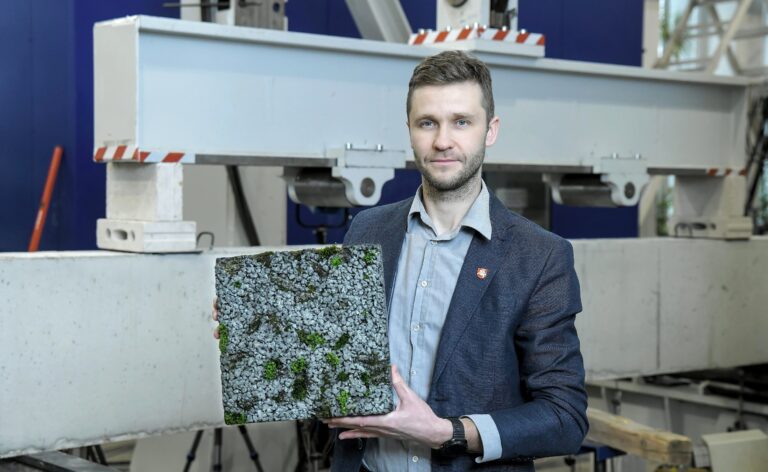
[caption id="attachment_88679" align="alignnone" width="2560"] Ronaldas Jakubovskis[/caption]
„The most rewarding moment is when years of laboratory research become a real structure that can be built and experienced in a natural environment,“ he says.
Although he works in academia, Dr. Jakubovskis sees himself primarily as a civil engineer supporting other civil engineers. While structural designers and project managers oversee the overall design of buildings and infrastructure – determining layouts, dimensions, and cost-effective construction solutions – researchers provide the specialised expertise needed to develop new materials and solve complex engineering challenges.
„Practising engineers often don't have enough time to investigate highly specialised solutions or explore entirely new materials – that's where we come in. Sometimes we analyse complex structural behaviour through numerical modelling, and sometimes we investigate how emerging materials can be applied in construction.
In my opinion, research engineers don't quite fit the traditional stereotype of scientists wearing white lab coats or solving abstract equations all day. Our work is highly practical—we often design, manufacture, and physically test new structural systems ourselves.“
Engineering That Leaves a Visible Legacy
Among the projects he is most proud of is the Biological Bridge installed at the Kairėnai Botanical Garden, as well as the Living Concrete wall currently being developed for the rooftop of the Lithuanian National Drama Theatre. Both projects demonstrate how engineering can merge sustainability, science, and architectural design.
„These projects represent the culmination of years of laboratory work and numerical modelling. They are demonstration structures that show what is possible when innovative materials meet advanced engineering. I also value their aesthetic qualities. Designing complex organic forms allows you to feel a little like a sculptor creating a work of art.“
Looking ahead, Dr. Jakubovskis believes his greatest achievements are still to come. His long-term vision is to create buildings with façades intentionally designed to be colonised by living organisms, allowing them to interact naturally with their environment while providing ecological and functional benefits.
[caption id="attachment_88005" align="alignnone" width="2560"] Ronaldas Jakubovskis[/caption]
„We are currently developing larger demonstration projects, seeking research funding, and expanding international collaborations. I believe that within the next five years, we'll be able to stand in front of one of these buildings and say: this is a significant achievement.“
A Profession That Will Still Matter in 100 Years
For Dr. Jakubovskis, choosing civil engineering was an easy decision. Since childhood, he enjoyed watching buildings rise from the ground and observing construction sites and heavy machinery.
„You don't need extraordinary dreams to become a civil engineer. If you want to build, you become an engineer. It's not like travelling to space or conducting research in Antarctica.“
What motivates him most is the opportunity to create structures that remain valuable for decades – or even centuries.
„Every civil engineer feels proud when driving past a bridge or building they helped design, and they will always point it out to everyone in the car,“ he says with a smile.
His own career began in structural design after completing his third year of university. He later pursued doctoral studies focusing on the cracking behaviour and deformation of reinforced concrete structures before returning to industry. Eventually, an invitation to rejoin VILNIUS TECH brought him back to academia.
„I came back, and today I'm doing exactly what I truly enjoy.“
Advice for Future Engineers
As both a researcher and lecturer at the Faculty of Civil Engineering, Dr. Jakubovskis emphasises that a university education is essential for anyone pursuing a career in civil engineering.
„It would be extremely difficult to master this profession through self-study alone. Should you begin with theoretical mechanics, mechanics of materials, or structural mechanics? University programmes are carefully designed so that knowledge develops step by step, preparing graduates to become highly qualified professionals.“
He also offers practical advice to prospective students:
„Don't be afraid of mechanics, physics, or mathematics. Every semester, identify a few key subjects, understand them thoroughly, and make sure you truly master them. Once those foundations are in place, everything else builds naturally.“
Industry Investing in Future Engineers
Preparing the next generation of civil engineers is a shared responsibility between universities and industry. As digitalisation, artificial intelligence, and emerging technologies continue to reshape construction, employers increasingly recognise the importance of investing in future talent.
The Faculty of Civil Engineering at VILNIUS TECH enjoys long-standing partnerships with the Lithuanian Builders Association (LSA) and the Lithuanian Association of Civil Engineers (LSIS), both of which actively support education and professional development.
The Faculty's industry partners – including Hanner, Gilesta, and Alvora – offer scholarships to first-year Civil Engineering students, helping talented young people begin their studies.
Other partners, such as Naresta, PST Group, HSC Baltic, and numerous construction companies, contribute by delivering guest lectures, presenting real-life projects, and inviting students to construction sites, where they gain first-hand experience of modern engineering practice.
These close collaborations ensure that VILNIUS TECH programmes remain aligned with industry needs while providing students with practical knowledge, professional skills, and valuable connections long before graduation.
Learn more about Civil Engineering studies at VILNIUS TECH and discover how you can help shape the cities of tomorrow.
More