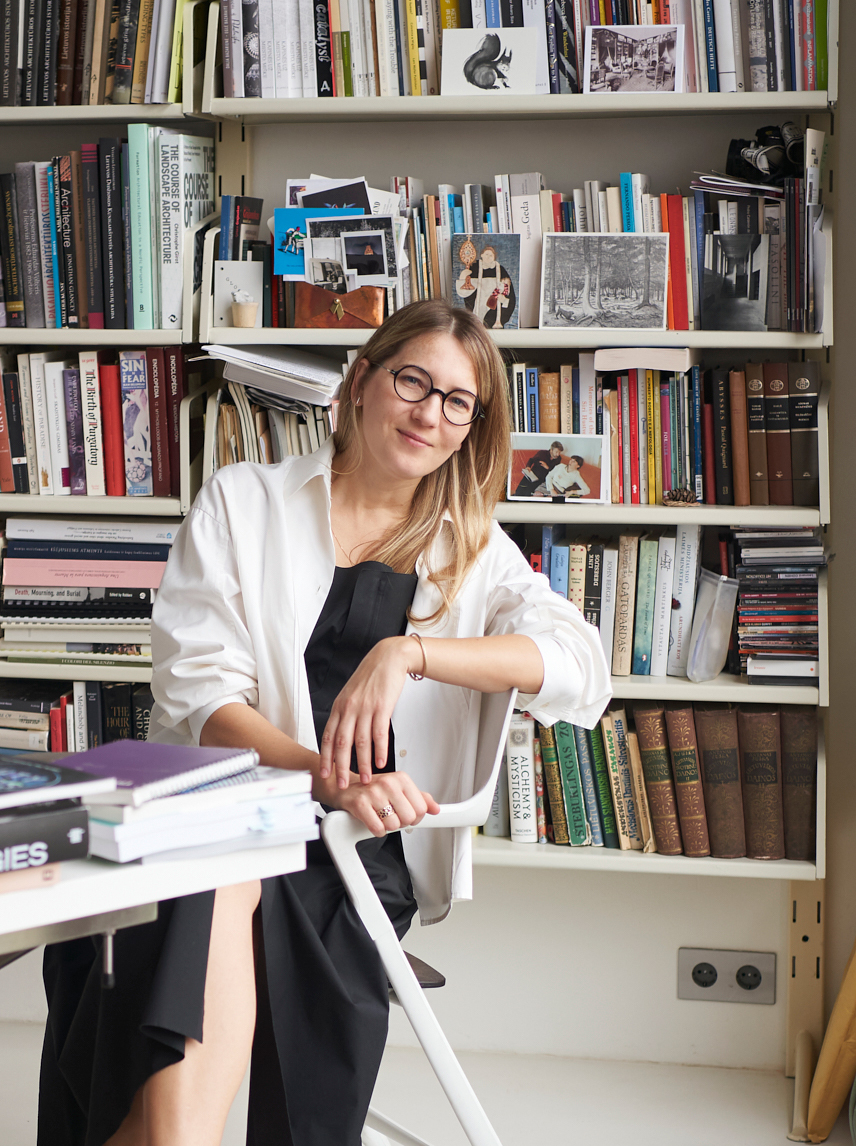
Dr. Egle Bazaraite has been researching cemeteries for many years—since her graduate studies at Vilnius Gediminas Technical University. In 2023, she published the book Cemeteries Outside the City, in the Forest. Catholic Burial Landscapes in 19th Century Vilnius, and is currently conducting research titled "Dying Temporarily, Living Forever: Restoring Memory Landscapes and Sustainable Burial.”
We spoke with Dr. Bazaraite about old and new cemeteries in Lithuanian cities and towns, changing traditions, and current cemetery trends.
Cemeteries evoke contradictory feelings in people: for some, they are a source of curiosity, for others, nostalgia, and for others, a way to feel connected to deceased loved ones. Visiting cemeteries can be both painful and comforting. Surely, there are also those who just feel uncomfortable in cemeteries. What kind of feelings do cemeteries evoke for you?
"I have visited various cemeteries since childhood, and perhaps that's why they have never troubled or caused discomfort for me. They have always been a place for meetings and community, especially in small village cemeteries, where you will always encounter familiar faces, close and distant relatives. Additionally, cemeteries are a journey through time for me and an opportunity to understand what was important to those who founded them and to those buried there. It is both a striking and inspiring place where the desire to remember and not be forgotten still lingers."
You have mentioned that not many cemeteries in Lithuania were established before the 19th century, making them relatively "young" in comparison. However, nowadays cemeteries are often classified as "old" and "new." What are the essential characteristics and differences between these types of cemeteries?
"Old cemeteries are typically those established in the 19th century, while new ones were founded in the 20th and 21st centuries. The most striking difference between old and new cemeteries is the rational planning of the latter, which is based on straight lines. As a result, they are very standardized—graves of the same size arranged next to each other form identical rows, and straight paths cut across the cemetery grounds. From a bird's-eye view, they often resemble rationally planned industrial zones or parking lots, rather than cemetery gardens, which were once idealized as places of eternal rest by cemetery creators in the 18th and 19th centuries. Unfortunately, both in the old Catholic cemeteries of Vilnius and in town cemeteries, fewer trees remain, which could provide shade and rustling sounds to create a softer, more pleasant atmosphere. This atmosphere is especially lacking in new cemeteries."
In your studies, you have researched the Catholic cemeteries of Vilnius—Rasos, Bernardine, and St. Peter and Paul’s (Sun’s). How would you describe them? What similarities do they share with cemeteries in other European countries, and what makes them stand out?
"Cemeteries established in the early 19th century reflect the contemporary view that cemeteries should be located outside the city—this is when cemeteries previously located in churchyards started to be shut down. By the end of the century, family burial chapels and mausoleums began to appear in cemeteries—this type of burial was chosen by noble and wealthy individuals. This indicates that they no longer wished to be buried as close as possible, or even inside churches in their crypts, and cemeteries outside the city became an acceptable place for burial.
Similar processes occurred in Western European cemeteries, whereas in France, Italy, and surrounding regions, the responsibility for burial passed from the Church to city municipalities. Large cemeteries were developed with specific projects and discussions about their design. Symbolic aspects were not left aside. The main difference, however, is that the major Catholic cemeteries in Vilnius remained under the care of religious institutions and stayed monoconfessional (except for the Antakalnis Cemetery), while cemetery spaces were developed according to the land's topography, and the cemetery paths developed accordingly. Due to this burial method, the 19th-century cemeteries of Vilnius no longer followed the principle of burying the deceased with their feet facing the nearest church, a principle still followed in small town cemeteries."
Currently, you are conducting postdoctoral research to understand cemetery development and transformation in Lithuania. What is driving these changes, and what are the current trends in commemorating the deceased?
"Cemetery development is largely driven by changes in headstone trends. Previously, wooden memorials were dominant in cemeteries, but they do not last as long as stone ones. As financial opportunities improved and stone imports increased, it became common to build stone memorials, and often even cover the graves with stone. Over the last few decades, many Lithuanians have relocated, meaning that fewer people are being buried in the same plots as their parents or grandparents. New graves are continuously being created, and when covered with stone, they last much longer, which programs the ongoing expansion of cemeteries.
Headstone choices are also influenced by the growing scale of migration. People living abroad often do not have the opportunity to visit their relatives' graves in Lithuania regularly, and according to local culture, it is not acceptable to leave graves abandoned, overgrown with unkempt plants, or without a lasting headstone. Many feel ashamed or guilty about this. When they cannot or do not wish to constantly have to look after the graves, they choose to cover them with stone, tiles, or gravel.
The desire to honour the memory of the deceased is understandable, but it is unfortunate that many environmentally unfriendly practices are currently popular. Furthermore, due to the standardized solutions offered by memorial manufacturers, headstones have become even more alike. Although cemeteries have long contained mass-produced headstones, the use of different plants and their compositions added more individuality. Now, even if one occasionally has to clean the memorial, little attention is paid to which plants to plant or replace once they stop blooming."
Many people now cover their relatives' graves with stones or tiles, reducing the need for frequent visits and maintenance. Is this a rational solution that does not affect living memory, or could this have consequences in the long run?
"Living memory is based on living practices. We remember notable people even after their deaths—we appreciate their accomplishments and are inspired by their ideas, so they continue to 'live.' However, we all have something worth remembering, though some people are remembered by many, and others by fewer. Different families and kinships also care for graves and memory in various ways. Some take care of ancestors they never met, who live only in stories, or perhaps only in an inscription on a headstone. Others care only for the graves of loved ones they knew personally or simply for those who were most important to them. Generally speaking, people from the 20th and 21st centuries have left behind far more artifacts than before—photos, videos, and objects. These items are often 'more alive' than a headstone in a cemetery—so maintaining the grave can feel like a tedious obligation, and people seek to solve it in a more rational way.
From an architectural perspective, it is likely that relatives who look after a grave will replace an old wooden cross with a new one and take care of a stone memorial, as it is important and necessary for them. However, there are people who see a stone memorial as a form of memory that doesn't need maintenance. They fulfill their duty, but such graves are not preserved in living memory and are eventually neglected, with care taken over by the cemetery management institution.
While it is now understood that a headstone should be placed for everyone, even if it is a burden for the relatives, rather than an opportunity to maintain a connection with the deceased, I believe that in such cases, the headstone is meaningless. However, such practices change very slowly, so it is necessary to discuss our needs and, in time, make more conscious choices about how we will commemorate the deceased."
When people walk through cemeteries, they often pay attention to unique headstones, chapels, and other interesting objects, but perhaps they rarely appreciate cemeteries as a whole, uniting the landscape with artistic and historical monuments. What would you encourage people to focus on?
In new cemeteries, I would encourage people to ask themselves what emotions these places evoke. Despite the pain of loss, does visiting them bring me peace? What might a calming cemetery environment look like?
In old cemeteries, I would encourage people to see a garden or a forest park, where the diversity of monuments stands out. Here, despite the changing processes, the elegiac atmosphere of memory still remains, and trees enhance it. This is a landscape of memory where many people rest, even though their memorials may not have survived. They, too, built the cities, towns, and villages we live in, tended the fields, raised livestock, built buildings, laid roads, and contributed not only materially but also in spirit, with their thoughts and ideas, to the quality of life in the area. Such places remind us of our own transience and the value of our time on this planet."
Egle Bazaraite is currently conducting the research "Dying Temporarily, Living Forever: Restoring Memory Landscapes and Sustainable Burial," funded by the European Union (project number S-PD-22-108) under the agreement with the Lithuanian Research Council (LMTLT).
Text author: External Communications Project Manager Giedre Gedeikyte.
Photo authors: Dr. Egle Bazaraite, Gintare Grigenaite, Agne Bekeraityte-Popiere.
Galerija