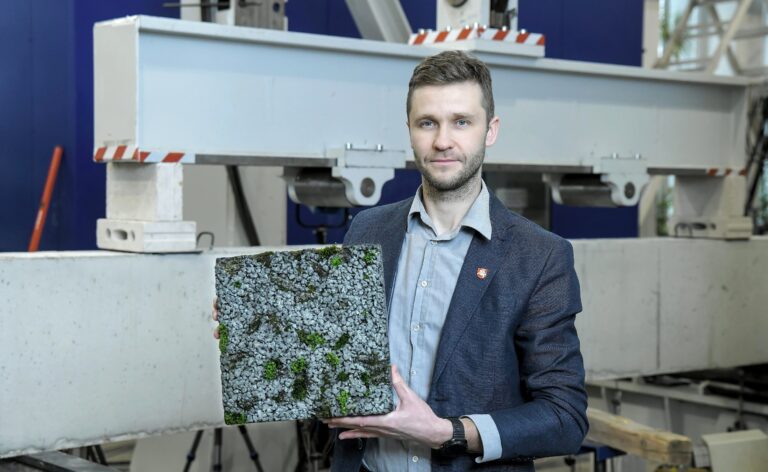
At the beginning of February, the European Commission selected 10 new European Climate Pact ambassadors, one of whom is Simonas Barsteiga, Head of the VILNIUS TECH Center for Smart and Climate-Neutral Manufacturing Processes, Materials, and Competencies. This initiative encourages citizens, communities, and organizations to strive for a climate-neutral Europe. The ambassadors' role is to share knowledge about climate challenges, collaborate in finding effective solutions, and support each other in achieving sustainability goals.
The First Goal – Promoting Knowledge Valorization
S. Barsteiga explains that there is still a significant gap between knowledge and its value in both science and business, as well as between scientific research, innovations, and their practical application. "We create and develop ideas, but what is their ultimate purpose? If we compile all scientific research and results in one place, will it create greater value for society? If not, why? Are we doing something wrong? If so, what exactly?" ponders the head of competencies.
In 2024, the European Council adopted conclusions on strengthening knowledge valorization. Knowledge valorization is the process of creating social and economic value from knowledge gained through scientific research and innovation. According to S. Barsteiga, this is achieved by transforming data, practical experience, and scientific research results into products, services, solutions, and knowledge-based policies that benefit society.
"Successful knowledge valorization requires three elements: technological advancement, strategic management, and value-driven orientation. Maximizing synergy demands not just individual efforts but also systemic change. I am convinced that the greatest breakthrough awaits us when we rethink and redesign our collaboration model. This is not just about willpower, ideas, or noble thoughts—collaboration must be encouraged by structure and system.
It would be remarkable if, simply by doing our jobs, we could naturally contribute to the goals of other departments, companies, or institutions. I believe that this is not only possible but essential if we aim for real knowledge valorization," says the new European Climate Pact ambassador.

Data – An Underutilized Resource
One of the first steps in achieving valorization is refining and structuring data and information. "For data to become a real tool for value creation, significant investments are needed—not only financial but also infrastructural and human resources. If we lack this resource and cannot properly interpret data, our results often become fragmented. I believe we are not utilizing even half of our own and Lithuania's potential."
Seeing that both he and others lacked access to information, a few weeks ago, S. Barsteiga launched an internal information-sharing initiative. He has gradually been moving his activities to the Climate Neutral Solutions "SharePoint" portal, aiming to bring together VILNIUS TECH scientists from various fields to share their knowledge and expertise in environmentally friendly and climate-neutral solutions. The platform seeks to identify common ground between different scientific disciplines and develop solutions that contribute to mitigating climate change.
S. Barsteiga explains that the goal is for this platform (or its future version) to enable every scientist or student to share and access information relevant to their fields. Currently, specialists in different fields work independently, unaware of each other's results, which could otherwise be integrated into collaborative efforts involving businesses, institutions, and society.
This platform would centralize everything—ongoing projects, their results, publications, and employee searches—into one place. The community could use it as needed, integrating knowledge and potentially collaborating further. "We waste a significant amount of time and energy searching for information or repeating the same work in different departments multiple times. Would consolidating all this work into one system create more value? If not, what are we doing wrong?"
According to S. Barsteiga, such a sharing platform could help researchers and academic administrators think beyond their specific disciplines—what is often referred to as "Out of the Box" thinking. That means recognizing solutions from other scientific fields when facing a problem. For example, materials developed in one department could be used in entirely new ways elsewhere. "Often, researchers view solutions only through the lens of their own field. However, businesses, society, and our community as a whole need to know what alternatives exist in other disciplines. Only by understanding all our available options can we integrate them effectively internally and with external partners—thus creating greater value."
Understanding Consequences Is Essential
Another goal is to change public perception regarding climate change. According to the head of the Competence Center, it is crucial for ordinary citizens, scientists, businesspeople, and other innovators to understand and critically evaluate the impact and measurable value of their actions and projects on climate neutrality, biodiversity, and other related factors.
"Why do we need to rethink what we do? The documentary film Climate Extremes illustrates this perfectly, and I strive to share it to raise awareness about climate impact on our environment. (You can find the film here: ClimateExtremes(FullDocumentary).mp4.)
Every creator should consider the consequences of their product—what its lifecycle (product life cycle) will be. Every item will eventually become obsolete, disassembled, or turn into waste. That is why I would like designers to think from the outset about what will happen to their product after its service life ends and how to make it as climate-neutral as possible," explains S. Barsteiga.
The Competence Center head adds that such a shift in thinking could be integrated into universities, for example, by incorporating climate-neutral solutions into all study programs—not just within specific disciplines but by encouraging interdisciplinary collaboration among students from different faculties. "This is just one option—there could be many more. The most important thing is that the drive for change comes from within us."