
European patent granted for new air purifier. Another VGTU scientific breakthrough

October 28, 2019

For some years now, VGTU scientists have been conducting research into biological air filters.  We are delighted to announce that their work has finally been recognised with a Europe-wide patent.

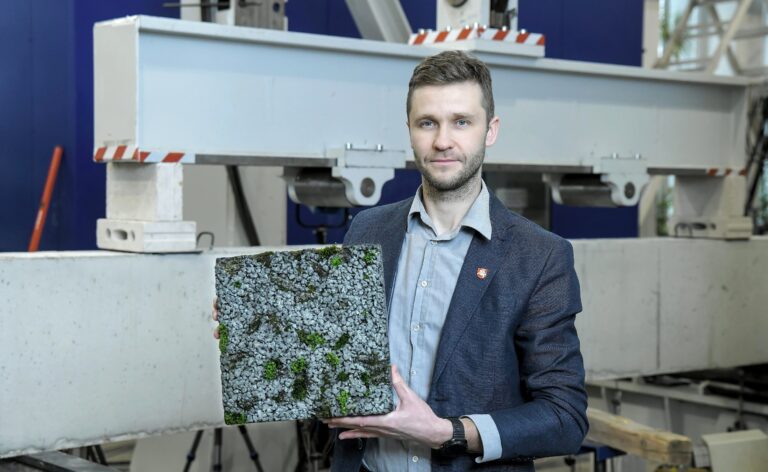
Congratulations to Professor Pranas Baltrėnas and Professor Edita Baltrėnaitė-Gedienė from the university’s Research Institute of Environmental Protection for this breakthrough! Their powerful vertical biofilter developed from an earlier idea removes organic pollutants from the air.

Clearing the air

Foul odours are the inevitable by-product of certain industries, among them agri-business where odour pollution can be a serious problem for people living nearby and also farm workers themselves.

“People living near large farms often complain about the odour. Farmers can now use our biofilter to clean the air in enclosed spaces (farm buidings) before it escapes into the atmosphere. The result is cleaner air and reduced levels of odour made possible by a filter that recycles air that is almost odourless”, noted our scientists.

When discharged into the atmosphere toxic organic chemicals such as acetone, dyes, selenium, ammonia, etc, destroy the ozone layer and add to the impact of climate change. Over time they accumulate and poison the human body, causing diseases and various forms of cancer.  Agriculture, energy and oil extracting industries, and furniture manufacturing industry are among the main emitters of these chemical pollutants.

How it works

The biofilter is made from vertical tubes filled with bio-charcoal and special wood fibres aligned in multiple planes. High temperature and high-pressure treatment of the wood fibres makes them resistant to decay. Under favourable conditions – moisture and higher temperatures – microorganisms begin to appear in the tubes, cleaning the flow of air by removing organic materials and chemical pollutants allowing clean air leaves the biofilter.

The filters can be used anywhere where large amounts of organic pollutants are emitted, for example in furniture manufacturing plants, during painting or varnishing processes, or agriculture where large amounts of ammonia are emitted.

Leading the way

Right now, according to Professor Baltrėnas, only a small number of businesses use biological treatment equipment, most of which is the older generation of filter cassette. This type of filter cleans polluted air relatively efficiently, but only if more filter cassettes are used.  However, if the number of filter cassettes is too high then air cannot exit and eventually blocks the filter. Researchers at VGTU have overcome this problem by designing filters that use vertical tubes that minimises air resistance.
Sustainability

One of the advantages of this new equipment is its longevity. That’s because bio-charcoal has a long life and wood fibres are highly resistant to decay. In fact, the biofilter designed by VGTU’s scientists can be used for 10 years or longer. What’s more, the microorganisms in the filter clean the air, leaving no waste.

Once again, congratulations to Professor Pranas Baltrėnas and Professor Edita Baltrėnaitė-Gedienė.

Related news

New doctoral dissertation
VILNIUS TECH Library invites you to follow the published new dissertations. The dissertation „Research and application of machine learning methods for migraine attack prediction“ prepared at VILNIUS TECH by Viroslava Kapustynska. The dissertation was prepared in 2021–2026. Scientific consultant – Prof. Dr Šarūnas Paulikas. The dissertation was defended at the public meeting of the Dissertation Defense Council of the Scientific Field of Electrical and Electronic Engineering in the Aula Doctoralis Meeting Hall of Vilnius Gediminas Technical University at 2 p.m. on 9 June 2026. Migraine is a complex neurological disorder characterized by strong inter- and intra-individual variability, which makes early forecasting difficult using only clinical observations. Wearable biosensors combined with machine learning offer new opportunities to detect subtle physiological changes that may precede migraine attacks and to develop individualized prediction models. This dissertation investigates migraine analysis and next-day prediction using physiological recordings collected under real-life monitoring conditions. Data were obtained with the Empatica Embrace Plus wearable device and include electrodermal activity, pulse rate, skin temperature, and movement-related signals. The analysis focuses on nocturnal recordings, since the night period provides a more stable physiological context with fewer external disturbances. Nights were standardized using sleep-based contextual selection and consistent night-level rules. The experimental framework is organized in two stages. In the first stage, a window-level binary classification task is used as an exploratory methodological analysis to examine how design choices influence model performance. Night recordings are segmented into analysis frames ranging from 5 to 120 minutes, statistical features are extracted, and the influence of signal preprocessing and feature representation is evaluated across several classifier families, including Random Forest, XGBoost, histogram-based gradient boosting, support vector machines, and k-nearest neighbors. In the second stage, the research evaluates next-day migraine prediction based on whole-night recordings. This stage refines the experimental methodology to obtain more reliable estimates of predictive performance under a stricter validation framework. The analysis focuses on the effect of temporal aggregation while comparing the same classifier families under consistent evaluation conditions. The results demonstrate considerable variability across participants in achievable prediction performance and optimal modeling configurations. Shorter analysis frames generally preserve informative short-term physiological changes, whereas longer windows tend to smooth these variations. Signal preprocessing shows a window-dependent effect and does not consistently improve performance. Overall, the results highlight the importance of temporal resolution, rigorous validation, and individualized modeling for wearable-based migraine prediction systems. Doctoral dissertation readers can search via VILNIUS TECH Virtual Library.
More
Expert Evaluation: VILNIUS TECH’s Progress Exceeded Expectations
VILNIUS TECH has received a highly positive assessment from international experts. In their recently published conclusions, it is noted that since the 2022 institutional evaluation, the university has achieved significant, evidence-based progress across all four evaluation areas: governance, quality assurance, studies and research activities, and impact on regional and national development. In 2022, VILNIUS TECH was granted a seven-year accreditation. At that time, the expert panel provided the university with 19 recommendations for further improvement. The latest progress review concludes that the university responded to these recommendations responsibly, systematically, and constructively, and that the implemented changes have become part of long-term institutional development. „We are pleased that external experts have highly evaluated the progress achieved by VILNIUS TECH across all four assessment areas. It was noted that the university demonstrates a mature quality culture, a strategic vision, and the ability to consistently sustain growth and increase its impact on society. This ensures that we are entering the next institutional evaluation period with a strong position,“ says Nora Skaburskienė, Director of the Studies Directorate. International experts particularly highlighted the consistently strengthened system of strategic management, the quality culture, active collaboration with business and alumni, leadership within the ATHENA European Universities Alliance, the development of new interdisciplinary study programmes, and significant progress in innovation and technology transfer. The rapid expansion of lifelong learning activities was also noted — VILNIUS TECH has broadened its micro-credential offerings, strengthened partnerships with social and business partners, and is creating favourable conditions for knowledge commercialization and startup development. According to the expert panel, the university has already moved beyond the stage of merely responding to recommendations and is now ready to purposefully leverage its accumulated potential to achieve even higher performance results. In summarizing the evaluation, the experts concluded that VILNIUS TECH is entering the next phase of institutional assessment with a solid foundation for continued successful development.
More