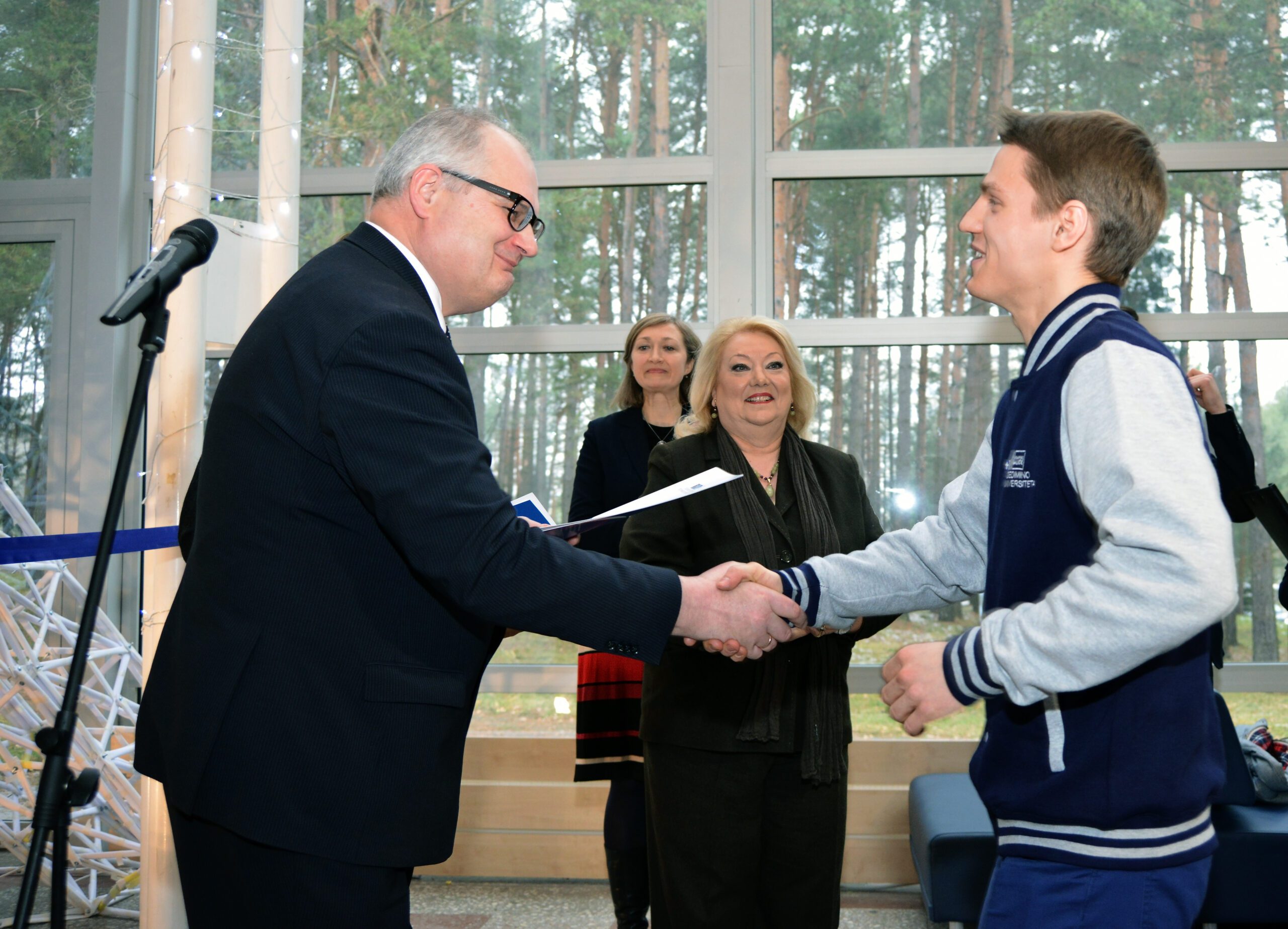
Winners of the best Vilnius Gediminas Technical University research articles contest
We are pleased to announce the results of the best VILNIUS TECH research articles contest.
Research articles (having VILNIUS TECH affiliation, publishing data, being not Online First or Online Ready, and not being published in conference material publications) published during 2025 in international journals ranked in Q1, Q2 quartiles in Web of Science (Clarivate Analytics) database editions Science Citation Index Expanded (SCIE) or Social Science Citation Index (SSCI) (quartiles according to Journal Impact Factor values), or in Scopus database (quartiles according to CiteScore values) were evaluated in the contest.
In total, 78 articles met the contest criteria and were evaluated in 10 different contest research areas:
Civil Engineering
4
Electrical & Electronic Engineering, Physics
10
Energetics & Power Engineering
2
Environmental Engineering, Chemical Engineering, Biochemistry
18
Informatics Engineering, Mathematics, Informatics
3
Management, Economics, Communication & Information
18
Materials Engineering
6
Mechanical Engineering, Measurement Engineering Field
4
Theory of Arts, Philosophy, Philology
7
Transport Engineering
6
The articles were evaluated by the Commission, led by the vice-rector for science and innovations – prof. dr. D. Navakauskas. During the contest every member of the Commission presented the papers submitted to the contest, the assessments of external experts were presented by the Commission’s secretarial member doc. dr. Vaidotas Vaišis, suggestions for article evaluations were proposed. The final decisions were made by the majority of Commission members votes in open voting.
The assessment of articles submitted to the contest within individual research areas:
CIVIL ENGINEERING:
First place – Misiūnaitė, Ieva; Rimkus, Arvydas; Gribniak, Viktor. Developing lightweight steel profile and lattice polymeric core composite for structural use // Thin–Walled Structures. London : Elsevier Ltd. ISSN 0263–8231. eISSN 1879–3223. 2025, vol. 206, pt. A, art. no. 112697, p. 1–15. [Science Citation Index Expanded (Web of Science); Scopus; ScienceDirect] [M.kr.: T 002,T 008] [IF: 6,600; AIF: 4,566; kvartilis: Q1 (2024, Clarivate JCR SCIE)] [CiteScore: 10,40; SNIP: 1,965; SJR: 1,625; kvartilis: Q1 (2024, Scopus Sources)] https://doi.org/10.1016/j.tws.2024.112697
Second place – Skuodis, Šarūnas; Zakarka, Mindaugas; Bielskus, Juozas; Dirgėlienė, Neringa. Comparison of methods for determining the frost depth // Bulletin of engineering geology and the environment. Heidelberg : Springer Heidelberg. ISSN 1435–9529. eISSN 1435–9537. 2025, vol. 84, iss. 11, art. no. 496, p. 1–15. [Science Citation Index Expanded (Web of Science); Scopus] [M.kr.: T 002] [IF: 4,200; AIF: 5,866; kvartilis: Q1 (2024, Clarivate JCR SCIE)] [CiteScore: 7,70; SNIP: 1,364; SJR: 1,161; kvartilis: Q1 (2024, Scopus Sources)] https://doi.org/10.1007/s10064–025–04507–5
Third place – Chou, Jui–Sheng; Nguyen, Hoang–Minh; Zagorskas, Jurgis; Turskis, Zenonas. Decision–informed artificial intelligence for optimizing zero–energy building design: Integration of solar orientation and climatic factors // Energy Conversion and Management. Oxford : Elsevier Ltd. ISSN 0196–8904. 2025, vol. 341, art. no. 120069, p. 1–16. [Scopus; ScienceDirect; Science Citation Index Expanded (Web of Science)] [M.kr.: T 002,T 007] [IF: 10,900; AIF: 5,733; kvartilis: Q1 (2024, Clarivate JCR SCIE)] [CiteScore: 19,80; SNIP: 2,261; SJR: 2,659; kvartilis: Q1 (2024, Scopus Sources)] https://doi.org/10.1016/j.enconman.2025.120069
ELECTRICAL & ELECTRONIC ENGINEERING, PHYSICS:
First place – Bui, Trong–An; Lee, Pei–Jun; Liobe, John Charles; Barzdėnas, Vaidotas; Udris, Dainius. Region of Interest-focused Dynamic Enhancement (RoIDE) for satellite images // IEEE Transactions on geoscience and remote sensing. Piscataway, NJ : Institute of Electrical and Electronics Engineers (IEEE). ISSN 0196–2892. eISSN 1558–0644. 2025, vol. 63, p. 1–14. [Science Citation Index Expanded (Web of Science); IEEE Xplore; Scopus] [M.kr.: T 001] [IF: 8,600; AIF: 4,550; kvartilis: Q1 (2024, Clarivate JCR SCIE)] [CiteScore: 13,60; SNIP: 2,369; SJR: 2,397; kvartilis: Q1 (2024, Scopus Sources)] https://doi.org/10.1109/tgrs.2024.3525411
Second place – Maskeliūnas, Rytis; Katkevičius, Andrius; Zagorskis, Alvydas; Hołubowski, Waldemar; Damaševičius, Robertas; Plonis, Darius. Directional Pareto optimized Kalman filtering with Demyanov–Rubinov subdifferentials for robust pollution concentration prediction // Advanced engineering informatics. London : Elsevier. ISSN 1474–0346. eISSN 1873–5320. 2025, vol. 67, art. no. 103542, p. 1–15. [Science Citation Index Expanded (Web of Science); Scopus] [M.kr.: T 001,T 007,T 004] [IF: 9,900; AIF: 4,750; kvartilis: Q1 (2024, Clarivate JCR SCIE)] [CiteScore: 13,10; SNIP: 2,484; SJR: 1,993; kvartilis: Q1 (2024, Scopus Sources)] https://doi.org/11016/j.aei.2025.103542
Third place – Čeponis, Andrius; Mažeika, Dalius; Bareikis, Regimantas. 3–DOF inertial piezoelectric actuator for angular positioning of the optical mirror // IEEE Access. Piscataway, NJ : Institute of Electrical and Electronics Engineers Inc. ISSN 2169–3536. 2025, vol. 13, p. 20025–20039. [Science Citation Index Expanded (Web of Science); Scopus] [M.kr.: T 009] [IF: 3,600; AIF: 4,500; kvartilis: Q2 (2024, Clarivate JCR SCIE)] [CiteScore: 9,00; SNIP: 1,504; SJR: 0,849; kvartilis: Q1 (2024, Scopus Sources)] https://doi.org/10.1109/ACCESS.2025.3534847
ENERGETICS & POWER ENGINEERING:
First place – Pakalka, Saulius; Donėlienė, Jolanta; Rudzikas, Matas; Valančius, Kęstutis; Streckienė, Giedrė. Development and experimental investigation of hybrid phase change material thermal energy storage prototype by utilising power-to-heat concept // Applied thermal engineering. Oxford : Elsevier Ltd. ISSN 1359–4311. 2025, vol. 271, art. no. 126377, p. 1–13. [Science Citation Index Expanded (Web of Science); Scopus; ScienceDirect] [M.kr.: T 006] [IF: 6,900; AIF: 5,350; kvartilis: Q1 (2024, Clarivate JCR SCIE)] [CiteScore: 11,00; SNIP: 1,990; SJR: 1,579; kvartilis: Q1 (2024, Scopus Sources)] https://doi.org/10.1016/j.applthermaleng.2025.126377
Second place – Masiukiewicz, Maciej; Tańczuk, Mariusz; Anweiler, Stanisław; Streckienė, Giedrė; Boldyryev, Stanislav. Long–term climate–based sizing and economic assessment of air–water heat pumps for residential heating // Applied thermal engineering. Oxford : Elsevier B.V. ISSN 1359–4311. eISSN 1873–5606. 2025, vol. 258, Part A, art. no. 124627, p. 1–16. [Science Citation Index Expanded (Web of Science); Scopus] [M.kr.: T 006] [IF: 6,900; AIF: 5,350; kvartilis: Q1 (2024, Clarivate JCR SCIE)] [CiteScore: 11,00; SNIP: 1,990; SJR: 1,579; kvartilis: Q1 (2024, Scopus Sources)] https://doi.org/10.1016/j.applthermaleng.2024.124627
ENVIRONMENTAL ENGINEERING, CHEMICAL ENGINEERING, BIOCHEMISTRY:
First place – Biyada, Saloua; Urbonavičius, Jaunius. Could bioplastics mitigate and solve world's plastic invasion? // Journal of environmental chemical engineering. London : Elsevier BV. ISSN 2213–2929. eISSN 2213–3437. 2025, vol. 13, iss. 4, art. no. 117226, p. 1–11. [Science Citation Index Expanded (Web of Science); Scopus] [M.kr.: T 008] [IF: 7,200; AIF: 8,100; kvartilis: Q1 (2024, Clarivate JCR SCIE)] [CiteScore: 12,50; SNIP: 1,286; SJR: 1,454; kvartilis: Q1 (2024, Scopus Sources)] https://doi.org/10.1016/j.jece.2025.117226
Second place – Marčiulaitienė, Eglė; Malaiškienė, Jurgita; Boris, Renata; Urbonavičius, Jaunius; Tauraitė, Daiva; Biyada, Saloua. Role of ammonia–oxidising bacteria in the removal of odorous gases by the use of plastic recycling waste as a biofilter // World journal of microbiology and biotechnology. Dordrecht : Springer Nature. ISSN 0959–3993. eISSN 1573–0972. 2025, vol. 41, art. no. 172, p. 1–14. [Science Citation Index Expanded (Web of Science); Scopus; Dimensions; CAB Abstracts; MEDLINE; AGRICOLA] [M.kr.: T 008] [IF: 4,200; AIF: 4,700; kvartilis: Q2 (2024, Clarivate JCR SCIE)] [CiteScore: 6,70; SNIP: 1,047; SJR: 0,892; kvartilis: Q2 (2024, Scopus Sources)] https://doi.org/10.1007/s11274–025–04392–w
Third place – Naimušin, Andrej; Kizinievič, Olga; Astrauskas, Tomas; Januševičius, Tomas. Layered acoustic structures made of plastic microfibre pulp waste with metamaterial for low– and middle–frequency sound absorption applications // Journal of low frequency noise, vibration and active control. London : SAGE Publications. ISSN 1461–3484. eISSN 2048–4046. 2025, vol. 44, iss. 4, p. 2242–2260. [Science Citation Index Expanded (Web of Science); Scopus; DOAJ] [M.kr.: T 004] [IF: 2,400; AIF: 3,400; kvartilis: Q2 (2024, Clarivate JCR SCIE)] [CiteScore: 6,00; SNIP: 1,056; SJR: 0,488; kvartilis: Q1 (2024, Scopus Sources)] https://doi.org/10.1177/14613484251328177
INFORMATICS ENGINEERING, MATHEMATICS, INFORMATICS:
First place – Saha, Abhijit; V, Pavan Kumar; Chatterjee, Prasenjit; Zakeri, Shervin; Vinogradova–Zinkevič, Irina. Evaluating autonomous urban freight solutions for smart and sustainable cities: A single valued neutrosophic multiple triangles scenarios model // Engineering applications of artificial intelligence. Oxford : Elsevier Ltd. ISSN 0952–1976. eISSN 1873–6769. 2025, vol. 162, pt. 2, art. no. 112700, p. 1–17. [Science Citation Index Expanded (Web of Science); Scopus; ScienceDirect] [M.kr.: N 009,T 007] [IF: 8,000; AIF: 4,775; kvartilis: Q1 (2024, Clarivate JCR SCIE)] [CiteScore: 9,50; SNIP: 1,888; SJR: 1,652; kvartilis: Q1 (2024, Scopus Sources)] https://doi.org/10.1016/j.engappai.2025.112700
Second place – Telksnienė, Inga; Telksnys, Tadas; Marcinkevičius, Romas; Navickas, Zenonas; Čiegis, Raimondas; Ragulskis, Minvydas. Framework for the structural analysis of fractional differential equations via optimized model reduction // Computer modeling in engineering & sciences. Henderson, NV : Tech Science Press. ISSN 1526–1492. eISSN 1526–1506. 2025, vol. 145, iss. 2, p. 2131–2156. [Science Citation Index Expanded (Web of Science); Scopus] [M.kr.: N 001,N 009] [IF: 2,500; AIF: 3,400; kvartilis: Q1 (2024, Clarivate JCR SCIE)] [CiteScore: 4,40; SNIP: 0,693; SJR: 0,450; kvartilis: Q2 (2024, Scopus Sources)] https://doi.org/10.32604/cmes.2025.072938
Third place – Sledevič, Tomyslav; Serackis, Artūras; Matuzevičius, Dalius; Plonis, Darius; Vdoviak, Gabriela. Visual recognition of honeybee behavior patterns at the hive entrance // PLOS ONE. San Francisco : Public Library of Science. eISSN 1932–6203. 2025, vol. 20, iss. 2, p. 1–28. [Science Citation Index Expanded (Web of Science); Scopus; Scilit] [M.kr.: T 001] [IF: 2,600; AIF: 5,800; kvartilis: Q2 (2024, Clarivate JCR SCIE)] [CiteScore: 5,40; SNIP: 1,065; SJR: 0,803; kvartilis: Q1 (2024, Scopus Sources)] https://doi.org/10.1371/journal.pone.0318401
MANAGEMENT, ECONOMICS, COMMUNICATION & INFORMATION:
First place – Lapinskaitė, Indrė; Stasytytė, Viktorija; Skvarciany, Viktorija. Unveiling how efficiently sustainability transforms into intangible assets of financial institutions // Research in international business and finance. Amsterdam : Elsevier. ISSN 0275–5319. eISSN 1878–3384. 2025, vol. 76, art. no. 102835, p. 1–10. [Scopus; Social Sciences Citation Index (Web of Science); ScienceDirect] [M.kr.: S 004] [IF: 6,900; AIF: 3,700; kvartilis: Q1 (2024, Clarivate JCR SSCI)] [CiteScore: 11,10; SNIP: 1,869; SJR: 1,415; kvartilis: Q1 (2024, Scopus Sources)] https://doi.org/10.1016/j.ribaf.2025.102835
Second place – Chang, Yu–Yu; Davidavičienė, Vida; Bronner, Alexandre; Raj, Yeshwant S. Overqualified yet motivated: Work motivation, technology uncertainty and overqualified employees' innovative behavior // IEEE transactions on engineering management. Piscataway, NJ : Institute of Electrical and Electronics Engineers (IEEE). ISSN 0018–9391. eISSN 1558–0040. 2025, vol. 72, p. 952–965. [Science Citation Index Expanded (Web of Science); Social Sciences Citation Index (Web of Science); Scopus] [M.kr.: S 003] [IF: 5,200; AIF: 4,850; kvartilis: Q1 (2024, Clarivate JCR SSCI); IF: 5,200; AIF: 6,300; kvartilis: Q1 (2024, Clarivate JCR SCIE)] [CiteScore: 9,70; SNIP: 2,262; SJR: 1,134; kvartilis: Q1 (2024, Scopus Sources)] https://doi.org/10.1109/tem.2025.3546164
Third place – Valantinaitė, Ilona; Sederevičiūtė–Pačiauskienė, Živilė; Asakavičiūtė, Vaida. Debutant teachers’ perceptions of the benefits of the discussion method in university studies // Journal of education culture and society : Foundation Pro Scientia Publica. ISSN 2081–1640. eISSN 2081–1640. 2025, vol. 16, iss. 1, p. 615–633. [Scopus] [M.kr.: S 008] [CiteScore: 2,10; SNIP: 0,708; SJR: 0,323; kvartilis: Q1 (2024, Scopus Sources)] https://doi.org/10.15503/jecs2025.2.615.63
MATERIALS ENGINEERING:
First place – Gribniak, Viktor; Plioplys, Linas; Antonovič, Valentin; Sokolov, Aleksandr; Kudžma, Andrius. Systematic investigation of the bond performance of steel reinforcement in refractory castables after high–temperature treatment // Construction and Building Materials. London : Elsevier. ISSN 0950–0618. 2025, vol. 491, art. no. 142715, p. 1–18. [Science Citation Index Expanded (Web of Science); ScienceDirect; Scopus] [M.kr.: T 008,T 002] [IF: 8,000; AIF: 5,566; kvartilis: Q1 (2024, Clarivate JCR SCIE)] [CiteScore: 13,90; SNIP: 2,084; SJR: 2,094; kvartilis: Q1 (2024, Scopus Sources)] https://doi.org/10.1016/j.conbuildmat.2025.142715
Second place – Ustaoğlu, Abid; Bayram, Muhammed; Sarı, Ahmet; Hekimoğlu, Gökhan; Erdoğmuş, Ertuğrul; Kizinievič, Olga; Kizinievič, Viktor; Ozbakkaloglu, Togay; Gencel, Osman. Properties of energy–effective lightweight concrete with shape–stable activated carbon/phase change material composites and scoria // Construction and building materials. London : Elsevier B.V. ISSN 0950–0618. eISSN 1879–0526. 2025, vol. 503, art. no. 144403, p. 1–15. [Science Citation Index Expanded (Web of Science); Scopus] [M.kr.: T 008,T 004,T 002] [IF: 8,000; AIF: 5,566; kvartilis: Q1 (2024, Clarivate JCR SCIE)] [CiteScore: 13,90; SNIP: 2,084; SJR: 2,094; kvartilis: Q1 (2024, Scopus Sources)] https://doi.org/10.1016/j.conbuildmat.2025.144403
Third place – Vėjelis, Sigitas; Vaitkus, Saulius; Šeputytė–Jucikė, Jurga; Kairytė, Agnė; Balčiūnas, Giedrius; Kremensas, Arūnas. Ten–year duration experiment of compression test kinetics of extruded polystyrene foam // Case Studies in Construction Materials. Amsterdam : Elsevier BV. ISSN 2214–5095. 2025, vol. 23, art. no. e05372, p. 1–14. [Science Citation Index Expanded (Web of Science); ScienceDirect; Scopus] [M.kr.: T 008] [IF: 6,600; AIF: 5,566; kvartilis: Q1 (2024, Clarivate JCR SCIE)] [CiteScore: 9,70; SNIP: 1,859; SJR: 1,613; kvartilis: Q1 (2024, Scopus Sources)] https://doi.org/10.1016/j.cscm.2025.e05372
MECHANICAL ENGINEERING, MEASUREMENT ENGINEERING FIELD:
First place – Čeponis, Andrius; Vainorius, Darius; Kilikevičienė, Kristina; Kilikevičius, Artūras. Investigation of a multifrequency ultrasonic acoustic pressure source for acoustic agglomeration // Ultrasonics. Amsterdam : Elsevier. ISSN 0041–624X. eISSN 1874–9968. 2025, vol. 148, art. no. 107554, p. 1–17. [Science Citation Index Expanded (Web of Science); Scopus] [M.kr.: T 009] [IF: 4,100; AIF: 3,350; kvartilis: Q1 (2024, Clarivate JCR SCIE)] [CiteScore: 7,90; SNIP: 1,654; SJR: 1,049; kvartilis: Q1 (2024, Scopus Sources)] https://doi.org/10.1016/j.ultras.2024.107554
Second place – Stosiak, Michał; Bury, Paweł; Karpenko, Mykola. The influence of hydraulic hose length on dynamic pressure waveforms including wave phenomena // Scientific reports. Berlin : Nature Portfolio. eISSN 2045–2322. 2025, vol. 15, art. no. 31548, p. 1–13. [Science Citation Index Expanded (Web of Science); Scopus] [M.kr.: T 003,T 009] [IF: 3,900; AIF: 5,800; kvartilis: Q1 (2024, Clarivate JCR SCIE)] [CiteScore: 6,70; SNIP: 1,213; SJR: 0,874; kvartilis: Q1 (2024, Scopus Sources)] https://doi.org/10.1038/s41598–025–17433–z
Third place – Dabrowski, Pawel S; Zienkiewicz, Marek H.; Tysiąc, Paweł; Burdziakowski, Paweł; Bražiūnas, Rokas; Szulwic, Jakub; Sužiedelytė Visockienė, Jūratė; Paršeliūnas, Eimuntas Kazimieras; Obuchovski, Romuald; Ossowski, Rafał. HBIM symmetry parametrization using TLS and UAV LiDAR measurements // Measurement. London : Elsevier Ltd. ISSN 0263–2241. eISSN 1873–412X. 2025, vol. 253, pt. D, art. no. 117750, p. 1–19. [Science Citation Index Expanded (Web of Science); Scopus; EI Compendex Plus] [M.kr.: T 004,T 010] [IF: 5,600; AIF: 3,700; kvartilis: Q1 (2024, Clarivate JCR SCIE)] [CiteScore: 11,50; SNIP: 1,814; SJR: 1,244; kvartilis: Q1 (2024, Scopus Sources)] https://doi.org/10.1016/j.measurement.2025.117750
THEORY OF ARTS, PHILOSOPHY, PHILOLOGY:
First place – Dynel, Marta Joanna. What would you do if you could narrate your wonder years?: Interactional pragmatics of voice–over narration // Journal of Pragmatics. Amsterdam : Elsevier BV. ISSN 0378–2166. eISSN 1879–1387. 2025, vol. 242, p. 156–174. [Scopus; ScienceDirect; Social Sciences Citation Index (Web of Science); Arts & Humanities Citation Index (Web of Science)] [M.kr.: S 008] [IF: 1,700; AIF: 1,800; kvartilis: Q1 (2024, Clarivate JCR SSCI)] [CiteScore: 4,60; SNIP: 1,914; SJR: 1,206; kvartilis: Q1 (2024, Scopus Sources)] https://doi.org/10.1016/j.pragma.2025.04.010
Second place – Dijokienė, Dalia; Alistratovaitė–Kurtinaitienė, Inesa. Methodology for the analysis and assessment of panoramic views of urbanised landscape // Landscape architecture and art. Jelgava : Latvia University of Agriculture. ISSN 2255–8632. eISSN 2255–8640. 2024, vol. 25, iss. 25, p. 25–35. [Scopus; Emerging Sources Citation Index (Web of Science)] [M.kr.: H 003] [CiteScore: 1,00; SNIP: 0,546; SJR: 0,299; kvartilis: Q1 (2024, Scopus Sources)] https://doi.org/10.22616/j.landarchart.2024.25.03
Third place – Poppi, Fabio Indìo Massimo. Conformans novas selves: The significance of Balkan route migrants’ possible and future narrative identities // Migration studies. Oxford : Oxford University Press (OUP). ISSN 2049–5838. eISSN 2049–5846. 2025, vol. 13, iss. 1, art. no. mnaf004, p. 1–24. [Social Sciences Citation Index (Web of Science); Scopus] [M.kr.: S 008] [IF: 2,700; AIF: 2,000; kvartilis: Q1 (2024, Clarivate JCR SSCI)] [CiteScore: 5,50; SNIP: 1,909; SJR: 1,004; kvartilis: Q1 (2024, Scopus Sources)] https://doi.org/10.1093/migration/mnaf004
TRANSPORT ENGINEERING:
First place – Karpenko, Mykola; Prentkovskis, Olegas; Skačkauskas, Paulius. Analysing the impact of electric kick–scooters on drivers: vibration and frequency transmission during the ride on different types of urban pavements // Eksploatacja i niezawodnosc – Maintenance and reliability. Warsaw : Polish Maintenance Society. ISSN 1507–2711. eISSN 2956–3860. 2025, vol. 27, iss. 2, art. no. 199893, p. 1–14. [Science Citation Index Expanded (Web of Science); Scopus; DOAJ] [M.kr.: T 003] [IF: 3,100; AIF: 3,500; kvartilis: Q1 (2024, Clarivate JCR SCIE)] [CiteScore: 6,00; SNIP: 1,122; SJR: 0,641; kvartilis: Q1 (2024, Scopus Sources)] https://doi.org/10.17531/ein/199893
Second place – Sivilevičius, Henrikas; Maskeliūnaitė, Lijana; Meilus, Laurynas. Selection of the best alternative of railway traction for passenger transportation using the analytic hierarchy process method distributive and ideal modes // Proceedings of the Institution of Mechanical Engineers, Part F: Journal of Rail and Rapid Transit. London : SAGE Publications. ISSN 0954–4097. eISSN 2041–3017. 2025, vol. 239, iss. 7, p. 574–589. [Science Citation Index Expanded (Web of Science); Scopus] [M.kr.: T 003] [IF: 2,100; AIF: 4,766; kvartilis: Q2 (2024, Clarivate JCR SCIE)] [CiteScore: 4,60; SNIP: 1,250; SJR: 0,629; kvartilis: Q2 (2024, Scopus Sources) https://doi.org/10.1177/09544097251335061
Third place – Siłuch, Dariusz; Droździel, Paweł; Pukalskas, Saugirdas. Evaluating vehicle repair duration in relation to driving styles // Eksploatacja i niezawodność – Maintenance and reliability. Warsaw : Polish Maintanace Society. ISSN 1507–2711. eISSN 2956–3860. 2025, vol. 27, iss. 2, p. 1–10. [Science Citation Index Expanded (Web of Science); Scopus; DOAJ] [M.kr.: T 003] [IF: 3,100; AIF: 3,500; kvartilis: Q1 (2024, Clarivate JCR SCIE)] [CiteScore: 6,00; SNIP: 1,122; SJR: 0,641; kvartilis: Q1 (2024, Scopus Sources)] https://doi.org/10.17531/ein/195746
Congratulations to the authors of the best articles!
Contest organizer – VILNIUS TECH Science and Research Office
The information was prepared by the Scientific Information Department of the VILNIUS TECH Library
More