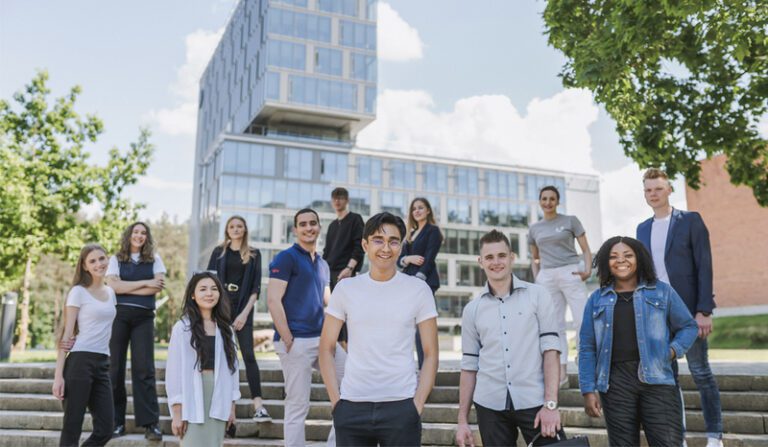
The world of science moves fast – and we are part of it. “Global News” opens a window into what our partners around the world are working on: what research they are conducting, what ideas they are developing, and what kind of future they are creating today.
ASIA
National Sun Yat-sen University, Taiwan
National Sun Yat-sen University (NSYSU) has opened the Joint Semiconductor Technology Laboratory, which will become one of the university’s most important centres for innovation and technological development. Around 800 million Taiwanese dollars (approximately 23 million euros) are being invested in the creation of the laboratory. The modern centre will carry out semiconductor manufacturing, packaging, testing, and material analysis activities – developing and improving technologies used in the production of chips and other electronic components.

One of the most important features of this centre is the large-scale semiconductor packaging and testing laboratory established in cooperation with the global technology company “ASE Group.” The laboratory will focus on three main areas: development of new devices, research into technical properties, and advanced material analysis.
The laboratory is expected to attract more than 5,000 students, researchers, and industry specialists annually, and during its first decade of operation it is expected to help train more than 1,200 highly qualified experts. This initiative is important not only for Taiwan, but also for the global technology market. As demand for chips continues to grow, the university aims to contribute to the preparation of new specialists and closer cooperation between science and business. In this way, NSYSU strengthens its position as one of the world’s leading centres of innovation and semiconductor technologies.
https://drive.google.com/drive/folders/1LUX9L7iny2bnrLGHD7LOQusrGZm_MCVy
POSTECH, South Korea
As POSTECH approaches its 40th anniversary, the university is not only reviewing its achievements, but also preparing for a new phase of development – “POSTECH 2.0,” referred to as the university’s second founding stage. Its goal is not to follow already existing scientific directions, but to create new ones and become a leader in areas such as artificial intelligence, quantum technologies, and biotechnology.
The most important part of this transformation is the belief that talented people are the university’s greatest asset. POSTECH is actively working to attract top-level researchers from around the world and provide them with conditions that allow them to focus entirely on bold and innovative scientific research.
Professor Youngjoon Choi, who recently joined the university, is conducting advanced research on graphene-based quantum materials. It is expected that this work will help create more stable qubits – the core elements of quantum computers required for next-generation quantum technologies. Meanwhile, Professor Luke Lee leads interdisciplinary research on brain waves and non-invasive sound therapies. He is also developing K-BIGHEART, a new international biomedical innovation research centre.
SOUTH AMERICA
University of Sao Paulo, Brazil
The university’s Faculty of Architecture and Urbanism is strengthening its international leadership role in design research by presenting the new international publication “Community (&) Design: Material, Spatial, and Social Encounters.” In this publication, prominent international scholars explore how design can encourage human connection, community spirit, sustainability, and the creation of a more inclusive future in different countries around the world.
An important role in this publication is played by Professor Maria Cecilia Loschiavo dos Santos – a FAUUSP professor who is one of the book’s editors. Together with Tom Bieling and Wolfgang Jonas, she wrote the publication’s introduction. The professor’s internationally recognized research in social design, sustainability, and urban culture was essential in shaping the publication’s interdisciplinary and socially responsible direction. This further strengthens FAUUSP’s role as an important global centre for critical design research.
This achievement also reflects the university’s broader international recognition. In the 2025 Times Higher Education Latin America University Rankings, the university was recognized as the best university in Ibero-America and is consistently ranked among the world’s leaders in higher education.
https://link.springer.com/book/10.65272/978-88-6977-546-8
Pontificia Universidad Catolica del Peru, Peru
University researchers are leading an international research consortium investigating the deteriorating condition of the western Amazon – one of the planet’s most important ecosystems. The “AndesFlux” project includes a network of four measurement towers located across three regions of Peru. Here, scientists measure in real time the exchange of carbon dioxide (CO2), water vapor, and methane between the forest and the atmosphere.
Researchers Eric Cosio and Norma Salinas found that the loss of large and old trees in the Amazon is accelerating. In addition, at certain times the forests no longer function as a carbon-absorbing ecosystem and instead begin releasing CO2 into the atmosphere themselves.
These studies are extremely important for the entire region because the water evaporated by Amazon forests sustains more than one-third of South America’s water cycle. For this reason, changes in the condition of the Amazon may have a direct impact on water security even in cities such as Lima.
“AndesFlux” is part of the global “AmeriFlux” network and collaborates with research institutions from the United Kingdom, the United States, France, and Germany.
EUROPE
Instituto Superior Tecnico, Portugal
The Lisbon-based university continues to strengthen its international role by developing strategic partnerships, participating in European university alliances, implementing international mobility programs, and carrying out joint research projects.
One important example of this direction was the International Staff Week and International Day organized in 2026. The event brought together participants from 23 countries and became another opportunity to strengthen cooperation with partners in Europe, Africa, and South America, who all shared experience and examples of best practice in higher education.
International activities also significantly expanded during 2023-2025, when “Tecnico” coordinated the Erasmus+ capacity-building project I-MAT (Innovative Mobility Attracting Tools for Latin America). This project, implemented together with international partners including VILNIUS TECH, aimed to strengthen international mobility opportunities and cooperation between higher education institutions in Latin America through innovative and digital solutions.
Hellenic Mediterranean University (HMU), Greece
The university is becoming one of the strongest examples of higher education in Greece due to its achievements in research, innovation, and internationalization.
In the field of research, as many as 19 HMU lecturers and researchers – around 10 percent of the entire academic staff – were included in Stanford University’s list of the top 2 percent of scientists worldwide. The university received a 4-star QS Stars rating, confirming the high quality of its studies, research, and management. Such an evaluation is especially significant for a university that is regional and only established in 2019.
In the field of innovation, HMU participates in the European research infrastructure projects EMERGE and “InfraChip,” is a partner in the European university alliances ATHENA and HEROES, and contributes to the implementation of the Erasmus Mundus master’s program EMINENT.
In terms of internationalization, the university is also demonstrating significant growth. During the 2024-2025 academic year, more than 1,000 international mobility participants arrived at HMU, while in 2025-2026 their number exceeded 1,200. According to these indicators, the university ranks between 4th and 5th place among 25 public higher education institutions in Greece.
HMU coordinates two virtual exchange programs, 12 blended intensive programs, and organizes the “ATHENA Colloquial Talks” discussion series, which involves more than 120 researchers from around the world. The university’s thirteenth International Week attracted as many as 420 participants.
KTH Royal Institute of Technology, Sweden
The “Human Protein Atlas” is one of the world’s most advanced scientific initiatives aiming to map all proteins in the human body. This project helps scientists better understand the development of diseases and create more precise treatment methods – from cancer to neurodegenerative diseases.
The project is led by Professor Mathias Uhlen from KTH Royal Institute of Technology. In the latest version of the project, artificial intelligence plays an especially important role – it is used for protein structure analysis, evaluation of genetic mutations, and identification of disease markers in blood samples.
These technologies allow faster and more accurate diagnosis of diseases such as cancer, Parkinson’s disease, and amyotrophic lateral sclerosis (ALS), often even without invasive procedures. Scientists hope that the combination of artificial intelligence and biomedical research will in the future allow not only early-stage disease detection, but also personalized treatment tailored to each patient.