Holiday Stress and Zero Time? A Trainer’s Advice on Keeping Your Shape and Spirits Up

December 12, 2025
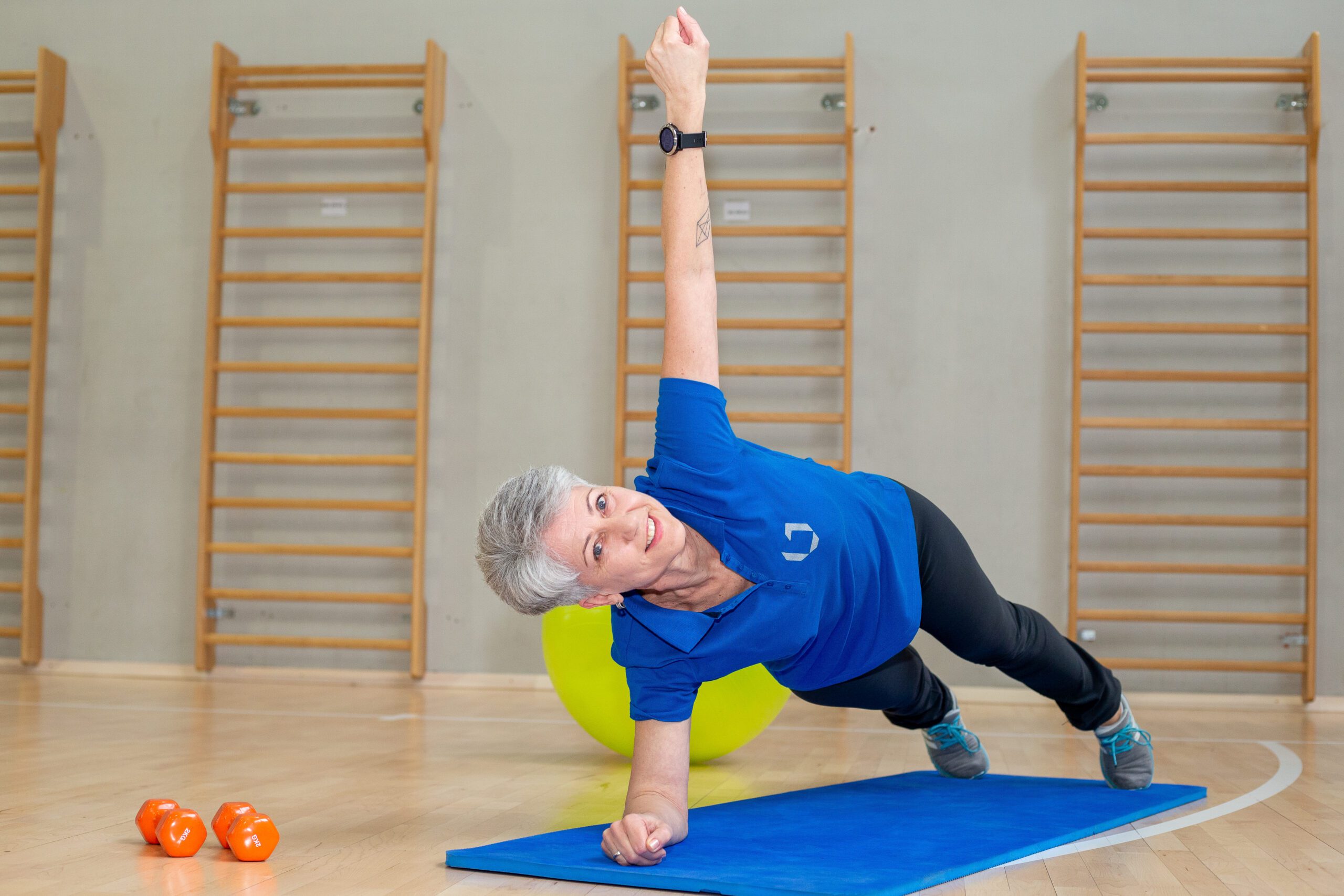
During the pre-holiday season, as we race through a marathon of shopping, events, and fairs, we often forget about ourselves. Due to a disrupted routine, we skip workouts, eat more calorie-dense foods, and the search for gifts causes headaches. To ensure the wait for the holidays becomes more pleasant rather than exhausting, Daiva Višinskienė, a trainer at the VILNIUS TECH Sports and Arts Center, shares tips on movement and combating stress.
– How would you advise people not to neglect physical activity during this stressful time?
– I would recommend choosing a pleasant but short activity. For example, dedicate at least 10–20 minutes a day to a walk while admiring Christmas decorations, take short dance breaks at home, or come up with games – like who can do the most squats, etc. Even light exercise at home works. The most important rule is: move for joy, not for burning calories!
– Do you have any favorite “holiday” movement rituals that you would recommend our readers try?
– At home, after setting the table, we like to dash out into the city for a bit to walk around the most beautiful, festively decorated streets.
There are other great options, for example: a Christmas hike with a thermos, choosing a different route every year; a walk with family or friends looking for nice spots to take photos; a “movement lottery” where you draw cards with tasks, or dancing to your favorite music. It is important to remember that this activity is not for sporting achievements, but for togetherness.
– How would you recommend using the winter season – the snow, the cold, nature – as additional motivation to get moving?
– When we get snow, joy and a better mood naturally take over. There are many outdoor activities: you can go sledding, build a snowman or other sculptures, or go for a hike. All these activities naturally involve movement.
– Gift hunting and traffic jams often cause tension. Do you have any “first aid” tips for stress relief? Is intense sport better for this, or conversely, slower practices like breathing exercises or mindfulness?
– Everything works, but it is very individual. Intense sport can be a good emotional release when you feel tired or tense, while breathing exercises help more when you are irritated and finding it hard to control your emotions.
– Why is physical activity such an important counterbalance in the fight against stress? How does uncontrolled tension affect our body and emotional state in the long run?
– Movement literally “burns up” stress hormones and encourages the release of feel-good hormones, thereby reducing tension. Physical activity affects both the body and the mind, so in the fight against stress, it is like a natural medicine.
– Often after the holidays, people feel heavy and “starting over” seems very difficult. How can one motivate oneself to return to a routine after New Year’s without great suffering?
– Feeling heaviness is normal. The most important thing is not to pressure yourself, but to return to the routine gently, without guilt. You should start with your thoughts – don’t blame yourself. It’s important just to get moving and start with physical activity that is pleasant for you. Also, don’t set maximum goals: instead of an hour, work out for 20 minutes – that will already be a win that grows motivation for the next workout.
– In general, what physical activity would you recommend for the “typical” office worker who sits from 8 AM to 5 PM and only gets up for coffee or lunch? Where to start?
– First of all, take mini-breaks: stand up, walk at least a few dozen steps, take a few deep breaths, do light stretching exercises at your workplace. If possible, work standing up for at least 20–30% of the day. Record your small victories – give yourself a “plus” for every movement break.
– What message would you like to share with university students, lecturers, and staff before the holidays?
– Dedicate at least a 10-minute personal break to yourself – without a phone, without work. Choose what suits you specifically: for some it will be a walk, for others – breathing or stretching exercises, reading a book, or a few minutes of total silence. It must be pleasant, gentle, without any pressure. This is time just for YOU, even if there is very little of it.

Galerija
Related news

New doctoral dissertation
VILNIUS TECH Library invites you to follow the published new dissertations. The dissertation „Analysis and modeling of deformations induced by the extrusion of fiber-reinforced polymers“ prepared at VILNIUS TECH by Mahmoud Samy Mahmoud Mohammed Farh. The dissertation was prepared in 2021–2026. Scientific consultant – Prof. Dr Viktor Gribniak. The dissertation was defended at the public meeting of the Dissertation Defense Council of the Scientific Field of Materials Engineering in the Aula Doctoralis Meeting Hall of Vilnius Gediminas Technical University at 2 p.m. on 10 June 2026. Additive manufacturing via fused filament fabrication (FFF) enables the creation of geometrically complex components. Yet, its use in structural and semi‑structural applications remains limited by anisotropic mechanical response, defect sensitivity, and fabrication‑induced residual stresses that cause warpage and geometric inaccuracy. This dissertation investigates polylactic acid (PLA)- based materials manufactured by FFF, including neat and partially recycled PLA, continuously reinforced PLA, and short-fiber-reinforced composites, to develop an integrated experimental-computational methodology for evaluating mechanical efficiency and predicting process-induced distortion. The research object comprises the mechanical, thermal, viscoelastic, microstructural, and thermo‑mechanical characteristics of these materials. The dissertation develops a unified approach linking reinforcement strategy, material structure, thermal history, mechanical performance, and warpage behavior. The adopted methodology combines quasi‑static tensile and flexural testing, thermomechanical characterization, scanning electron microscopy, and finite-element simulations. Continuous aramid reinforcement developed in this study for FFF increases the load-bearing capacity of the tension specimens by 67%. Still, reinforcement efficiency was limited by toolpath continuity, interfacial defects, and the absence of in‑process fiber tensioning. Short‑fiber-reinforced composites exhibit distinct fiber‑type‑dependent behavior: carbon‑filled PLA increases stiffness, while wood‑filled PLA enhances crystallinity, stiffness retention near the glass‑transition temperature, toughness, and dimensional fidelity. Wood‑fiber reinforcement reduces edge warpage by 43% and carbon fiber by 14.3% under identical conditions. A staged thermo‑mechanical simulation framework is developed to model printing, cooling, and detachment, transferring residual stress and distortion fields into subsequent mechanical simulations. The ABAQUS model for neat PLA predicts warpage with an average error of 8.2–10.6%, whereas a Digimat workflow captures the deformation in short‑fiber-reinforced PLA with an error of 14.3–17.9%. The latter predictions were obtained for the first time. The dissertation consists of an introduction, three main chapters, general conclusions, and references. The First Chapter provides a literature review of FFF of reinforced polymers, including material combination and modeling strategies. The Second Chapter specifies the chosen materials, test program, and thermo mechanical modeling concept. The Third Chapter evaluates experimental and numerical results, integrating mechanical, thermal, microstructural, and simulation based findings. The General Conclusions summarize the dissertation work, which is supported by four publications, including three articles in Web of Science indexed journals with impact factors, and four conference presentations. Doctoral dissertation readers can search via VILNIUS TECH Virtual Library.    
More
New doctoral dissertation
VILNIUS TECH Library invites you to follow the published new dissertations. The dissertation „Interaction between currency market evolution with monetary policy instruments in the age of digitisation“ („Valiutų rinkos evoliucijos sąveika su monetarinės politikos instrumentais skaitmenizacijos amžiuje“) prepared at VILNIUS TECH by Tomas Pečiuli. The dissertation was prepared in 2020–2026. Scientific consultant – Assoc. Prof. Dr Asta Vasiliauskaitė. The dissertation was defended at the public meeting of the Dissertation Defence Council of the Scientific Field of Economics in the Aula Doctoralis Meeting Hall of Vilnius Gediminas Technical University at 10 a.m. on 10 June 2026. The emergence of decentralised cryptocurrencies has created fundamental challenges for traditional monetary policy systems. Although these digital assets have the potential to increase financial inclusion and efficiency, their volatility and the lack of centralised oversight create systemic risks that cannot be properly managed using classical models. This dissertation presents an integrated hybrid analytical framework designed to quantitatively assess the impact of cryptocurrencies on monetary policy transmission mechanisms, providing policymakers with empirically grounded tools to analyse this evolving financial domain more effectively. The dissertation is divided into three main parts. The First Chapter summarises the theoretical role of cryptocurrencies in modern monetary theory. The Second Chapter presents and substantiates a new methodology that combines machine-learning techniques with advanced econometric modelling, specifically using an Elastic Net machine learning model with ARIMA residuals and MSGARCH specifications to capture regime-dependent behaviour. The Third Chapter empirically validates the framework using data from cryptocurrency markets and central bank policy operations. The empirical results show a significant asymmetric policy transmission effect, with the price of Bitcoin reacting by USD -15,348 to a 1% change in the Federal Reserve interest rate. The analysis also identifies critical volatility thresholds (σ>80%) at which cryptocurrency fluctuations increase inflation risk. These results indicate the growing systemic importance of cryptocurrencies in monetary policy dynamics. The study contributes to the emerging field of digital asset economics. The integrated modelling approach helps overcome the long-standing limitations of analysing nonlinear financial phenomena. Practical applications include real-time financial stability risk monitoring systems and evidence-based guidelines for regulatory interventions. The modular structure of the framework allows for future expansion by incorporating evolving market structures and new digital assets. The dissertation’s results have been presented to the scientific community in eight peer-reviewed publications in scientific journals and conference proceedings. This work provides central banks with essential analytical tools to maintain monetary stability and to promote responsible financial innovation in the digital era. Doctoral dissertation readers can search via VILNIUS TECH Virtual Library.
More