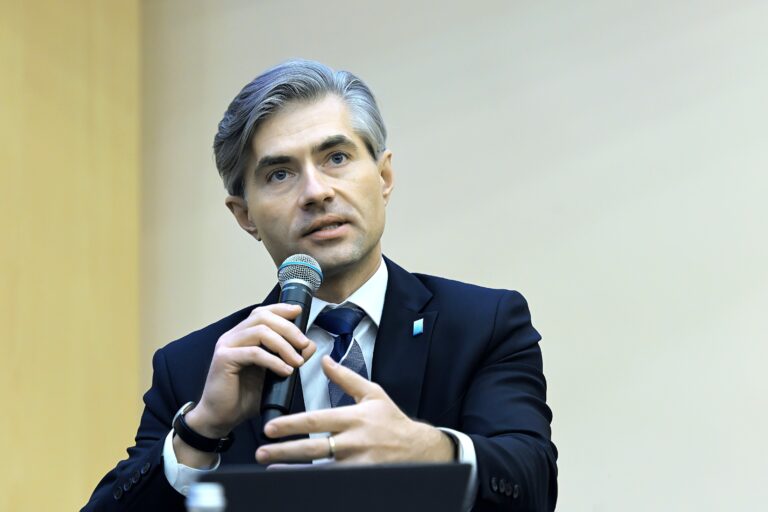
Lecture by Colonel Jakob Sogard Larsen Commander NATO Force Integration Unit in Lithuania

September 13, 2016
 
Lecture by Colonel Jakob Sogard Larsen (Danish Army) Commander NATO Force Integration Unit in Lithuania (NFIU LTU) “Applying Military Strategic Management Practices in the Public/Business Sectors”
 
Welcome
Prof. Manuela Tvaronavičienė (VGTU) Expert of NATO for project “Energy security: Cultural Change” (2015-2016)
 
The lecture will moderated by Assoc. Professor Renata Korsakienė


The Faculty of Business Management is pleased to announce the lecture, to be given by Colonel Jakob Sogard Larsen (Danish Army) Commander NATO Force Integration Unit in Lithuania (NFIU LTU).
 
The lecture will take place at 14.30 pm on 19 September (the Auditorium SRK-I 704).
 
 
The NFIU LTU is a permanent NATO Headquarters with 41 persons from 14 different nations (with the personnel staying between 2-4 years). It was established on the 1st of September 2015 and its main task is to facilitate the rapid deployment of the Very High Readiness Joint Task Force and additional high readiness military forces in order to assure our NATO partners and enhance NATO responsiveness in the possibility of a crisis. The Headquarter is located permanently in Vilnius/Lithuania and is co-located with the Joint Headquarters of the Lithuanian Armed Forces.
 
Colonel Jakob Sogard Larsen has been deployed 6 times to different missions (Bosnia, Kosovo and Afghanistan) and this NATO appointment is his third appointment in the NATO structure.
 
As an active soldier for more than 30 years – with many leadership challenges in his military career – working at different levels with multinational organizations for many years, he understands the strengths and challenges of leading a multinational organization.
 
Colonel Jakob Sogard Larsen will cover the following topics:
  • Leadership versus Management in the military
  • Differences in leading at strategic, operational and tactical levels.
  • Creating an understanding of military leadership.
  • Understanding military and civilian organizations, including cultural awareness.
  • Challenges and strengths of leading a multinational organization in operations and in peace.
  • Best practices in military leadership and management.
  • Principles for success – my understanding and experience.
  • Thoughts on how these leadership principles and management practices could be applied by you in your public sector and business careers.
 
Motto:
IF you can, you must!
 
 
Active discussion and questions are more than welcome. The students and professors are invited to participate.

Related news

Minister of Foreign Affairs K. Budrys: Lithuania is not an immediate target, but preparedness and resilience remain essential
Lithuania’s security situation, the war in Ukraine, relations with the United States and China, and the growing threat of hybrid attacks were among the topics discussed during the public event “Are We Ready for What Comes Next?”, part of the Unlock Lithuania lecture series, featuring Lithuania’s Minister of Foreign Affairs, Kęstutis Budrys. The discussion was moderated by Dr. Vytautas Jankauskas, Adviser on Science and Innovation at the Ministry of Foreign Affairs. [caption id="attachment_136497" align="alignnone" width="2560"] V. Jankauskas and K. Budrys[/caption] Speaking to students and members of the university community, the minister addressed concerns about regional security, explained how Lithuania and its allies are strengthening the country's defence capabilities, and emphasised the importance of public preparedness and reliable information. Lithuania's security depends on preparedness and cooperation with allies Assessing the current security situation in the region, Budrys pointed out that Russia's war against Ukraine has fundamentally changed Europe's security environment. The scale of the conflict, the number of casualties and the use of modern military technologies have created challenges that extend beyond Ukraine's borders. Lithuania also experiences the indirect consequences of the war. Recent incidents involving drones approaching or entering Lithuanian airspace have demonstrated how developments on the battlefield can affect neighbouring countries. According to the minister, such incidents highlight the need to strengthen air surveillance, improve alert systems and ensure that Lithuania can respond quickly to emerging threats. "This is a collective effort. The purpose is to build resilience – the ability to respond quickly and ensure that our society is prepared," he said. Budrys also addressed concerns about the possibility of a direct military threat to Lithuania, emphasising that the current probability of such an attack is low. While Russia's intentions remain a concern, the minister noted that it currently lacks the capabilities to carry out military aggression against Lithuania. "We are not the target at the moment," he said, adding that Lithuania's NATO membership and close cooperation with its allies provide important security guarantees. Public awareness and reliable information are part of national security The minister also addressed the concerns of people who feel unsafe amid growing regional tensions. Drawing on his own experience as a parent, he emphasised that open conversations and clear information can help people better understand potential threats and respond appropriately. He pointed out that preparedness does not mean expecting the worst. Rather, it means knowing what to do in different situations, understanding official instructions and being familiar with available safety measures. For example, people should know where to seek shelter during an alert and how to follow the recommended two-wall safety rule, which means putting at least two walls between themselves and the outside of a building. Budrys encouraged students not to keep their concerns to themselves, but to discuss them with family members, colleagues and university representatives. He also highlighted the importance of critical thinking when following international developments. Noting that many young people get their news from social media platforms such as TikTok, he urged them to question the sources of information and verify what they see online. "Where did you get this information? Where did you read it? How does it work?" he said, describing the questions he regularly asks his own daughter. According to the minister, if the authorities received credible intelligence indicating an imminent threat, the public would be informed immediately. He stressed that transparent communication is essential for building trust and ensuring that people know how to act. Diplomacy remains essential despite growing global tensions The discussion also touched on the future of diplomacy in a world where military conflicts are becoming increasingly frequent. Budrys argued that diplomacy will remain indispensable, as all military conflicts ultimately require political agreements and negotiations to reach a lasting resolution. However, he acknowledged that the international environment is becoming more complicated as the global order shifts from a unipolar to a multipolar system. He warned that fundamental principles of international law, including respect for sovereignty, territorial integrity and the peaceful resolution of conflicts, are increasingly being challenged. Russia's actions in Ukraine, he noted, undermine the international rules established after the Second World War. This is why Lithuania continues to seek international support for Ukraine and advocates for a just and lasting peace. Lithuania seeks a stronger response to Russian hybrid threats In response to questions about Russian sabotage operations, attacks on critical infrastructure and other forms of hybrid warfare, Budrys argued that these activities should be treated as a serious part of Russia's broader military strategy. Lithuania's response, he said, should include increasing the political and economic costs of such operations for Russia. Among the measures he highlighted were further sanctions and efforts to designate Russia's military intelligence service as a terrorist organisation. Budrys emphasised that these threats are not limited to Lithuania or the countries on NATO's eastern flank. All European countries need to assess their vulnerabilities and strengthen their ability to protect critical infrastructure and society. The conversation at VILNIUS TECH gave students an opportunity to raise questions about the issues shaping Europe's security and Lithuania's role in the international community. Throughout the discussion, the minister returned to one central message: security is built not only through military capabilities and international alliances, but also through public awareness, preparedness, resilience and the ability to respond collectively to emerging challenges.
More
Between ships and technology: how can safe vessel traffic be ensured in the port of Klaipėda?
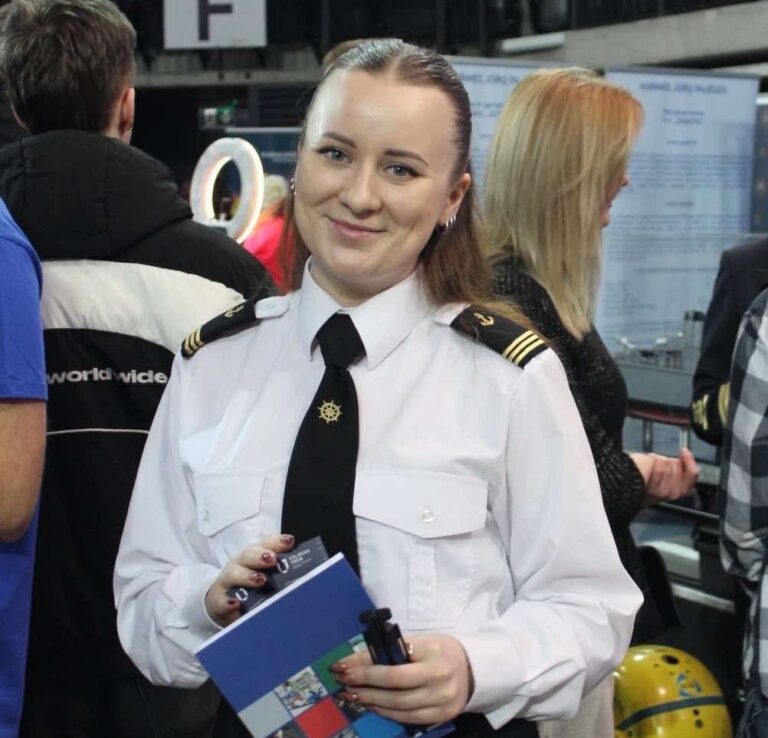
The Port of Klaipėda is Lithuania’s only ice-free port and one of the most important transport hubs in the Eastern Baltic region. Every day, vessels of various types – from passenger and cargo ships to tankers – navigate its waters, making safe vessel traffic one of the port’s key priorities. Heavy maritime traffic, narrower sections of the channel and large vessels moored alongside the quays present challenges for navigation specialists that require not only knowledge and experience, but also advanced technologies. Kamilija Būdvytytė, a graduate of the Marine Navigation study programme, dedicated her bachelor’s thesis to exploring this topic. She was awarded a scholarship by the Klaipėda Industrialists’ Association for research of significance to the city of Klaipėda. In her thesis, „Analysis of the Safe Passing of Vessels with Moored Ships in the Port of Klaipėda Based on the Recommendations and Regulations of International and Local Institutions“, she examined how the speed of a passing vessel and its distance from a moored vessel affect navigational safety. Using an advanced navigation simulator and digital modelling, K. Būdvytytė analysed various vessel-passing scenarios and assessed their impact on mooring systems and overall safety. The research results revealed that even relatively small changes in speed or distance can have a significant effect on the safety of vessel traffic and can help facilitate more effective decisions when organising traffic in the Port of Klaipėda. Although it may seem that the greatest risk is faced by moving vessels, according to the VILNIUS TECH graduate, moored vessels are also exposed to hazards. A passing vessel generates waves, water currents and pressure changes that can affect a moored vessel. These hydrodynamic effects can cause a vessel to be drawn towards the passing ship or pushed away from the quay, placing additional loads on mooring lines and quay fenders. Such situations are particularly sensitive when tankers are moored alongside the quay. „During my research, I paid particular attention to the factors that determine the safe passing of vessels. Some of the most important are vessel speed, the distance between vessels, their size and draught, as well as the width and depth of the channel. Weather conditions are equally important, including wind, currents and visibility. The main principle is simple: the higher the vessel’s speed, the greater the safe distance from a vessel moored alongside the quay should be,“ says K. Būdvytytė. To assess the impact of these factors, she used modern technologies. The research was conducted using the Wärtsilä TRANSAS NTPro 6 navigation simulator, in which the Port of Klaipėda channel was recreated. Different scenarios were modelled to analyse the passing of a Ro-Ro vessel alongside a tanker moored at the quay, while varying the vessel’s speed and the distance between the ships. According to the author, digital modelling provided insights that went far beyond theoretical calculations. The simulator made it possible to assess not only hydrodynamic forces, but also the effects of wind, currents, restricted water depth and changes in manoeuvrability. Such simulations provide an opportunity to safely test a variety of scenarios that would be difficult or even dangerous to reproduce under real-life conditions. „One of the most interesting findings of the research was that even small changes in speed or distance can significantly affect the loads on mooring lines. The highest loads were recorded not when the vessels were approaching or moving away from each other, but when they were sailing parallel to one another in close proximity. For example, when a vessel was travelling at a speed of 8 knots at a distance of just 50 metres from a tanker, the maximum load on a single mooring line reached 7.2 tonnes-force. When the speed was reduced to 4 knots or the distance increased to 120 metres, the loads decreased several times. These results clearly demonstrated that lower speeds and greater distances make a significant contribution to safety,“ explains the VILNIUS TECH graduate. According to K. Būdvytytė, the findings of the research could be useful not only for scientific research but also for the practical operations of the Port of Klaipėda. They could help determine safe sailing speeds more precisely in different areas of the port, improve vessel traffic management procedures, and support the training of pilots and bridge teams. K. Būdvytytė also suggests considering situational speed restrictions in areas where vessels pass particularly close to tankers moored alongside the quays. Today, safe navigation is supported by a wide range of smart technologies. Vessels use electronic navigation systems, radar, Automatic Identification Systems (AIS), electronic charts and various communication solutions. An important role in port operations is played by the Vessel Traffic Service (VTS), which monitors vessel movements in real time and coordinates their actions. „Future ports will increasingly resemble smart transport systems. Artificial intelligence (AI), automated traffic management platforms and so-called digital twins will help predict potential risks more accurately, identify the safest routes and optimise vessel movements. Nevertheless, even as technologies continue to advance rapidly, the human factor will remain crucial – whether it is a pilot, captain or traffic management specialist who makes the final decision in critical situations,“ says K. Būdvytytė. The research conducted by the VILNIUS TECH graduate demonstrates that modern maritime navigation is inseparable from advanced technologies, while safety still depends heavily on people’s ability to make responsible decisions. The study highlights how scientific knowledge, digital modelling and innovation can contribute to safer and more efficient port operations in the future.
More