Research gets interesting where technologies meet
Dr. Shady Adib’s journey in civil engineering spans continents and cultures. After graduating from the German University in Cairo, he was eager to see how advanced structural engineering problems were tackled elsewhere in the world. A Master’s in Structural Engineering at VILNIUS TECH became his bridge to a research career in the UK.
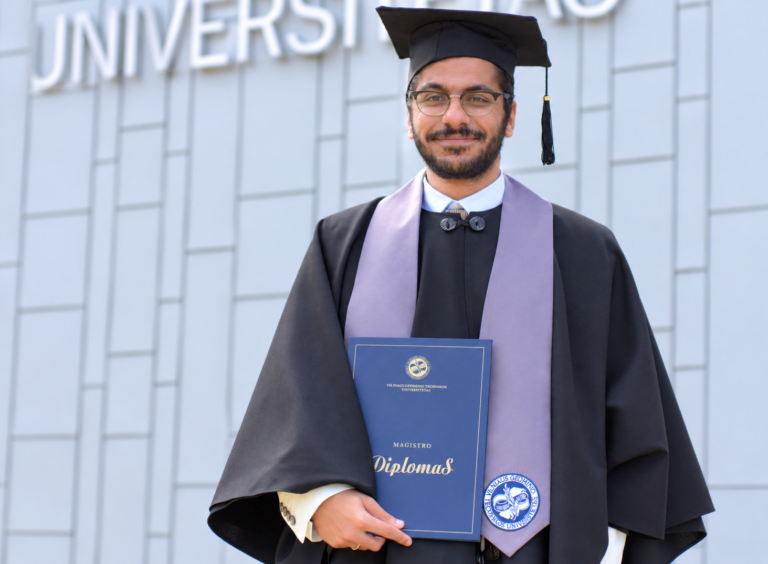
[caption id="attachment_135189" align="alignnone" width="1463"] Dr. Shady Adib[/caption]
Today, he is most fascinated by the interplay of AI, physics, uncertainty, and engineering decision-making. Another of his interests, „digital twins“, always makes him smile: he was working on the technology just as his twin daughters were born. Join us for a conversation with the visiting researcher at Imperial College London and assistant professor at the University of Hertfordshire about the future of engineering.
– What first drew you to civil engineering?
– I have always been fascinated by the fact that civil engineering has such a direct impact on people's everyday lives. Bridges, buildings, and infrastructure are things that people use every day, often without thinking about the engineering behind them. What attracted me particularly was the combination of mathematics, physics, and problem-solving, but also the responsibility that comes with designing structures that need to remain safe for many decades.
As I progressed through my undergraduate studies in Civil Engineering in Cairo, I became especially interested in structural engineering. I liked trying to understand how structures behave, how they respond to loading, and eventually how we can detect when their behaviour begins to change. That curiosity gradually developed from simply wanting to design structures into wanting to understand and monitor them throughout their entire life.
– What brought you to VILNIUS TECH? What were you looking for at that stage of your studies?
– After completing my bachelor's degree in Civil Engineering in Cairo, I knew that I wanted to specialise further in structural engineering and, importantly, experience a different academic environment. Coming to VILNIUS TECH gave me the opportunity to study in Europe, to work in an international environment, and to develop a stronger research-oriented understanding of structural engineering. At that stage, I was looking for more than another academic qualification. I wanted to understand how advanced structural engineering problems were approached, become exposed to different research methods, and determine whether research was something I wanted to pursue as a long-term career. VILNIUS TECH became an important bridge between my undergraduate education and the research career that followed.
[caption id="attachment_135190" align="alignnone" width="1275"] Dr. Shady Adib[/caption]
– Was there a particular course, professor, project, or experience that had a lasting influence on your academic or professional direction?
– I remember my time at VILNIUS TECH as a very important period in both my academic and personal development. One of the strongest influences on me was my supervisor, Ieva Misiūnaitė. I was very fortunate to work with her, and I learned a great deal from her, not only about structural engineering and research methodology, but also about how to approach a research problem critically and systematically. Working with her was one of my first real experiences of academic research. She encouraged me to think beyond simply completing coursework and to start asking deeper research questions, analysing results carefully, and communicating technical ideas clearly.
During my master's studies, I also had the opportunity to publish my first conference paper, which was a very important milestone for me. I think that experience had a lasting influence on my career. It gave me confidence that research was something I genuinely enjoyed and could see myself continuing with.
More broadly, studying at VILNIUS TECH also strengthened my background in structural engineering and numerical analysis, while living and studying in an international environment helped me become much more independent academically and personally. Looking back, I would say that VILNIUS TECH, and particularly my experience working with Ieva, played an important role in my decision to continue towards a PhD and an academic research career.
– How did your interests develop between your master’s studies and your PhD at Newcastle University?
– During my master's studies, my interests were primarily focused on structural analysis and modelling.
By the time I began my PhD at Newcastle University, I had become increasingly interested in the difference between how we expect a structure to behave in a numerical model and how it behaves in the real world. That led me to structural health monitoring and, eventually, digital twins.
My PhD focused on developing a digital-twin framework for real-time structural damage identification. The central idea was to connect structural models with sensor measurements so that the digital representation of a structure could continuously learn from what was happening to the physical structure. So, there was a natural progression from structural engineering to computational modelling, to structural health monitoring, and eventually to digital twins and intelligent infrastructure.
– How did you become interested in combining civil engineering with technologies such as AI and digital twins?
– Once you start working with structural health monitoring, you quickly realise that sensors can generate enormous quantities of data. A traditional structural model alone cannot always make full use of that information. That naturally led me towards machine learning and artificial intelligence. I started asking questions such as: Can an algorithm recognise patterns in structural behaviour that would be difficult for an engineer to detect manually? Can we reconstruct missing sensor information? Can we combine physical engineering knowledge with AI rather than treating them as two separate worlds? That combination has gradually become the main direction of my research.
[caption id="attachment_135191" align="alignnone" width="2560"] Dr. Shady Adib[/caption]
– It's fascinating to bring all those disciplines together!
– What fascinates me is that each discipline solves a different part of the problem. Structural engineering helps us understand how structures should behave. Sensors and IoT technologies allow us to observe what is actually happening. Digital twins provide a framework for connecting the physical structure with its digital representation. Artificial intelligence helps us interpret large amounts of data, recognise patterns, reconstruct missing information, and make predictions.
But I think the most interesting research happens when these technologies are not treated separately. The real question is: How can we build infrastructure that can continuously understand its own condition and help engineers make better decisions?
For me, that is much more exciting than simply applying AI to an engineering dataset.
– Digital twins are becoming increasingly important in engineering. For someone who isn't an expert in the field, how would you explain what a digital twin is and how it can change the way we monitor and maintain structures?
– I normally explain a digital twin as a living digital representation of a physical asset. Imagine a bridge. Traditionally, we might have drawings, inspection reports, and perhaps a computer model of the bridge. These are useful, but they are usually separate and relatively static. A digital twin tries to connect these different sources of information with the actual bridge.
Sensors on the bridge can continuously provide information about vibration, displacement, temperature, or other behaviour. The digital model receives this information and updates our understanding of the structure. So instead of asking, „What did the bridge look like when we inspected it six months ago?“ we can increasingly ask, „What is happening to the bridge now, and what might happen next?“ That can potentially move infrastructure management from reactive maintenance towards predictive and preventative maintenance.
– How is artificial intelligence changing the work of civil engineers? Do you see AI primarily as a tool that helps engineers do their work better, or is it changing the nature of the profession itself?
– I think it is doing both. In the short term, AI is an extremely powerful engineering tool. It can help analyse large datasets, automate repetitive tasks, detect defects in images, support optimisation and accelerate modelling.
But in the longer term, I think it will also change the nature of civil engineering. Engineers will increasingly work with systems that continuously collect data and make recommendations. That means the engineer's role may shift from simply performing calculations towards supervising intelligent systems, interpreting their results, understanding uncertainty and making responsible decisions.
However, I do not see AI replacing engineering judgement. Infrastructure involves safety, uncertainty, and responsibility. AI can provide evidence and recommendations, but engineers still need to understand whether those recommendations are physically credible and whether they can be trusted.
– What are you working on now, and what questions are you most interested in answering?
– My current research focuses on what I would describe as increasingly intelligent or cognitive digital twins for infrastructure. Recently, at Imperial College London, I have been working on AI-enabled data imputation for digital twins. One challenge with real monitoring systems is that sensor data are never perfect. Sensors can fail, communication can be interrupted, and measurements can be corrupted. The question we are investigating is: Can an intelligent digital twin reconstruct missing information while still making reliable assessments of the physical structure?
[caption id="attachment_135192" align="alignnone" width="1792"] Dr. Shady Adib[/caption]
I am also increasingly interested in questions around explainable AI and uncertainty. If an AI system tells an engineer that a bridge may be damaged, the engineer should not simply receive a prediction. We need to understand why the system reached that conclusion, how certain it is, and whether the explanation is consistent with structural physics. That interaction between AI, physics, uncertainty, and engineering decision-making is probably the area that interests me most at the moment.
– You are currently a visiting researcher at Imperial College London and an assistant professor at the University of Hertfordshire. How does working across research institutions and countries shape the way you approach your work?
– Working across different universities and countries has had a very strong influence on how I approach research. I studied in Egypt, Lithuania, and the UK, and I have worked with researchers from many different disciplines and backgrounds. Every institution has a slightly different research culture and different strengths. At Imperial, for example, I have been exposed to a very strong environment around AI, computational engineering, and interdisciplinary research. At the University of Hertfordshire, teaching keeps me connected to the fundamentals of engineering and to the way the next generation of engineers is being educated.
I think moving between these environments encourages you not to become too narrow. It reminds you that the most interesting engineering problems often require collaboration across institutions, countries, and disciplines.
– What do you think civil engineering will look like 10 to 20 years from now?
– I think civil engineering will become much more data-driven and much more connected. Infrastructure will increasingly contain embedded sensing systems. Digital twins will provide continuously updated representations of buildings, bridges, and transport networks. AI will help analyse those systems and identify problems earlier. Robotics and autonomous inspection technologies will also become increasingly important, particularly for inspecting difficult or dangerous locations.
Another major development will be the integration of sustainability and whole-life thinking into engineering decisions. Instead of asking only, „Can we build this structure?“, engineers will increasingly ask, „How can we operate, maintain, adapt, and eventually reuse this infrastructure efficiently over its entire life?“
I also think we will see increasing interest in infrastructure systems that are not simply monitored, but that can learn from their own operation and adapt over time.
– What new skills will the next generation of civil engineers need?
– The fundamentals will remain essential. Future engineers will still need mechanics, structural analysis, materials, mathematics, and engineering judgement.
But on top of that foundation, I think several additional skills will become increasingly important. Engineers will need some understanding of programming, data analysis and artificial intelligence. They will also need to understand sensors, digital systems and uncertainty.
Perhaps even more importantly, they will need to know how to work across disciplines. A civil engineer may increasingly collaborate with computer scientists, data scientists, robotics engineers and AI researchers. At the same time, critical thinking will become even more important. When AI can generate an answer almost instantly, the valuable skill is knowing whether that answer makes engineering sense.
– Looking back at your journey – were there any decisions or turning points that significantly changed the direction of your career?
– There have been several important turning points in my career. Moving from Cairo to Vilnius for my master's degree was definitely one of them. It was my first major international academic experience, and it was where I really started to see research as a possible long-term career.
Another major turning point was starting my PhD at Newcastle University, where my work moved from conventional structural engineering towards structural health monitoring and digital twins. There is also a slightly funny personal connection to this. During my PhD, while I was working on digital twins, I became a father to twin girls. So, at one point I was spending my days working on digital twins and then going home to my real twins. It became a running joke, but in a way, it also made the term „digital twins“ very memorable for me.
More seriously, by the end of my PhD I realised that I did not want digital twins to remain only the topic of my doctoral research. I could see how much potential the field had, especially when combined with structural health monitoring, sensors and artificial intelligence. That was an important decision for me: rather than moving away from the topic after my PhD, I chose to continue developing it and make digital twins one of the central themes of my research.
Looking back, each stage, Cairo, Vilnius, Newcastle, Hertfordshire, and Imperial, added something different, but that combination of personal experience and research interest helped turn digital twins from a PhD topic into a longer-term research direction.
More