Rainer Kurm is a member of the Union of Estonian Artists, he participates in exhibitions of artists from the Baltic countries.
„The motifs of the paintings are abstract/semi-abstract geometric compositions and landscapes. Themes include a living environment characterized by Nordic tones and a deep and respectful relationship with both the Creator, nature and creation. These words are indeed very similar in Estonian: Looja, loods, loovus".
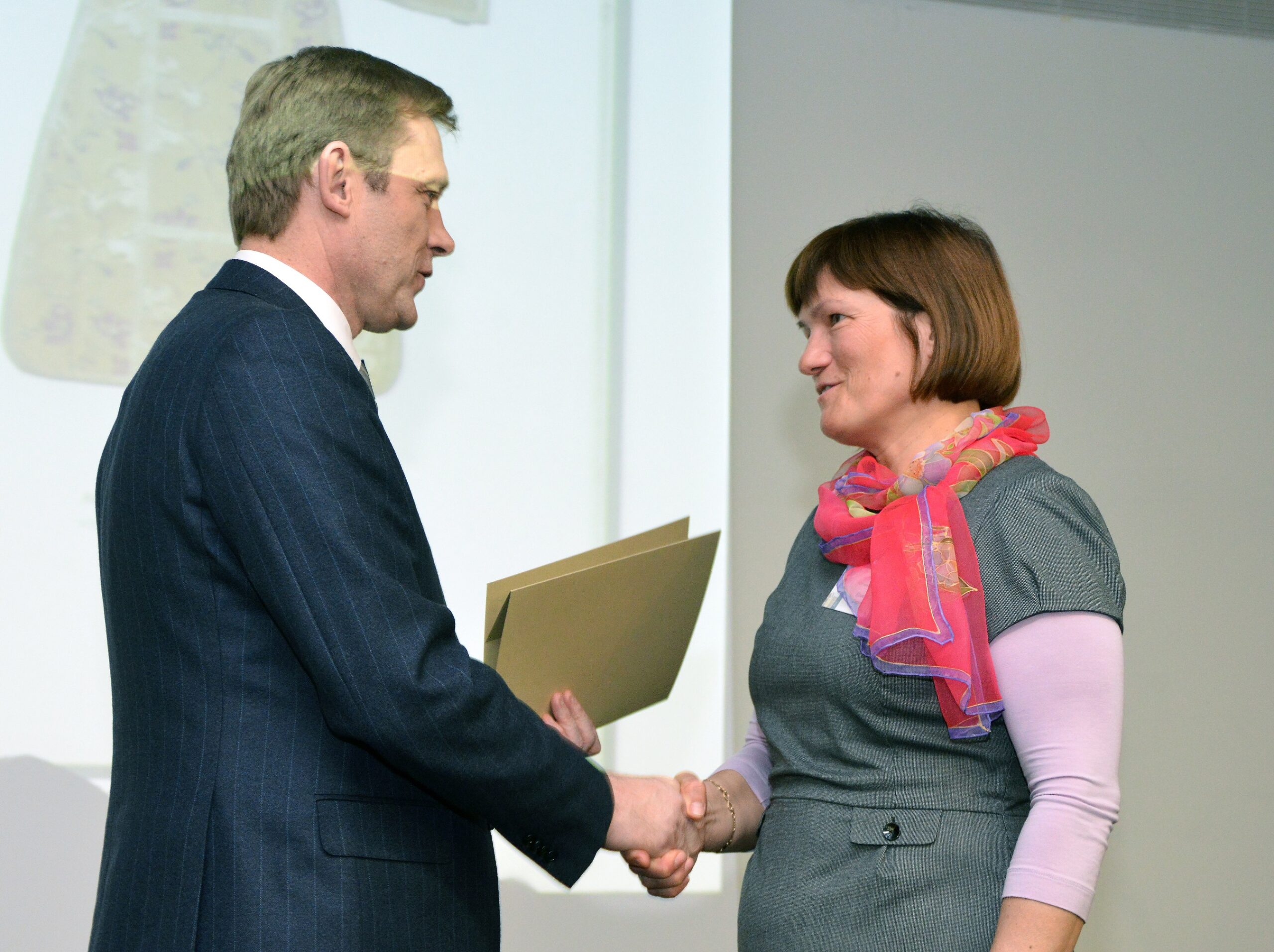
During the meeting, the author answered the visitors' questions and discussed the subtleties of painting.
There are often dark skies in your paintings. Is this somehow linked to your state of mind?
It is hard for me to judge that myself, perhaps someone else could tell better. I do have works with dark skies, but there are also ones with lighter and brighter moods. But I must say that the events of recent years have undoubtedly left their mark on us all, whether we are conscious of it or not.
Yes, it has influenced me to some extent. The counterinfluence of technology and art has existed since the beginning of 20th century, when geometric art began to display new, urban environment and the depiction of machinery became widespread. I am not a huge fan of science fiction myself, but this environment has certainly influenced me in my formative years. Studio22 where I started my art studies in the 80ies, and its leader Tõnis Vint had a great interest in sci-fi. One of Vint’s favourite films was Stanley Kubrick’s Space Oddysey and it certainly left an impression. I, however, do not watch films that much nowadays. Another thing that influenced me, I think, was perhaps time spent with my father in his workplace in Technological University of Tallinn. He was working with computers in the 80ies already and at that time the machines were huge, the size of a wardrobe. I remember the long dimly lit corridors in the University and the computers with their blinking lights. This had a definite sci-fi/spaceship feel.
Vilnius is an extraordinary city, and also very different from Tallinn and Riga. The scale, proportions, logic gives an idea of powerful and multi-layered centuries of history. I am inspired by its magnificent, awe-inspiring and varied sacral architecture, the multitude of cathedrals, synagogues, churches, monasteries. Also, geographically it is very different.
Čiurlionis is very much loved in Estonia, he was a legend in his own time. His internal freedom, extraordinary spirituality, his own distinct style and technical mastery of skills. My grandmother Helga, who had studied art history, also appreciated his works a lot. She had a book of his paintings, and it was treated with great regard. We still have that book. And my first art teacher Kalju, who later became a pastor, held Čiurlionis in great regard. He especially appreciated his spirituality in his works. It is important to stress that this kind of art had even more weight in the beginning of the 80ies when our countries were still under communist occupation. There is a special kind of holiness in Čiurlionis’s works.
Mostly I use traditional painting tools, no special technical tools at all. For straighter lines I use a paint roller, for layers a painting knife sometimes, and to achieve very thin lines I use a brush in size 0. I also try to layer the paint quite thinly.
As it takes a long time for oil paint to dry, it sets certain limits. Normally it takes one or two months to finish one painting. It doesn’t, of course, mean that I work with only one painting this whole time, as I need to wait for the previous layer to dry before applying another. So, I work on several paintings at the same time. And it does happen that a few months after finishing the painting I want to paint some surfaces over. One of the reasons for this is that the oil paint becomes darker when it dries. I think many artists do this; it is not unique.
I actually do not have a background in technology, but I do feel that for all of us our everyday environment has become filled with technology, whether we like it or not.
I am constantly making sketches; I use little sketchbooks that can fit in my bag if needed. So, I usually pick an idea from a sketchbook, and then it is only a matter of decision and choice. And it is very exciting in itself, choices are necessary in life. And anyone can do these little sketches, the order of them shows how in time some shapes and forms emerge, change, or disappear. It is all linked to our mind and sense and visualisation is an important part of observing these processes and giving them meaning.
As I mentioned, the time I spend on a painting is measured in months rather than days, so during this long time my state of mind changes many times. In some sense it is true that the paintings express a certain emotion, as the sketches for the painting are made in a shorter time period and are charged with the energetic code of that moment in time. The painting process, however, adds various impulses in different layers and the emotions start to communicate with one another or kind of shine through.
It is true that especially North Estonia is very flat, but we do have tens of kilometres of magnificent coastal cliffs. So, you can get the experience there. But there are very interesting landscapes in Europe, you don’t have to travel too far to find a more mountainous landscape.
I became interested in the 80ies when I started learning art in Studio22 in Tallinn. The founder of the studio, graphic artist Tõnis Vint with other likeminded young artists Maran, Põllu, Sooster were the ones who started the revolution in art in the 60ies. They tried to liberate art from Stalinist regime of terror and of social realism that was forced on the entire society. Tõnis Vint appreciated the legacy of Bauhaus, the effect of art on the environment, connecting art with applied art, design, and architecture.
It was a serious fight, I have always admired people who find it in themselves to consciously oppose to the officially accepted value system and face accusations of formalism, being an agent of the West and other serious transgressions. This fight against the dictature of social realism has somewhat been covered by Estonian art historians, but it is a sensitive topic. We keep hearing opinions about how unnecessary it is to judge the past.
Graffiti is classified as street art and as with many types of art, here we can also observe kind of blurring of lines, change, new hierarchies of value. In an aesthetic, historically more refined environment graffiti can have quite a destructive effect, but there are many layers of meaning to it that we might not be able to appreciate adequately due to the aesthetical conflict. I think there will be more processes like this in the future, it will not be the last. And it is still art, whether we like it or not.
I think, quite unoriginally, that my favourite colour is most likely grey. It is a good balancer; colours can sometimes have quite an aggressive effect without the grey to balance them. And the grey colour in nature, especially in spring, is simply wonderful. And the grey light of rainy days shows us the endless mercy of God’s infinite wisdom
We have had very exciting joint exhibitions with the artists of Latvia and Lithuania in Riga, Tallinn and also USA. In addition, we have art camps in summer in Latvia, Kurzeme region. There have been art conferences in Tallinn (Artest Plus, Arts plus, BBI, Imago Dei). I am often in awe that people have the energy, knowledge and strength to organise these international events. For years we have been fortunate to cooperate with Charles Kelley and I hope he continues to make time for us. In the beginning of 20th century Baltic cooperation had a significant role to play when it comes to art. We had closer contact with the Latvian artists mostly, on Latvia’s side Artists’ Group of Riga, who brought a cubist influence, and on our side Estonian Artists’ Group, of which all the major Estonian avant-garde artists were members.
In 1924 the first Estonian-Latvian joint art exhibition took place. The idea was to hold an exhibition of abstract geometric art of the three Baltic states, but it did not take place because of the lack of financing.
Interview by Geda Žyvatkauskaitė
Galerija