Lithuania’s security situation, the war in Ukraine, relations with the United States and China, and the growing threat of hybrid attacks were among the topics discussed during the public event “Are We Ready for What Comes Next?”, part of the Unlock Lithuania lecture series, featuring Lithuania’s Minister of Foreign Affairs, Kęstutis Budrys. The discussion was moderated by Dr. Vytautas Jankauskas, Adviser on Science and Innovation at the Ministry of Foreign Affairs.
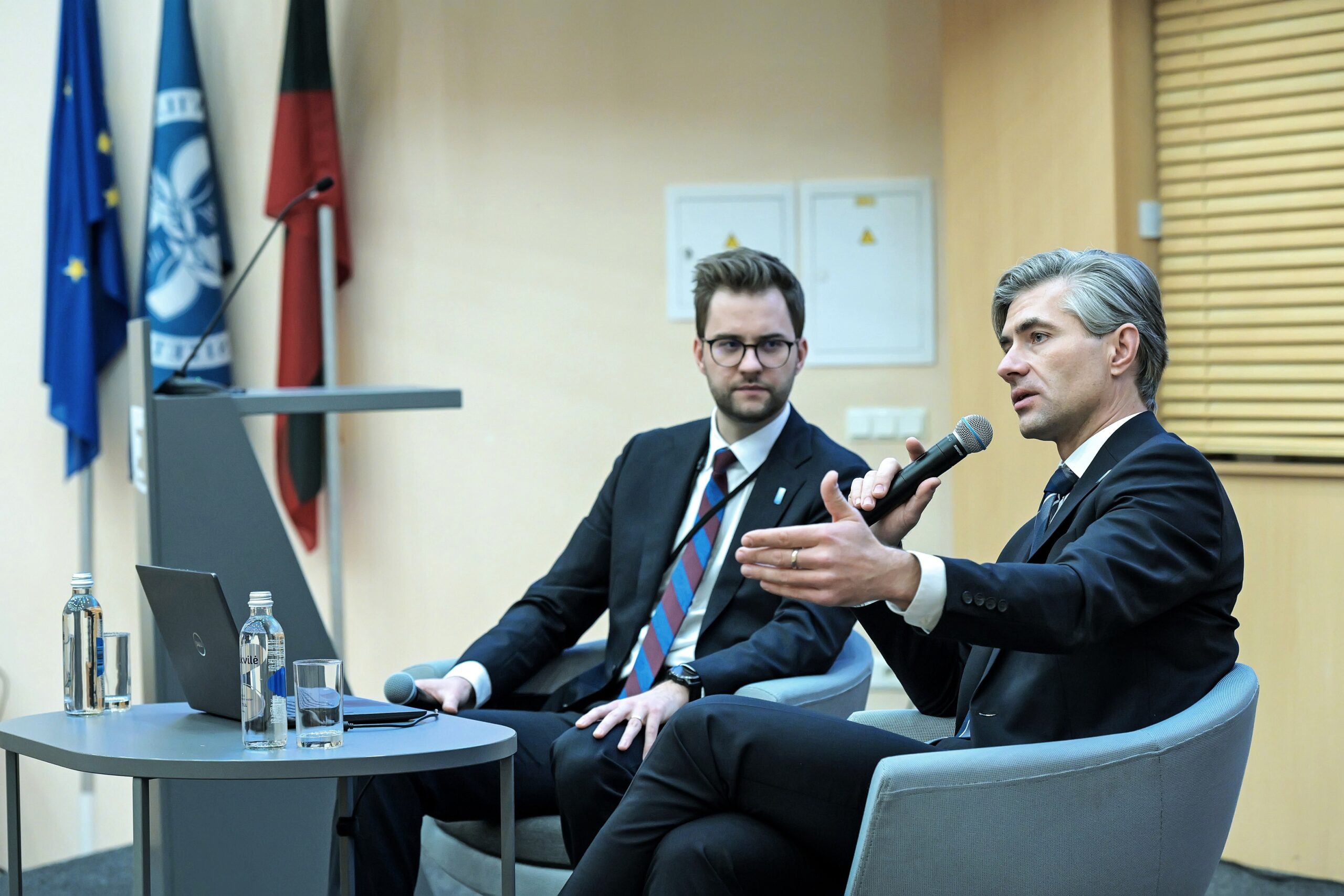
V. Jankauskas and K. Budrys
Speaking to students and members of the university community, the minister addressed concerns about regional security, explained how Lithuania and its allies are strengthening the country’s defence capabilities, and emphasised the importance of public preparedness and reliable information.
Lithuania’s security depends on preparedness and cooperation with allies
Assessing the current security situation in the region, Budrys pointed out that Russia’s war against Ukraine has fundamentally changed Europe’s security environment. The scale of the conflict, the number of casualties and the use of modern military technologies have created challenges that extend beyond Ukraine’s borders.
Lithuania also experiences the indirect consequences of the war. Recent incidents involving drones approaching or entering Lithuanian airspace have demonstrated how developments on the battlefield can affect neighbouring countries. According to the minister, such incidents highlight the need to strengthen air surveillance, improve alert systems and ensure that Lithuania can respond quickly to emerging threats.
“This is a collective effort. The purpose is to build resilience – the ability to respond quickly and ensure that our society is prepared,” he said.
Budrys also addressed concerns about the possibility of a direct military threat to Lithuania, emphasising that the current probability of such an attack is low. While Russia’s intentions remain a concern, the minister noted that it currently lacks the capabilities to carry out military aggression against Lithuania.
“We are not the target at the moment,” he said, adding that Lithuania’s NATO membership and close cooperation with its allies provide important security guarantees.
Public awareness and reliable information are part of national security
The minister also addressed the concerns of people who feel unsafe amid growing regional tensions. Drawing on his own experience as a parent, he emphasised that open conversations and clear information can help people better understand potential threats and respond appropriately.
He pointed out that preparedness does not mean expecting the worst. Rather, it means knowing what to do in different situations, understanding official instructions and being familiar with available safety measures. For example, people should know where to seek shelter during an alert and how to follow the recommended two-wall safety rule, which means putting at least two walls between themselves and the outside of a building.
Budrys encouraged students not to keep their concerns to themselves, but to discuss them with family members, colleagues and university representatives.
He also highlighted the importance of critical thinking when following international developments. Noting that many young people get their news from social media platforms such as TikTok, he urged them to question the sources of information and verify what they see online.
“Where did you get this information? Where did you read it? How does it work?” he said, describing the questions he regularly asks his own daughter.
According to the minister, if the authorities received credible intelligence indicating an imminent threat, the public would be informed immediately. He stressed that transparent communication is essential for building trust and ensuring that people know how to act.
Diplomacy remains essential despite growing global tensions
The discussion also touched on the future of diplomacy in a world where military conflicts are becoming increasingly frequent.
Budrys argued that diplomacy will remain indispensable, as all military conflicts ultimately require political agreements and negotiations to reach a lasting resolution. However, he acknowledged that the international environment is becoming more complicated as the global order shifts from a unipolar to a multipolar system.
He warned that fundamental principles of international law, including respect for sovereignty, territorial integrity and the peaceful resolution of conflicts, are increasingly being challenged.
Russia’s actions in Ukraine, he noted, undermine the international rules established after the Second World War. This is why Lithuania continues to seek international support for Ukraine and advocates for a just and lasting peace.
Lithuania seeks a stronger response to Russian hybrid threats
In response to questions about Russian sabotage operations, attacks on critical infrastructure and other forms of hybrid warfare, Budrys argued that these activities should be treated as a serious part of Russia’s broader military strategy.
Lithuania’s response, he said, should include increasing the political and economic costs of such operations for Russia. Among the measures he highlighted were further sanctions and efforts to designate Russia’s military intelligence service as a terrorist organisation.
Budrys emphasised that these threats are not limited to Lithuania or the countries on NATO’s eastern flank. All European countries need to assess their vulnerabilities and strengthen their ability to protect critical infrastructure and society.
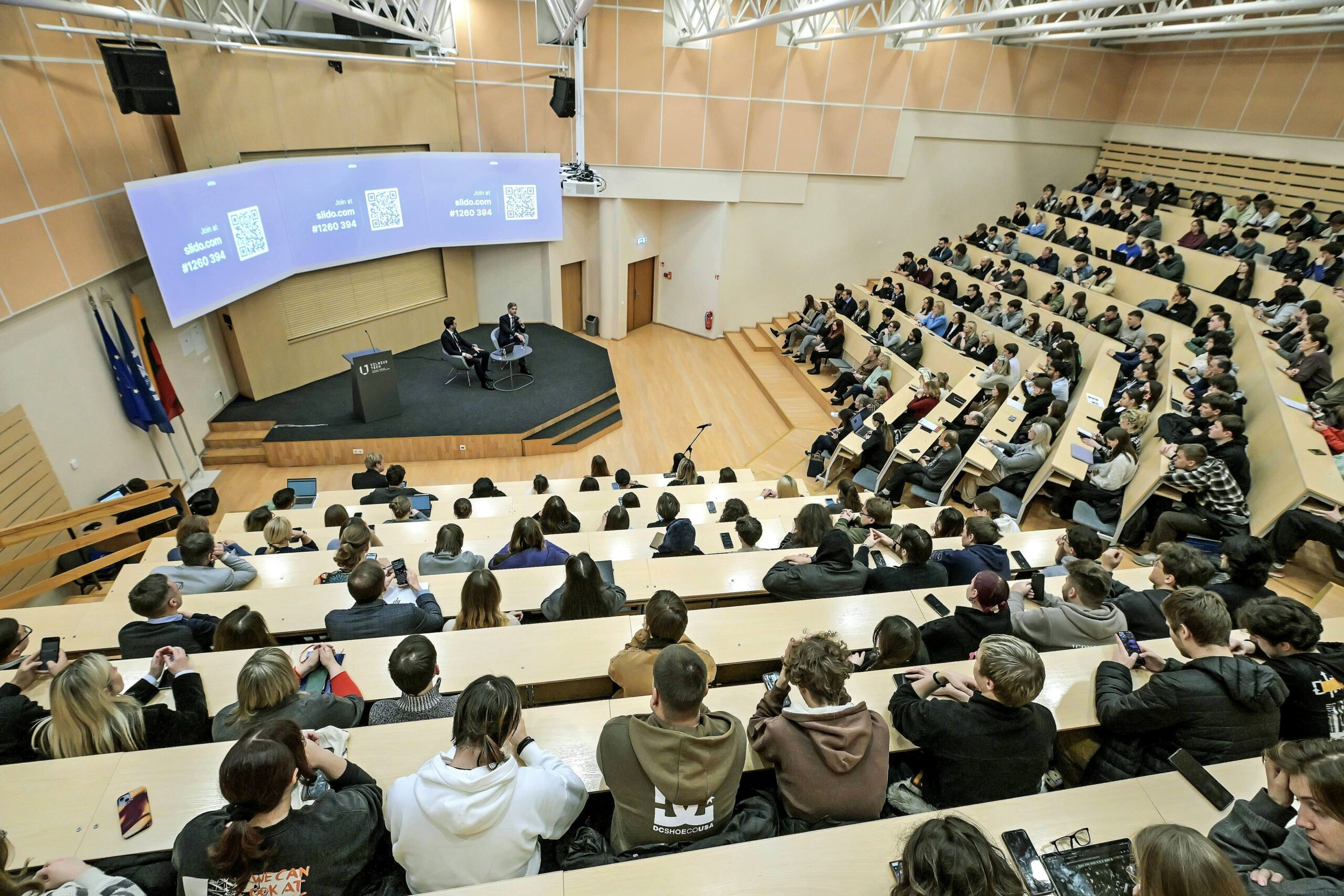
The conversation at VILNIUS TECH gave students an opportunity to raise questions about the issues shaping Europe’s security and Lithuania’s role in the international community. Throughout the discussion, the minister returned to one central message: security is built not only through military capabilities and international alliances, but also through public awareness, preparedness, resilience and the ability to respond collectively to emerging challenges.