
New doctoral dissertation

June 11, 2024
VILNIUS TECH Library invites you to follow the published new dissertations. The dissertation „Investigation of hydrodynamic and thermodynamic processes in the liquefied natural gas transportation and regasification system“ prepared by VILNIUS TECH, Vigailė Semaškaitė. The dissertation was prepared in 2019–2024. Supervisor – Prof. Dr Habil. Marijonas Bogdevičius.

The dissertation was defended at the public meeting of the Dissertation Defence Council of the Scientific Field of Transport Engineering in the SRA-I Hall of Vilnius Gediminas Technical University at 2 p.m. on 11 June 2024.

The research work concerns the current world energy situation, alternative fuels, specifically liquefied natural gas (LNG), and the minimisation of pollution, which is important in the transport sector. The technological analysis and theoretical investigations are applied to analyse hydrodynamic, thermo-dynamic and evaporation processes and determine hydraulic energy losses in LNG transportation and regasification systems, thereby increasing the technological availability of LNG terminals. The introduction presents the relevance of the research, its purpose, tasks, scientific novelty, and results obtained from theoretical research based on the technical parameters of the Floating Storage and Regasification Unit (FRSU) and the established technological regimes of the regasification process. It also specifies the significance of the dissertation’s topic, defensive statements, and a list of scientific publications published by the author. The first chapter analyses the transportation, storage and regasification technologies and challenges of LNG mathematical models. The chapter introduces LNG fundamentals, provides a global overview of the NG and LNG markets, and delves into transportation, storage, and regasification technologies, as well as mathematical models applied as technical solutions to evaluate technological problems. It focuses on the challenges associated with the thermal-physical properties of LNG that impact hydrodynamic and thermodynamic evaporation processes. The second chapter presents the analysis of FSRUs’ technical equipment and characteristics. It explains the estimation of LNG’s technical parameters and thermal-physical properties. The analysis aims to determine the technological parameters for creating theoretical mathematical models of LNG transportation and regasification systems. The third chapter considers mathematical models of the LNG transportation and regasification systems at an FSRU. The analysis of hydrodynamics, thermodynamics, and evaporation processes in the total LNG transportation and regasification systems was performed and adopted according to the researchers in this dissertation. Nine scientific articles focusing on the subject of the dissertation were published: three in scientific journals included in Clarivate Analytics Web of Science databases with IF; one in a scientific journal included in Elsevier Scopus databases with IF; one in Clarivate Analytics Web of Science Database Conference Proceedings; three in Elsevier Scopus Science Database Conference Proceedings; and two in peer-reviewed international conference materials.
 
Doctoral dissertation readers can search via VILNIUS TECH Virtual Library.
Related news

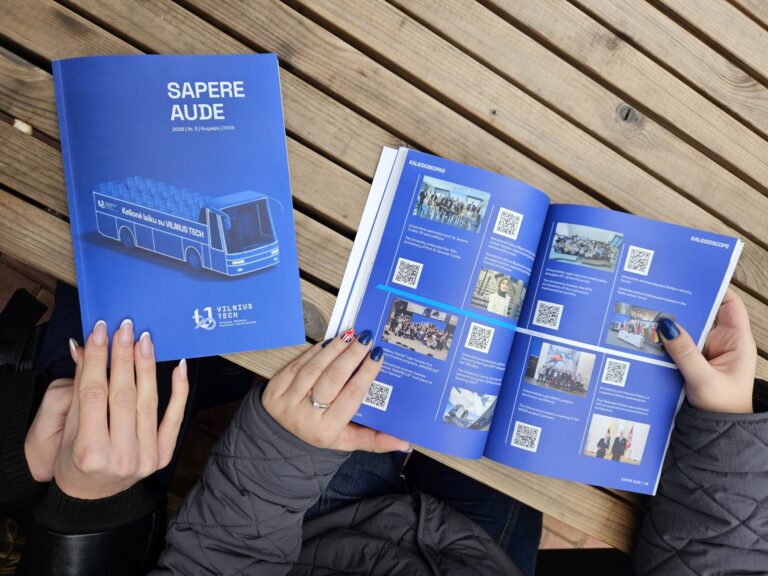
The new issue of Sapere Aude explores how scientists are shaping the cities
Artificial intelligence (AI), micromobility, the effects of climate change and smart infrastructure are transforming cities at an accelerating pace. This is why the autumn issue of Sapere Aude, VILNIUS TECH’s university magazine, focuses on „Cities and Technology“. The theme invites readers to see a city not merely as a physical space, but as a complex, constantly evolving system where science, engineering, data and human-driven innovation come together. Today, the future of cities is shaped by a wide range of disciplines, from transport engineering and urban planning to AI and communication research. The new issue of the magazine introduces researchers, students, alumni and other members of the university community whose work contributes to making cities safer, smarter and more sustainable. The issue opens with an interview with Prof. Dr. Simona Ramanauskaitė, the newly appointed Dean of the Faculty of Fundamental Sciences, who shares her perspective on the role of science, technology and the university in a rapidly changing world. One of the key themes of the issue is urban mobility and safety. Doctoral student Edita Juodvalkienė, supervised by Prof. Dr. Donatas Čygas, is preparing a dissertation on improving the traffic safety of electric scooters on urban streets. Meanwhile, alumnus Dominykas Eičinas is analysing suspension designs for micromobility vehicles. His final-year project has been submitted to a student research competition organised by the Ministry of Transport and Communications of the Republic of Lithuania. However, the challenges facing future cities extend far beyond transport. Gabriela Sokolovskaja, a graduate of the Architecture study programme at the Faculty of Architecture, explores how technology can help cities adapt to the challenges of climate change. In her final project, she examined how rainwater collection and reuse could become an integral part of climate-resilient urban planning and contribute to sustainable urban development. Smart technologies also play a vital role in shaping modern cities. Master’s student Laurynas Zalagas explores their application in urban infrastructure by developing solutions for monitoring street lighting systems using drones and AI. Other articles in the issue examine AI-based solutions for monitoring bee behaviour, human–AI interaction in visual communication, and the analysis of safe vessel passing in the Port of Klaipėda. Technological ideas within the university community are generated not only by researchers and students. The magazine also features young innovators from Ateities inžinerija (Future Engineering), a distance-learning programme whose projects explore solutions in environmental protection, design, transport and green energy. Their work demonstrates how engineering thinking and creativity can help address real-world societal challenges while students are still at school. The autumn issue also features interviews with VILNIUS TECH alumni now working at Lithuania’s national broadcaster LRT, as well as an introduction to the newly established Tech Fund, its vision and objectives. The new issue of Sapere Aude invites readers to see the city as a living, constantly evolving system shaped by people, science and innovation. The cities we will live in tomorrow depend on the decisions being made today in university laboratories, lecture halls and research projects. Read the latest issue of Sapere Aude here.
More
US and Lithuanian science and technology leaders meet in Vilnius
World-class experts from NASA, the Massachusetts Institute of Technology (MIT), Johns Hopkins University, the US innovation ecosystem, and Lithuanian public institutions gathered in Vilnius for the Lithuanian-American Science and Innovation Forum. The event aimed to strengthen transatlantic cooperation, promote technological leadership, and ensure the competitiveness and resilience of innovation. Assoc. Prof. Dr Artūras Medeišis, Dean of the Faculty of Electronics at VILNIUS TECH, also took part in the forum. Opening the event, Lithuanian Minister of Foreign Affairs Kęstutis Budrys emphasised that Lithuania and the United States share many interests in conducting scientific research and ensuring its practical application. “Lithuania is already renowned for its world-class expertise in photonics and laser technologies, life sciences, cybersecurity, and digital innovation. Cooperation would only increase the added value created by our researchers,” the minister said. US Ambassador to Lithuania Kara C. McDonald echoed his remarks. [caption id="attachment_133886" align="alignnone" width="2560"] Gregory Mann[/caption] One of the keynote speakers, Gregory Mann, a representative of the US space agency NASA in Europe, spoke about America’s ambitious plans to return to the Moon. He also emphasised that Lithuania, with its scientific expertise and technological capabilities, could contribute to future missions not only to the Moon but also to Mars. A discussion on how to turn a scientific idea into a functioning technology and transform an existing technology into a product with a strong presence on international markets brought together Angelos Angelou, founder and CEO of International Accelerator, a US business accelerator for foreign-founded startups; Dr Adler Archer, a researcher at the prestigious Johns Hopkins University; Assoc. Prof. Dr Artūras Medeišis, Dean of the VILNIUS TECH Faculty of Electronics; Dominykas Milašius, Head of Delta Biosciences; and Reda Nausėdaitė, Deputy Director for Innovation and Development at the Center for Physical Sciences and Technology (FTMC). A. Medeišis emphasised that researchers can achieve significant results when they have a clear plan, ambition, and vision, particularly when supported by government initiatives that facilitate cooperation with institutions such as MIT. “One of the most common challenges in establishing sustainable connections and developing cooperation is the need for funding, particularly when it comes to transatlantic collaboration. Unfortunately, there are few funding instruments available to support international and cross-border cooperation. We have now established a consortium together with MIT and other Lithuanian universities that can provide seed funding to develop collaboration across the Atlantic. This funding helps establish partnerships and launch joint projects,” said the VILNIUS TECH representative. [caption id="attachment_134004" align="alignnone" width="2560"] Artūras Medeišis[/caption] Another distinguished guest at the conference was MIT Professor Markus Buehler, who delivered a presentation entitled Materials Intelligence: AI, Creativity and the Future of Scientific Discovery. “Materials have a certain kind of ‘intelligence’ encoded in them through their structures, hierarchies, and interactions across different scales,” Prof. Buehler explained, illustrating how this idea manifests itself in biological materials, artificial intelligence, scientific discovery, design, and creative work. The forum also featured Prof. Gediminas Urbonas, who has built an impressive career at MIT. The Lithuanian-American Science and Innovation Forum was part of the programme of Lithuania’s International Science Week, * (re)SEARCH 2026*. The event was organised by the Ministry of Foreign Affairs of the Republic of Lithuania in cooperation with the Center for Physical Sciences and Technology (FTMC) and the Lithuanian Consortium for Cooperation with MIT.
More