
New surprise: students have developed a robot humanoid

August 19, 2015
Lately, a wide audience learned about the greatest invention of Edita Verbickaitė, student of Vilnius Gediminas Technical University (VGTU) – the technology, allowing printing orthopaedic inserts and splints on 3D printer. Now a new surprise of the students of this higher education institution: a team of three students of the Department of Mechatronics and Robotics have created a real robot humanoid, while preparing their undergraduate theses. Like many great ideas, this one broke unexpectedly, partly, because of students‘ habit to postpone everything until the last minute and because of a promise to Indian students.
“In autumn, everyone had to choose a topic and supervisor for the final thesis. As everywhere, the rule ‘‘first come, first served‘‘ was valid here, too. For those who were the last, only the teachers who did not deliver lectures and whom we did not know, were available.  Our friend‘s teacher Robertas Urbanavičius suggested not only to create a robot humanoid, existing in the drawings and 3D models, but make a real robot humanoid,‘‘ –  said Mindaugas Lučiūnas, one of the authors of the invention, about the prehistory of the robot creation.
A working team of students has been appointed, because we had to finish our Bachelor‘s thesis till spring, and the task of creating a robot humanoid was far more complicated than building a Lego car. Gediminas Liška and Vladislavas Rusinas were among others, and the head of the project was R. Urbanavičius, the Associate Professor of the Department of Mechatronics and Robotics of the Faculty of Mechanics at VGTU, coordinating many projects in applied mechanics, mechatronics and robotics, performed by the students of our faculty. He was often inviting foreign students to study in Lithuania, and once an Indian student said: “If you create a walking robot, there will be no doubts for us, where to study‘‘.
Although this project has not been fully implemented yet (the robot is standing perfectly well, maintains its balance, when pushed, but in the meantime, it does not walk), it is really an exceptional project in Lithuania.
“The result of our work is a 60 cm tall robot humanoid, with 25 degrees of freedom. Like a human being, it has the feet, the arms, and the head. We fitted a gripper as an end effector in the robot arms for grasping objects. His eyes can swivel from side to side, and the eyelids — to follow the eyes and move the eyelids.  Our aim was to create a good learning tool and research platform for our future students. It is also a great way to show how VGTU students implement their ideas, together with their theory studies,‘‘ – said M. Lučiūnas, who also explained that similar robots can help children with autism, people after a stroke with serious consequences and people with walking disabilities; they  can also compete in various sport events or even water flowers. Currently, the market price of such functioning robots starts from several thousand euros and goes steeply up.
VGTU graduate says that first of all, the newly set up team discussed the robot‘s weight, the materials from which they should produce it and the functions it should be able to perform. After that, they distributed their work: Vladislavas constructed the robot‘s arms, Gediminas – the feet, and Mindaugas – the head, according to the parts of the robot, to be more precise. Later, they analysed similar products, held discussions with teachers, made sketches, calculated the nodes, created the 3D models, produced the details and then the best part of the project followed – the assembly and testing of the robot.
M. Lučiūnas was happy to use the 3D printer at the University, so he had no problems with complex details. The biggest personal challenge for him was to install all necessary functions into a small head of the robot. According the guy who decided to continue his Master‘s studies in Mechatronics next academic year, the team spent all spare time for the improvement of their robot: they tried to force him walk, grasp objects, express emotions. Traditionally, they ran out of one night before the final presentation, for robot programming.
“Currently, our robot is standing, is able to manipulate things by hands, to turn head and eyes. The latest upcoming improvements should be equipping the robot with sensors, installing video cameras into the eyes, and gluing up several microphones, distance and tactile sensors. All these equipment will allow the robot to autonomously recognize the surrounding environment, avoid obstacles, grab and manipulate objects and react to the sounds and emotions of the surrounding people,‘‘ – said VGTU graduate about the possible future developments.
“We hope to continue our work with this humanoid robot. Though there is still a long way to the perfection, we have already made a great job, a good example for the younger students. The popularity of humanoid robots is increasing all over the world, so we could also be among the leaders,’’– adds the professor.
The supervisor of this exceptional project stressed the importance of performing a real, tangible work while a student – there is no wonder, they predict bright career prospects for the robot developers’ team who gained valuable scientific and teamwork experience.
Related news

Interdisciplinarity in practice: how Electronics and Medical Engineering students developed a Human motion analysis system
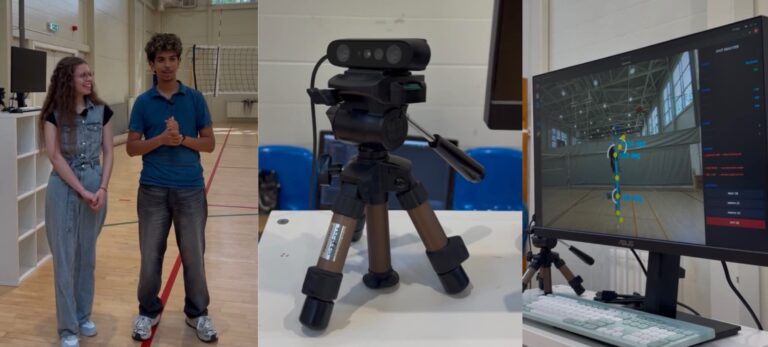
Modern engineering solutions are increasingly created through collaboration between specialists from different fields. The university environment provides an opportunity to combine diverse competencies and develop solutions that would be difficult to achieve within the boundaries of a single discipline. Such collaboration was also at the heart of a bachelor’s thesis project in which VILNIUS TECH students Laura Venckutė (Faculty of Electronics) and Abderrazak El Aamrani (Faculty of Mechanics) combined expertise in electronics and medical engineering to develop a human motion recognition and evaluation system. From an Idea to Interdisciplinary Collaboration At the beginning of the project, students from the Medical Engineering and Electronics Engineering study programmes sought to address a problem relevant to both sports and rehabilitation: the lack of accessible systems capable of automatically evaluating human movements and providing immediate feedback. As the project authors point out, incorrect movements can reduce training effectiveness and increase the risk of injuries during rehabilitation, sports activities, or everyday tasks. For this reason, they decided to look for a technological solution that could help objectively assess movement quality. The idea emerged from previous projects and experience gained during their studies, while an important catalyst was the opportunity for collaboration proposed by their supervisors. From the outset, it was clear that the project would require expertise from different fields, as motion analysis involves not only developing a technical system but also defining meaningful criteria for evaluating human movement. [caption id="attachment_120707" align="alignnone" width="2048"] Electronics and Medical Engineering students developed a Human motion analysis system[/caption] The students brought different, yet closely interconnected and complementary competencies to the project. The Electronics Engineering student was responsible for computer vision, embedded systems, and system integration, while the Medical Engineering student contributed expertise in biomechanics and human movement assessment. Although responsibilities were divided according to individual areas of expertise, key decisions were made collaboratively. From the Initial Concept to a Functional System In the early stages, the team planned to develop a system capable of analysing a broader range of movement patterns and performing more advanced analytical functions. However, as the project progressed, technical limitations, available hardware resources, and the scope of the bachelor’s thesis had to be taken into account. As a result, some ideas had to be abandoned. According to the team members, no major disagreements arose during the project. Decisions were made by discussing possible alternatives, evaluating how well they aligned with the project objectives, and, whenever possible, testing different approaches in practice. When technical and medical requirements conflicted, the team sought solutions that best balanced project goals and implementation constraints. The final outcome of the project is a human motion recognition and feedback system based on a pose estimation algorithm designed for basketball shooting analysis. The system detects a person in real time, estimates body posture, evaluates shooting technique according to biomechanical criteria, and subsequently provides feedback to the user. The Value of Interdisciplinarity and Future Opportunities During testing, the system performed better than expected. It successfully analysed the movements of users of different heights and maintained reliable performance at distances of up to 12 metres. According to the students, not only did the technical results exceed expectations, but the collaboration process itself also proved highly successful. In their view, such a project could theoretically be completed by a specialist from a single field. In practice, however, this would be difficult and inefficient. The project required both expertise in electronics and an understanding of human movement analysis. Without competencies from both fields, considerably more time would have been needed for learning unfamiliar topics and identifying appropriate solutions. Looking ahead, the students see opportunities to further develop the project by improving system stability, optimising resource usage, expanding the range of supported movement patterns, and increasing motion recognition accuracy. Although they are not yet certain whether they will continue working in this specific area, they hope to further deepen their expertise in related fields of technology and engineering. Supervisors’ Insights: Interdisciplinarity as a Foundation of Future Engineering The thesis supervisors emphasise that the nature of the project itself required collaboration across disciplines. However, the greatest value of the project lies not only in the technical solution that was developed, but also in the students’ ability to work together effectively. Professor Kristina Daunoravičienė, lecturer in the Medical Engineering study programme, notes that developing a human posture recognition and evaluation system requires both an understanding of human movement and biomechanics, as well as the ability to create a technical system capable of collecting, processing, and presenting information to the user. „The need for different knowledge and competencies made this topic an excellent platform for collaboration between Medical Engineering and Electronics Engineering students. Such projects foster not only technical solutions but also the ability to understand the logic, limitations, and priorities of other disciplines,“ says Prof. Dr Kristina Daunoravičienė. Although the students were initially unfamiliar with one another and came from different engineering backgrounds, a shared goal quickly became the foundation of successful cooperation. According to the supervisor, Medical Engineering contributed the perspective of human movement assessment and result interpretation, while Electronics Engineering provided expertise in system architecture, prototyping, and optimisation. According to Prof. Dr K. Daunoravičienė, the most important outcome of the project is not only the developed prototype and its comparison with the Xsens motion analysis system: „Equally important are the competencies of collaboration, communication, trust, initiative, and the ability to learn from one another. These are the qualities that allow good ideas to become real, functioning solutions.“ Associate Professor Dr Vytautas Abromavičius of the Faculty of Electronics also points out that in the era of artificial intelligence, technical expertise alone is no longer sufficient. Clear communication, the ability to understand specialists from different fields, and working together towards a common goal are becoming increasingly important. „This bachelor’s thesis demonstrated that our students communicated exceptionally well and were able to explain specialised professional terminology in a simple and understandable way. This mutual understanding enabled them to effectively combine knowledge from different disciplines and achieve an excellent result,“ says Assoc. Prof. Dr Vytautas Abromavičius. According to him, the need for interdisciplinary projects in modern engineering continues to grow. Every real-world product developed for the market consists of multiple interconnected components; therefore, a broader understanding of the problem leads to better product applicability and a more complete final outcome.
More
VILNIUS TECH Professor A. Čenys Represents Baltic States at Google Leadership Summit
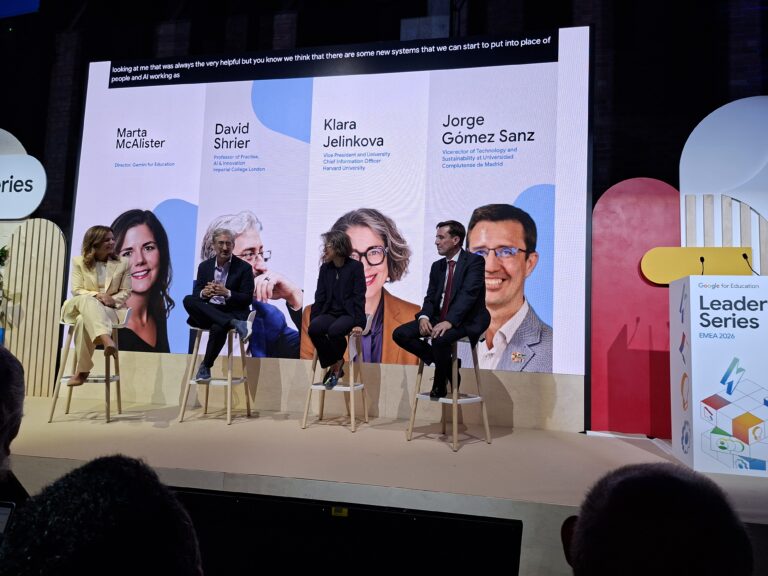
Prof. Antanas Čenys, a prominent researcher at VILNIUS TECH and the SustAInLivWork project, participated by personal invitation from Google in the exclusive Google for Education Higher Education Leader Series EMEA in London. Prof. Čenys was the only AI and cybersecurity expert from the Baltic countries to be personally invited to this high-level summit. The exclusive event brought together higher education leaders, technology pioneers, and innovation stakeholders from across Europe, the Middle East, and Africa. The summit focused on shaping the future of Artificial Intelligence, digital transformation, cybersecurity, and driving responsible innovation within the global academic and industrial landscapes. The insights and discussions from the London summit strongly resonate with the core mission of the SustAInLivWork project: strengthening Europe’s capacity to develop, deploy, and scale trustworthy AI solutions while simultaneously building the advanced skills, critical infrastructures, and innovation ecosystems required for a sustainable digital future. Through SustAInLivWork, VILNIUS TECH and its partners are actively delivering: An International AI Cluster: bridging the gap between research excellence, industry, and public sector stakeholders; Advanced Innovation Services: driving AI and data-driven solutions for various sectors; AI Skills Development: establishing lifelong learning opportunities and specialized training; Cross-Regional Collaboration: accelerating practical AI adoption and ensuring positive societal impact. The summit also underscored the rapidly growing importance of cybersecurity as a fundamental pillar for secure AI deployment. This focus perfectly aligns with ongoing initiatives led by VILNIUS TECH, including specialized cybersecurity skills development programmes supported by Google.org, aimed at strengthening digital resilience and cyber competence across Europe. As Europe accelerates its comprehensive AI transformation, structured collaboration between universities, industry leaders, policymakers, and major technology providers becomes increasingly paramount. SustAInLivWork and VILNIUS TECH remain committed to contributing to this evolutionary journey by building strong bridges between cutting-edge research, thriving innovation ecosystems, and sustainable societal progress.
More