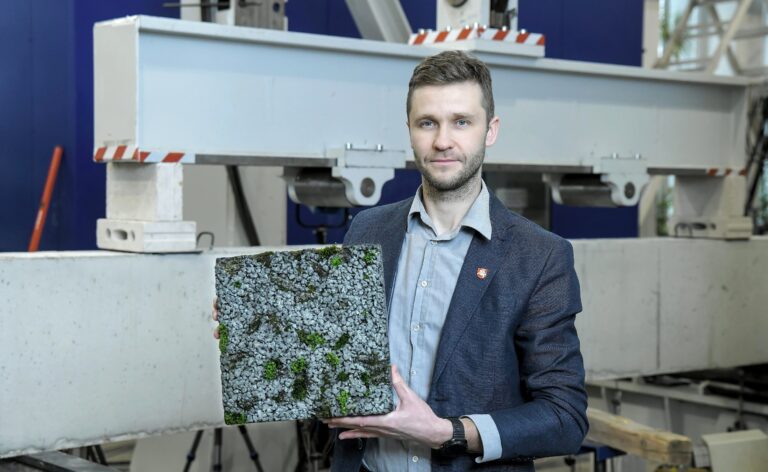
A new Competence Center for Smart and Climate-Neutral Manufacturing Processes, Materials, and Technologies has opened its doors at Vilnius Gediminas Technical University (VILNIUS TECH). This center will provide access to state-of-the-art scientific equipment, enabling advanced research, testing of innovations, and the development of industry-applicable solutions.
This center stands out due to significant investments in scientific infrastructure—EUR 17 million was allocated for its development. This is one of the largest investments in research infrastructure in the university’s history, helping to modernize the research base and strengthen VILNIUS TECH’s position as one of the most advanced universities and research centers in the region.
The Significance and Future Plans of the Center
To discuss the center’s importance and future plans, we spoke with Simonas Barsteiga, Director of the Competence Center for Smart and Climate-Neutral Manufacturing Processes, Materials, and Technologies.
How did the idea to establish this center come about?
Sustainability is a core value in the VILNIUS TECH strategy, serving as a response to the challenges posed by climate change. Alongside sustainability, the university also prioritizes creativity, innovation, openness, and connectivity. Connectivity and collaboration have long been key drivers of human progress. Today, as the pace of change accelerates, connectivity has become a crucial factor in successfully implementing projects and addressing cultural and digital challenges.
Lithuania has also emphasized the importance of connectivity by launching a national call for smart and climate-neutral mission projects. The goal is to unite science, business, and society in strengthening the circular economy and promoting the transition to climate-neutral solutions. The establishment of this Competence Center is a direct response to this initiative. Its concept was realized through a mission-driven science and innovation program, which not only facilitated the creation of modern infrastructure but also encouraged business partners to engage in scientific research activities.
What was the most interesting aspect of establishing this Competence Center?
The biggest challenge and the most exciting experience for me was turning seemingly impossible ideas into reality. One of the key missions of this center is to strengthen connections between different scientific disciplines at the university and ensure that every small step contributes to the broader innovation ecosystem.
It is a significant challenge, but also an invaluable learning and development opportunity. Every day presents new situations, sometimes extremely complex, but in the end, even the smallest step taken today can become a turning point. These small steps can drive major transformations for the university. The center is a place where everyone is invited to contribute to these changes.
What makes this center unique?
The Competence Center’s infrastructure opens opportunities to participate in ambitious international projects and attract top researchers and partners. This will allow us to develop new solutions aligned with the "Horizon Europe" program and the European Union’s Green Deal.
The uniqueness of the center is not just in its technologies or large investments. The key is to establish an innovation platform accessible to everyone. It must be an environment that fosters knowledge sharing and close collaboration between scientists, students, industry, and society. Only by achieving this level of openness and connectivity can we truly transform the future of VILNIUS TECH.
What is the significance of this center for the university, Lithuania, and the world?
In the future, an increasing number of projects will require a detailed assessment of their impact on climate neutrality. The financial value of greenhouse gas (GHG) emissions will need to be incorporated into cost-benefit analyses. Projects will have to align with the national energy and climate goals for 2030 and 2050. This will involve climate risk assessments, adaptation strategies, monitoring plans, and follow-up actions.
While we do not yet have all the answers, this center moves Lithuania closer to achieving its strategic goals—addressing societal challenges through innovation and fostering interdisciplinary collaboration.
Modern infrastructure will support the development of essential technologies and environmentally friendly products, directly contributing to GHG emissions reduction. By gaining new knowledge and competencies, we can become a catalyst for climate-neutral solutions and technologies in Lithuania. If we focus on collaboration, we could extend our impact globally.
How will the center operate?
The Competence Center is a university-level unit covering multiple research fields across different faculties. Its goal is to contribute directly to the university’s strategic objectives by integrating interdisciplinary research and experimental development (R&D) projects. The center’s operational model is based on openness and collaboration. Although officially the center has only one dedicated employee, its mission is to work with the entire VILNIUS TECH community—engaging faculty departments, research institutes, scientists, students, and administrative staff. This model enables the integration of diverse expertise, experiences, and competencies.
This is not a traditional team but a dynamic, decentralized structure where anyone contributing to the center’s activities becomes part of it and helps achieve the university’s strategic goals. This approach ensures that the center functions as a bridge between various sectors, creating opportunities to bring scientific ideas to life.
For such a decentralized team to succeed, a new approach to collaboration, information sharing, and management is required. We must reach a high level of openness and connectivity to meet our objectives and generate real added value for the university and society.
What are the future plans and projects of the Competence Center?
Over the next year, the center will be fully equipped with modern laboratory facilities to support innovative research and strengthen cooperation.
Currently, five major R&D projects are underway, focusing on developing innovative construction material prototypes:
-
Artificial lightweight aggregate made from recycled plastic for concrete mixtures;
-
Recycled plastic void-forming inserts for concrete and reinforced concrete structures;
-
Cement-free lightweight concrete mixture for structural elements;
-
Multifunctional mat made from recycled tire textile fiber waste.
Additionally, other solutions are being developed, including:
-
Noise-reducing barriers;
-
Hydrogen supply systems for conventional internal combustion engine vehicles;
-
Climate-neutral asphalt mixtures with reduced rolling resistance;
-
Efficient wastewater sludge treatment and purification technologies.
All innovative R&D activities at VILNIUS TECH will incorporate experimental design, mathematical modeling, statistical, theoretical, analytical, numerical, and scientific generalization methods applied integrally at the materials, technologies, and processes level.
In the future, VILNIUS TECH aims to integrate further into the international academic and research landscape by strengthening interdisciplinary collaboration within the university and with European research centers, universities, and industry leaders.
To remain competitive at an international level, special attention will be given to developing climate-neutral solutions and participating in climate change mitigation programs. The goal is to integrate as many VILNIUS TECH activities as possible to ensure successful participation in "Horizon Europe" and other EU-funded projects that support Lithuania’s and Europe’s strategic goal of becoming a climate-neutral continent by 2050.
We will not limit ourselves to existing fields. The center has no boundaries—we welcome all who want to contribute to our vision of becoming a catalyst for sustainable, smart, and climate-neutral solutions that inspire not only Lithuania but the entire world. This commitment requires collaboration and a continuous reassessment of how we operate and share knowledge to become more efficient, drive progress, and create value for society, our country, and the planet.