
On the Occasion of the International Day of Women in Science – Meet Three Generations of VILNIUS TECH Scientists

February 11, 2025
February 11th marks the International Day of Women in Science. Currently, nearly 43% of the entire VILNIUS TECH scientific and academic community consists of women who contribute to shaping the university, educating young professionals, and influencing the future of the world.

To celebrate this day, we invite you to get to know three scientists from different generations.

Emeritus Professor Dr. Marija Burinskienė – Learning Through Practice

 
Professor Dr. Marija Burinskienė has been working at VILNIUS TECH for 45 years—20 of which she led the Department of Urban Construction at the Faculty of Environmental Engineering. She holds the distinction of being the first and, so far, the only female emeritus professor at the university. After graduating with a degree in civil engineering from the Vilnius Institute of Civil Engineering (VISI) in 1977, she remained at the institution to this day.

Professor Burinskienė admits that she initially wanted to pursue architecture. However, fate led her to urban studies.

"I enjoy engineering urbanism. I like to think that I have some understanding of cities and can discuss and analyze them. I serve on both the arts and science commissions because I believe in versatility. Of course, some researchers dive deep into a single field and make major discoveries. My approach is slightly different—I believe urbanists cannot be specialists in just one area; they must have a broad perspective. The subject is too vast to be broken down into isolated parts," she explains.

For many years, Professor Burinskienė taught urban development, integrating real-life case studies into her lectures. This hands-on approach helped students better grasp challenges and practical solutions.

"While working at the Institute of Territorial Planning, I was involved in many projects, and I shared this experience with my students. I believe it is not enough to simply be a lecturer and rely only on textbook knowledge. When a professor is actively engaged in real projects and can transfer that knowledge to students, learning becomes truly alive."

Students, in turn, contributed to real-world projects, collaborating on the general plans of Lithuanian municipalities.

"We worked together to shape concepts, strategies, and visions for different municipalities. After all, not every region can focus on tourism or agriculture. It was crucial to consider residential areas, their development, industry, and changes in street networks," the professor recalls

The scientist recalls that she was often the only woman in many spaces—the only one in her department, the only female lecturer—and she constantly had to prove her abilities and worth.

"A man often assumes that just by showing up, he is naturally competent. But for a woman or a girl, intelligence still has to be proven. In general, when it comes to women in science, I believe that women tend to be more diligent and hardworking. They have to invest much more time, effort, and perseverance than men to prove they are capable. That’s why women often end up working longer and harder—on top of managing family and children."

As advice, the emeritus professor adds:

"Every person, every specialist, has an innovative spark. If you want to create something unconventional, something different, you have to approach it differently—you can't just replicate what has already been done. Your creativity and ideas should be reflected in planning, in the city, and in your decisions."

Kotryna Šileikytė: The Joy of Learning and Discovery


Kotryna Šileikytė is the head of laboratories at the Faculty of Mechanics, a lecturer in Welding, and a third-year PhD student. Currently, the young scientist is developing a real-time rehabilitation system.

"My goal is to create a system that allows doctors to instantly see numerical data indicating whether a person's body movements are within the normal range or if there are deviations. As the patient performs a movement, the system immediately shows whether it is executed correctly. This could help solve the issue of subjectivity, where a patient's condition may be underestimated or overestimated due to the examining specialist’s level of expertise, experience, empathy, mood, or well-being on that particular day," explains the PhD student.

Kotryna chose to study Medical Engineering (previously known as Biomechanics) out of her love for the natural sciences, and engineering itself is somewhat of a family tradition—both her grandfather and father studied at VILNIUS TECH (then known as VISI). She has no regrets about her decision, as working in the scientific field brings her the joy of discovery.

"I love the feeling of solving a problem, searching for an answer, and finally finding a solution. Of course, it doesn’t happen immediately—some equations need to be refined, modified, adjusted for variables, and so on. But when you finally get results, you feel like you’ve accomplished something."

Another aspect of her studies that brings her joy is meeting like-minded individuals, forming new connections, and gaining access to international opportunities.

Currently, K. Šileikytė teaches Welding at the Department of Mechanical and Materials Engineering. Her young age often surprises students, but it also helps her connect with them. After just one semester, students nominated her for an award in elections organized by the Student Union.

"Now that I’ve started teaching, I realize how important the connection with students is and how we, as lecturers, can present material in a way that makes it easier for them to understand. Especially nowadays, as each generation seems to be more sensitive and needs subjects to be explained and taught differently. In the past, lecturers were seen as superior, which made students afraid to ask questions. But now, teaching is more flexible, adapting to students' needs. I enjoy that students trust me, communicate with me, come to talk, and search for solutions together," says the lecturer.

For young women considering a career in engineering, K. Šileikytė offers this advice:

"Don’t be afraid to make decisions. Women are just as capable of solving engineering problems as anyone else. Don’t listen to external voices or stereotypes suggesting that women aren’t capable of understanding, calculating, or achieving in this field. Women can do everything just as well. I believe that if you trust yourself and know that you can do it, then you shouldn’t stop—keep going and pursue your goals."

Indrė Bernatavičiūtė: A Love for Bioengineering

"I have been interested in science since childhood because I was always curious—how does nature work? How does the human body function? Science helps answer fundamental questions about the universe, life, and human nature. That realization made me want to pursue a future in science and the knowledge it provides," says Indrė Bernatavičiūtė, a master’s student in Bioengineering.

Her passion for this field began in high school when university representatives introduced various study programs. Indrė recalls that the only word that truly caught her attention and stayed with her was Bioengineering. From that moment, she started researching study opportunities, the field’s benefits, and its future prospects.

*"I realized that bioengineering offers broad opportunities and encompasses many different disciplines. It allows scientists to contribute to cutting-edge medical technologies, improve people’s quality of life, and solve pressing issues—such as developing new medicines, addressing climate change, tackling food shortages, and creating sustainable energy sources.

I was also motivated by the constant evolution of this field. Every year, new technologies emerge, enabling the development of more advanced biomedical devices, tissue engineering solutions, and artificial enzymes for industrial use."*

Both during her bachelor's and now in her master's studies, Indrė has been conducting research at the Molecular Biotechnology Laboratory in the Faculty of Fundamental Sciences at VILNIUS TECH. The lab focuses on encapsulating bioactive compounds.

She recalls being immediately drawn to this research topic during her undergraduate studies, and after enjoying her practical work there, she decided to stay and continue her research at the master's level.

"For my bachelor's thesis, I studied the stability of the antioxidant activity of β-carotene-encapsulated particles. Now, in my first year of my master’s, I am researching natural dyes extracted from beetroot waste and developing transport systems for them. Both studies focus on protecting and stabilizing environmentally sensitive pigments that are beneficial to human health by encapsulating them in suitable materials. My current research on natural dyes from beetroot waste also aligns with the sustainable use of agricultural resources."

Encouraging More Girls in Science

When discussing how to encourage more young women to pursue science, Indrė believes that early exposure is key.

"We need to inspire girls to explore different scientific fields from a young age by developing engaging school programs, organizing hands-on workshops, and offering extracurricular activities like science clubs, robotics groups, or camps. Additionally, sharing the success stories of female scientists and engineers can help increase visibility and inspire leadership. Women should have more opportunities to speak at conferences, participate in expert discussions, and receive academic recognition. One of the most important things is ensuring that companies implement fair hiring and promotion policies based on competence rather than gender."

For young women considering a career in STEM, Indrė offers words of encouragement:

"Don’t be afraid to chase your dreams and do what you love. Believe in yourself, and don’t let anyone tell you that you can’t achieve something. The beginning might be challenging, but the more you learn and practice, the stronger you’ll become. Have faith that your knowledge will one day lead to new discoveries and open even more opportunities for the future."

Related news

From biological bridges to living facades: how civil engineers are reshaping cities
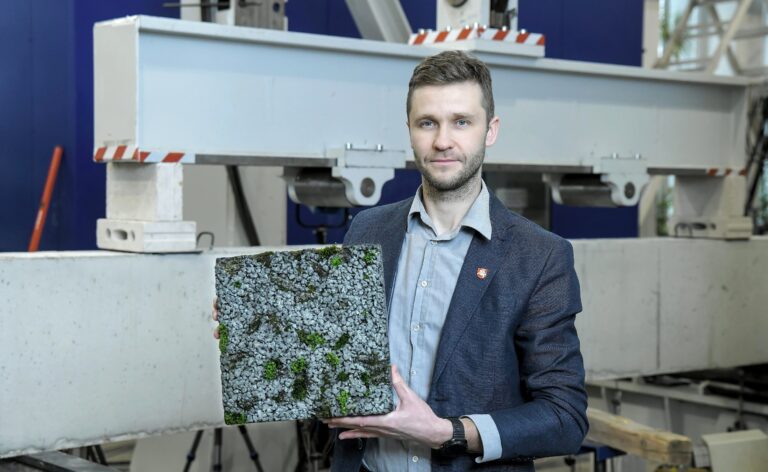
Modern buildings are no longer made of concrete and steel alone. Biology, artificial intelligence, and sustainable technologies are becoming an integral part of construction, transforming the way cities are designed and built. As technology advances and environmental awareness grows, civil engineers are developing innovative materials and construction methods that are more sustainable, durable, and environmentally responsible. One of these innovators is Assoc. Prof. Dr. Ronaldas Jakubovskis, a researcher at the Faculty of Civil Engineering at VILNIUS TECH, whose work is helping shape the future of urban environments. Turning Research into Real-World Structures Assoc. Prof. Dr. Ronaldas Jakubovskis serves as a Senior Researcher at the Laboratory of Innovative Building Structures, where his work focuses on developing advanced structural solutions through experimental testing, laboratory research, and numerical modelling. However, innovation rarely begins with a completely new idea. According to Dr. Jakubovskis, much of the research process is dedicated to analysing existing materials and construction technologies to understand how they can be improved. [caption id="attachment_88679" align="alignnone" width="2560"] Ronaldas Jakubovskis[/caption] „The most rewarding moment is when years of laboratory research become a real structure that can be built and experienced in a natural environment,“ he says. Although he works in academia, Dr. Jakubovskis sees himself primarily as a civil engineer supporting other civil engineers. While structural designers and project managers oversee the overall design of buildings and infrastructure – determining layouts, dimensions, and cost-effective construction solutions – researchers provide the specialised expertise needed to develop new materials and solve complex engineering challenges. „Practising engineers often don't have enough time to investigate highly specialised solutions or explore entirely new materials – that's where we come in. Sometimes we analyse complex structural behaviour through numerical modelling, and sometimes we investigate how emerging materials can be applied in construction. In my opinion, research engineers don't quite fit the traditional stereotype of scientists wearing white lab coats or solving abstract equations all day. Our work is highly practical—we often design, manufacture, and physically test new structural systems ourselves.“ Engineering That Leaves a Visible Legacy Among the projects he is most proud of is the Biological Bridge installed at the Kairėnai Botanical Garden, as well as the Living Concrete wall currently being developed for the rooftop of the Lithuanian National Drama Theatre. Both projects demonstrate how engineering can merge sustainability, science, and architectural design. „These projects represent the culmination of years of laboratory work and numerical modelling. They are demonstration structures that show what is possible when innovative materials meet advanced engineering. I also value their aesthetic qualities. Designing complex organic forms allows you to feel a little like a sculptor creating a work of art.“ Looking ahead, Dr. Jakubovskis believes his greatest achievements are still to come. His long-term vision is to create buildings with façades intentionally designed to be colonised by living organisms, allowing them to interact naturally with their environment while providing ecological and functional benefits. [caption id="attachment_88005" align="alignnone" width="2560"] Ronaldas Jakubovskis[/caption] „We are currently developing larger demonstration projects, seeking research funding, and expanding international collaborations. I believe that within the next five years, we'll be able to stand in front of one of these buildings and say: this is a significant achievement.“ A Profession That Will Still Matter in 100 Years For Dr. Jakubovskis, choosing civil engineering was an easy decision. Since childhood, he enjoyed watching buildings rise from the ground and observing construction sites and heavy machinery. „You don't need extraordinary dreams to become a civil engineer. If you want to build, you become an engineer. It's not like travelling to space or conducting research in Antarctica.“ What motivates him most is the opportunity to create structures that remain valuable for decades – or even centuries. „Every civil engineer feels proud when driving past a bridge or building they helped design, and they will always point it out to everyone in the car,“ he says with a smile. His own career began in structural design after completing his third year of university. He later pursued doctoral studies focusing on the cracking behaviour and deformation of reinforced concrete structures before returning to industry. Eventually, an invitation to rejoin VILNIUS TECH brought him back to academia. „I came back, and today I'm doing exactly what I truly enjoy.“ Advice for Future Engineers As both a researcher and lecturer at the Faculty of Civil Engineering, Dr. Jakubovskis emphasises that a university education is essential for anyone pursuing a career in civil engineering. „It would be extremely difficult to master this profession through self-study alone. Should you begin with theoretical mechanics, mechanics of materials, or structural mechanics? University programmes are carefully designed so that knowledge develops step by step, preparing graduates to become highly qualified professionals.“ He also offers practical advice to prospective students: „Don't be afraid of mechanics, physics, or mathematics. Every semester, identify a few key subjects, understand them thoroughly, and make sure you truly master them. Once those foundations are in place, everything else builds naturally.“ Industry Investing in Future Engineers Preparing the next generation of civil engineers is a shared responsibility between universities and industry. As digitalisation, artificial intelligence, and emerging technologies continue to reshape construction, employers increasingly recognise the importance of investing in future talent. The Faculty of Civil Engineering at VILNIUS TECH enjoys long-standing partnerships with the Lithuanian Builders Association (LSA) and the Lithuanian Association of Civil Engineers (LSIS), both of which actively support education and professional development. The Faculty's industry partners – including Hanner, Gilesta, and Alvora – offer scholarships to first-year Civil Engineering students, helping talented young people begin their studies. Other partners, such as Naresta, PST Group, HSC Baltic, and numerous construction companies, contribute by delivering guest lectures, presenting real-life projects, and inviting students to construction sites, where they gain first-hand experience of modern engineering practice. These close collaborations ensure that VILNIUS TECH programmes remain aligned with industry needs while providing students with practical knowledge, professional skills, and valuable connections long before graduation. Learn more about Civil Engineering studies at VILNIUS TECH and discover how you can help shape the cities of tomorrow.
More
Discover JSTOR: Explore Scholarly Journals and Primary Sources
With exams behind you and more time available for independent exploration, we invite you to take advantage of VILNIUS TECH’s subscribed database, the JSTOR Archival Journals and Primary Sources Collection. This collection offers not only scholarly articles but also original historical documents, images, primary sources, manuscripts, plant specimens, cultural heritage objects, and other unique materials. JSTOR also provides access to more than 4,000 academic journals covering a wide range of subjects, including literature, history, politics, psychology, economics, business, life sciences, natural sciences, the arts, and more. By combining scholarly articles and primary sources on a single platform, JSTOR makes it easier to discover new research perspectives, uncover unexpected connections across disciplines, and enrich both study and research activities. What can you discover in JSTOR? Nineteenth-century pamphlets on technological innovations and social change. Historical letters, speeches, and documents. Millions of plant specimens from around the world. Photographs, maps, and 3D models of cultural heritage objects. Works of art, posters, and historical photographs. More than 4,000 academic journals across a wide range of disciplines. Access is available from VILNIUS TECH computer network or via VPN. As a security measure, two-factor authentication is additionally required (i.e. verification from mobile device app or by call).
More