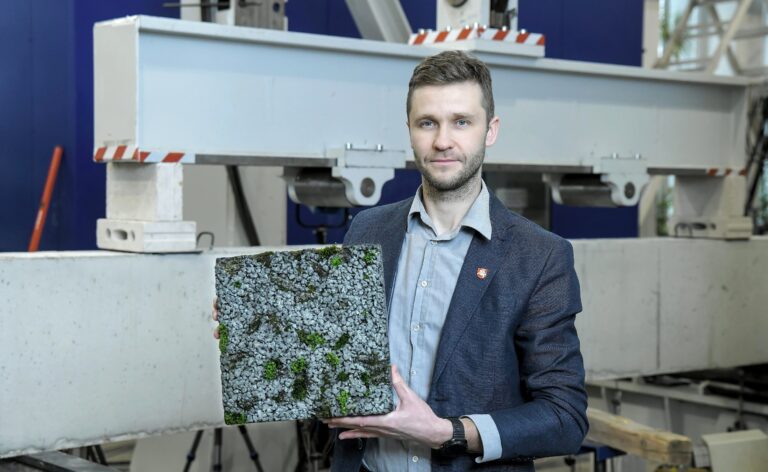
"Artificial intelligence, the Internet of Things are the keywords that in future will change everyday life and current skills. “In the future, we will need specialists with digital skills, building designers who will be able to design buildings and who will have knowledge of a building behaviour”, says Saulius Indriūnas, a graduate of Vilnius Gediminas Technical University (VGTU) in Civil Engineering. The popularity of this study field has been confirmed by the Government Strategic Analysis Centre. The Centre completed the analysis which revealed that civil engineering is one of the ten study fields the graduates of which earn the highest income. We have talked to S. Indriūnas about the changes in the construction sector, about current and anticipated challenges.
You graduated from Vilnius Gediminas Technical University with Bachelor's and Master's degrees in Civil Engineering. What made you choose the field of Civil Engineering?
I still do remember the school days when I had to make a paramount decision in my life – where and what I wanted to study. The choice of civil engineering studies at VGTU was determined by the fact that I had always been interested in mathematics, computer science, and physics. I was considering between civil engineering and information technology. I picked up civil engineering, but this choice was somewhat coincidental, as none of my family members had ever had any connections with the field of construction. Today, my work tasks are related to both construction and IT areas.
You are a project manager at the Lithuanian branch of the German company “Eisfeld Ingenieure AG”. Please, tell us about your first job and how your career unfolded, and you got to where you are now.
When I graduated from bachelor’s degree studies, I immediately started working for a building construction company and simultaneously studied for a master’s degree in civil engineering. I got a job in a small company. In my opinion, small companies usually stimulate the improvement of skills faster because you get involved into a great variety of different design processes. I started with simple drawing works, continued with static calculations, got acquainted with building physics. I enjoyed manoeuvring between the behavioural characteristics of the ropes – that was the subject studied at the university – and the real practical tasks at work.
Lithuania is a young country, therefore most of the standards and mathematical models we use in the field of construction calculations are based on the experience of West European countries. I decided to try my hand in Germany because I wanted to learn more and acquire more knowledge in the professional area while using the German language. I worked for almost five years in this country, and I think this period equals to my professional doctoral studies. In addition to classic design subjects such as reinforced concrete theory, building behaviour analysis, building information modelling (BIM), I had the German language course, management and even philosophy “lectures” on a daily basis and in my office. I am happy to have returned to Lithuania and being able to continue work for “Eisfeld Ingenieure AG”. My duties are to develop a team in Vilnius, exchange and share experience and practical skills between different countries.
Every year, the construction sector is supplemented with new innovations and trends. Getting to know them, tracking and adapting them to the local market is the job of a civil engineer. What does your work routine look like?
The German building construction division has started work in Vilnius very recently, so currently we are busy with a great number of administrative tasks. We see our activities in two directions. The first direction covers the day-to-day design services with the tools that are available today. The second direction is related to the establishment of the strategy for the digitization of our activities. We are considering what processes we could robotize today, what is not worth digitizing, and what our work process will look like in the long run. We follow the performance and achievements of other companies, learn from mistakes, monitor scientific innovations. We are currently in contact with VGTU experts on a product that would automate modelling processes with the use of machine learning and artificial intelligence methods.
What skills will future civil engineers need?
Artificial intelligence, the Internet of Things, intelligent materials and constructions – these are the terms that are often heard in the world media as well as Lithuanian media. In the future they will certainly change our everyday life and current skills. However, this transition will not be very sudden, especially in the construction industry.
Therefore, future civil engineers will need to be involved in this transition, they will have to shape it. They will have to combine classic methods of building design, construction and maintenance with new innovative approaches. They will have to learn to balance between professionals with different attitudes and perspectives, hear the arguments of different generations. They will not only have to compile lines of codes with the keys on the keyboard, but they will also need to handle a sheet of paper and a pencil well.