Updated VILNIUS TECH Digital Twin – We Invite You to Try It

February 10, 2025
The face and geography of the VILNIUS TECH academic campus have recently undergone noticeable changes: we’ve renovated the Saulėtekis and Old Town buildings, established new competence centers and laboratories, opened the Sustainability Center, and built new laboratories and teaching buildings for the Departments of Mechanical Engineering, Electronics, and Transport Engineering on Plytinės street – forming an innovation cluster. We are developing the Linkmenų building area, where historical buildings will be modernized, and in the Antanas Gustaitis Aviation Institute complex, we plan to open a new lecture hall building for students. All these changes, along with the future development prospects of VILNIUS TECH, inspired us to update and expand the 3D photogrammetric model of the VILNIUS TECH digital city (its visuals and content), which should be considered a digital twin.

This is the fourth version of the model since 2016, when the photogrammetric reality model of the former VGTU Saulėtekis campus was first introduced to the university community. Now, in the significantly updated VILNIUS TECH digital city, we have the Saulėtekis, Plytinės, and Linkmenų building areas, which will later be expanded to include the Vilnius Old Town buildings and the Lithuanian Maritime Academy’s campus in Klaipėda.

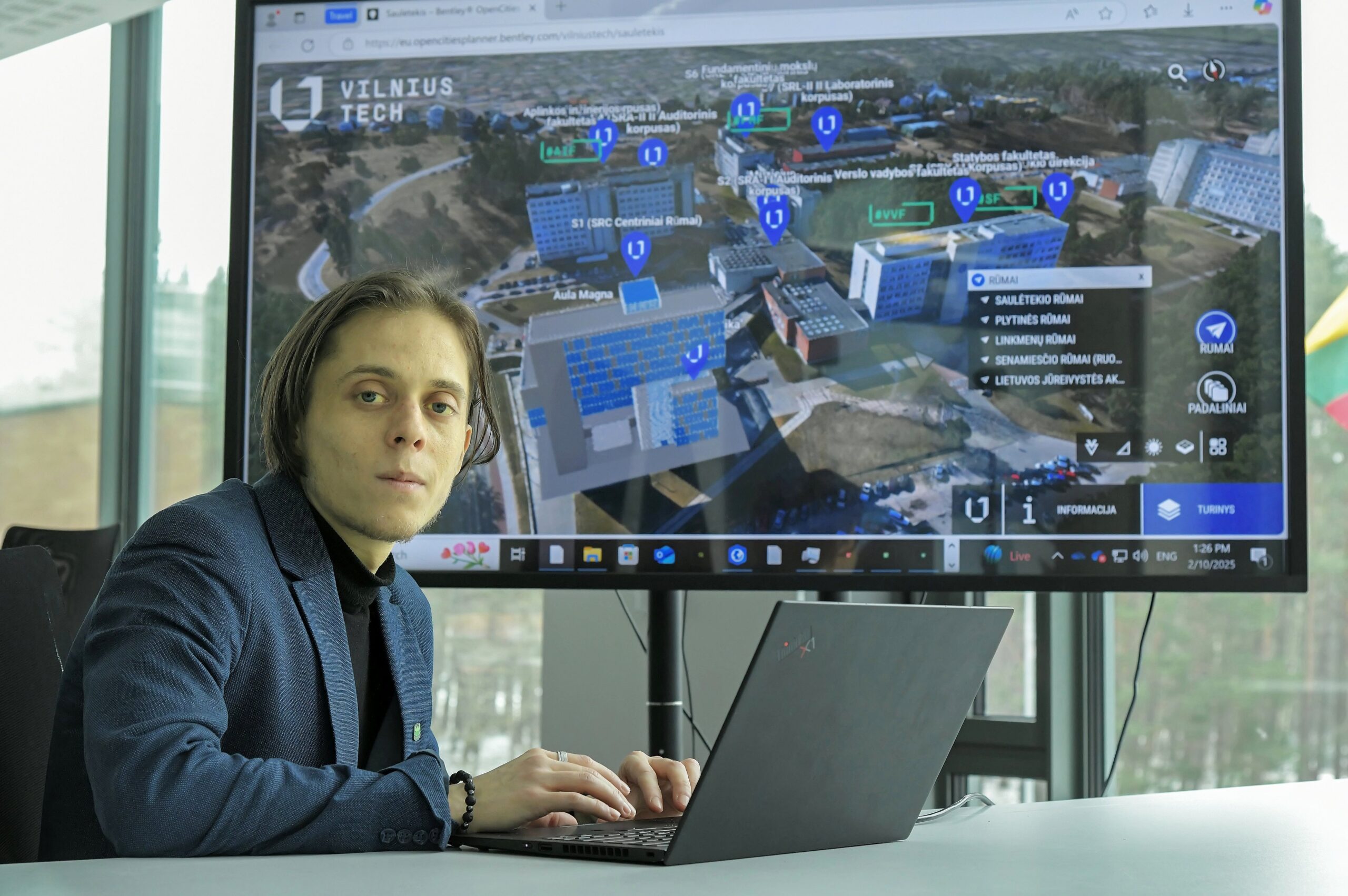
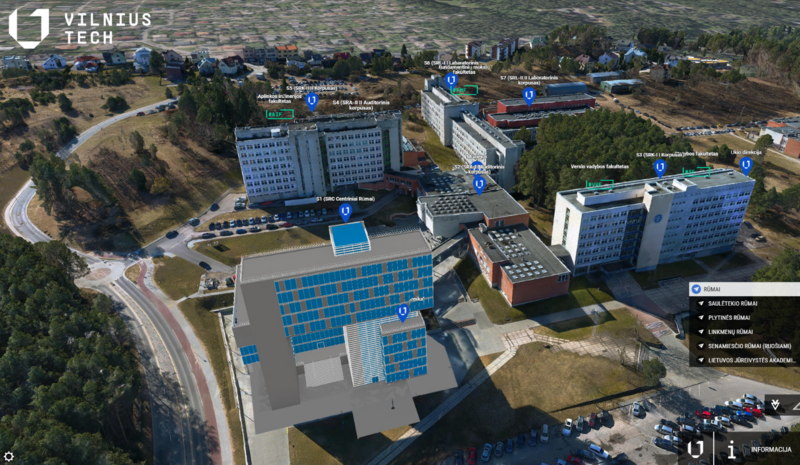
The main purpose of this project is to open the doors to a next-generation information portal designed for students, university departments, services, and guests. The search areas and points of interest have been organized based on the university's structure. These can be accessed through two content menu groups: buildings and departments. By selecting "Buildings," the user is instantly "teleported" to the building’s geographic location on the Vilnius city map and gains access to a variety of information about the buildings, their purposes, and the university departments located there. The “Departments” section visually helps to find the locations of all VILNIUS TECH structural units with accurate addresses and contact information. For user convenience, faculties, study and creative centers, directorates, laboratories, the library, the “Technika” publishing house, and the museum are marked in the model with visual icons (logos) to make the search and navigation easier. Of course, all student, staff, and guest dormitories are included in a separate menu section.

How Can the VILNIUS TECH Digital Twin Be Useful?

The models with their surroundings can be used for real estate maintenance and development projects, visual experiments, simulations, and games – for both everyday operational needs and for education and studies. For example, one of the main purposes of the digital 3D model is to create a modern professional environment for VILNIUS TECH’s property management operations. The model allows not only to visualize the managed property but also to conduct a full range of virtual experiments: observing the sun’s path and its visual effects with precision at any time of day and season, “walking” through the campus and inside the buildings (the "3D Tour AULA MAGNA" option is recommended), and performing measurements of lengths, areas, and volumes from any position, as it is a real 3D model.

The model can also be used effectively in the development of new projects – from architectural competitions to further project implementation based on traditional BIM scenarios (application cases for 3D, 4D, 5D models), property management, and technical maintenance needs. It only requires imagination. The fact that dreams are becoming reality is demonstrated by the work of VILNIUS TECH students integrated into the reality model. One example is the BIM model of the VILNIUS TECH central building (S1), created by Živilė Klibavičiūtė (SIMfm-17). Another project, a comprehensive design by the SIMfm-23 group for the "VILNIUS TECH Linkmenų building I and II reconstruction project, adapting the I building for residential use," won first place in the student category of the Lithuanian BIM Projects 2024 Digital Construction competition. The visuals of this project and other BIM models (such as the Plytinės building) integrated into the VILNIUS TECH digital city model can be viewed in the "BIM Models" section.

Where to Find the Updated VILNIUS TECH Digital Twin?

Click the location icon on the www.vilniustech.lt upper menu bar or go to this link: https://eu.opencitiesplanner.bentley.com/vilniustech/sauletekis 

We would like to thank the team at the Digital and Informational Building Modeling Technology Center, who are responsible for creating, updating, and maintaining the VILNIUS TECH digital twin model, as well as the AGAI Aerospace Data Center team who actively contributed to the realization of this project.

The photos show the VILNIUS TECH digital twin and one of its creators, Žygimantas Pagalys.


Galerija
Related news

New doctoral dissertation
VILNIUS TECH Library invites you to follow the published new dissertations. The dissertation „Investigation of recurrent neural networks-based methods for early fault detection and short-term power forecasting in wind energy applications“ prepared at VILNIUS TECH by Mindaugas Jankauskas. The dissertation was prepared in 2021–2026. Scientific consultant – Prof. Dr Artūras Serackis. The dissertation was defended at the public meeting of the Dissertation Defence Council of the Scientific Field of Electrical and Electronic Engineering in the Aula Doctoralis Meeting Hall of Vilnius Gediminas Technical University at 10 a. m. on 5 June 2026. The increasing role of wind energy in modern power systems creates a growing need for reliable turbine operation, accurate short-term power forecasting, and computationally efficient data-driven methods. This dissertation addresses two related problems: early fault detection in wind turbines using supervisory control and data acquisition (SCADA) time-series data, and short-term wind farm power forecasting using meteorological forecasts. The dissertation aims to develop and investigate data-driven methods that improve the accuracy, efficiency, and practical applicability of short-term wind power forecasting and early wind turbine fault detection using SCADA and meteorological forecast data. The first part of the dissertation develops and investigates a virtual-sensor-based method for condition monitoring and early fault detection in wind turbines using SCADA time-series data, including the selection of the most informative features and the evaluation of factors affecting prediction accuracy. The second part of the dissertation analyzes and optimizes recurrent neural-network structures for the virtual sensor by evaluating feature-sequence formation, training schemes, and alternative activation functions to increase accuracy and reduce the computational cost relevant for practical deployment. The third part of the dissertation develops and investigates a bidirectional long short-term memory (BiLSTM) based method for short-term wind farm power forecasting using meteorological forecast data, and evaluates the impact of different numerical weather prediction (NWP) sources and the suitability of an objective function with a normalized Nord Pool price multiplier for day-ahead energy production forecasts. The dissertation contributes to the fields of wind energy and artificial intelligence by proposing and validating data-driven methods for virtual sensing, residual-based early fault detection, recurrent-model optimization, computationally efficient activation-function selection, and economically meaningful short-term wind power forecasting. The research results have been published in three peer-reviewed scientific journals and one conference proceeding, and were presented at seven conferences and seminars. Doctoral dissertation readers can search via VILNIUS TECH Virtual Library.
More
Geopolitics is changing design priorities: infrastructure must withstand explosions too
Until recently, buildings were primarily designed to withstand conventional loads such as wind, snow, and everyday use. However, geopolitical developments in Europe and around the world are changing perspectives in Lithuania as well: the resilience of infrastructure to extreme scenarios, such as explosions, is becoming an integral part of the design process. Dr. Povilas Dabrila, a junior researcher at the Department of Steel and Composite Structures of the Faculty of Civil Engineering at VILNIUS TECH University, says that explosions are a rare but high-consequence threat, and traditional design approaches do not always account for such scenarios. [caption id="attachment_115773" align="alignnone" width="2560"] Povilas Dabrila[/caption] “The war in Ukraine has forced us to rethink many things. One of them is how we design, maintain, and protect infrastructure. For a long time, we focused mainly on conventional impacts: snow, wind, operational loads on buildings and bridges, and energy efficiency. Today, however, it is clear that infrastructure may also face far more dangerous scenarios, such as explosions or vehicle impacts,” he explains. According to him, infrastructure becomes even more important during crises, as people’s safety may depend on it. “Bridges, roads, buildings, energy facilities, and communication networks are essential not only for everyday life. If a bridge collapses or communications fail during a crisis, emergency assistance may not arrive in time. This is no longer merely a technical loss—it can cost lives. Therefore, infrastructure resilience today is not just an engineering issue; it is also a matter of public safety, crisis preparedness, and national resilience,” emphasizes Dabrila. What happens during an explosion? The researcher explains that the effect of an explosion on structures differs fundamentally from conventional loads. “An explosion affects a building extremely suddenly. A blast wave forms and, within a very short time, transfers significant pressure to the façade, windows, walls, and floors. What distinguishes an explosion from other challenging conditions is the duration of its impact. Snow loads a structure gradually over a long period, and even wind is not as sudden as an explosion. In the case of an explosion, the impact is felt almost instantly.” As a result, structures respond differently as well. “The key question is not only whether an element can withstand the load. What also matters is how it behaves under dynamic loading—how it deforms and whether it maintains its integrity.” According to Dabrila, explosions often first damage weaker elements such as windows, façade components, and non-load-bearing walls. The greatest risk arises when load-bearing elements are damaged, leading to more extensive structural failures. In such cases, collapse may occur. “In rare cases, localized damage can trigger a much larger collapse. For example, if a single column is damaged, internal forces are redistributed to other elements, which may also fail, causing the collapse to spread further. It is important to note that such situations are rare in ordinary buildings. Buildings are designed with safety margins, and regulations require the evaluation of structural safety and reliability.” Reducing the impact is essential According to Dabrila, blast resistance requires a comprehensive approach: both the resilience of the structure itself and measures that either increase the distance between the explosion and the building or reduce the impact of the blast. “A building’s resistance to explosions does not depend solely on stronger walls or columns. It is a system-wide issue: how the building is designed, how it behaves when damaged, and what additional measures reduce the impact before it reaches the structure. From a structural perspective, the most important thing is sufficient load-bearing capacity. If a column, beam, slab, or connection is damaged, internal forces should be able to redistribute to other structural elements. Then the failure of one element does not necessarily lead to the collapse of the entire structure.” It is also important to understand how the structure behaves under sudden loads. Explosion loads are extremely intense and short-lived, so engineers must evaluate not only whether a component can withstand the load but also how it deforms and whether the structure retains its integrity. Equally important are measures that reduce the impact itself. “These may include standoff distances, earth berms, concrete barriers, additional protective structures, screens, or nets. Their purpose is to move the threat farther away, block direct impact, or absorb part of the energy so that it does not reach the primary structure. We can see practical examples in Ukraine. The country employs various protective solutions, ranging from additional structural elements to protective nets that reduce the risk of direct drone strikes or other impacts.” How blast resistance is achieved According to Dabrila, designing structures that are more resistant to explosions involves solutions at several levels — from reducing the impact itself to strengthening the structure. “The first goal is to reduce the impact before it reaches the building. This can be achieved through standoff distances, concrete blocks, earth berms, barriers, protective fences, anti-drone nets, or additional structural installations. At the same time, the most critical structural components — columns, slabs, walls, and connections — are strengthened. This can be done using steel, reinforced concrete, composite materials, or additional bracing.” Energy-absorbing systems are also used, including protective panels, multilayer façades, and composite modules. Their purpose is to absorb part of the blast energy and reduce damage to the primary structure. According to Dabrila, digital technologies make it possible to evaluate potential scenarios in advance. “Modeling is also extremely important. Today, numerical models allow us to evaluate how a building or its individual elements would behave during an explosion, impact, or another extreme event. This enables us to base decisions on calculations and testing rather than assumptions. In the future, I believe we will see more lightweight, easily installable protective systems — for example, multilayer composite modules that can be used to protect existing buildings and infrastructure.” Science is seeking practical solutions Dabrila explains that research in this field is focused not only on theory but also on practical applications in infrastructure design. The Faculty of Civil Engineering at VILNIUS TECH studies how structures and materials behave under complex loading conditions. “Our research focuses on structural resistance to extreme loads and the development of lightweight multilayer composite systems. We are looking for solutions that could provide additional protection for buildings, bridges, and other infrastructure against impacts, blast waves, high temperatures, and similar threats. One area of research involves protective composite modules that could be installed on existing structures and serve as an additional protective layer.” According to him, both the materials and their internal structure are important. “Different layers, materials, and internal geometries can be combined, including energy-absorbing structures. The goal is to make the protection as lightweight as possible while maximizing energy absorption.” Experimental testing conducted at the faculty helps researchers understand the real behavior of materials, while numerical modeling allows this knowledge to be applied on a larger scale. “Through testing, we observe how materials actually deform and fail. Modeling allows us to scale those results up — for example, evaluating not only a small specimen but also a structural component or a real-world structure. Such research is important because it can lead to practical recommendations: which materials to choose, what layer configurations to use, how to attach protective modules, and where protection would provide the greatest benefit.” The goal is to control damage Dabrila stresses that it is impossible to make buildings completely resistant to explosions. Everything depends on the size of the explosion, the distance from the blast, the building’s structural system, the surrounding environment, and how the impact reaches the building. “The primary objective is usually not to make a building ‘indestructible’ but to control the damage. This means setting clear priorities. The most important goals are protecting people, preventing sudden collapse, reducing damage, and, if possible, maintaining critical functions.” In Dabrila’s view, assessing infrastructure resilience against extreme scenarios has not yet become common practice in Lithuania. Explosions and other extreme scenarios are typically considered only for specific types of facilities. However, changing circumstances are also changing design priorities. “There is increasing discussion about civil protection, critical infrastructure security, and the resilience of facilities under crisis conditions. As a result, this topic is gradually moving from a narrow specialist field into a broader engineering and national security issue.” He notes that much still depends on the client’s perspective. “Such solutions often involve additional costs, while their benefits become apparent only during a crisis. As a result, it can be difficult to justify the investment, especially when the primary focus is minimizing construction costs.” Nevertheless, he believes that building resilience should be viewed not as an extra expense but as a risk management measure. “Resilience is not a luxury — it is risk management. Not every project requires the most expensive solutions, but critical facilities should be subject to higher standards. Sometimes even simple measures — better site planning, protective barriers, or strengthening critical structural elements—can significantly reduce risk.” In his opinion, infrastructure security will increasingly be viewed as part of national resilience. “Whether such solutions become a standard part of the design process will depend on clients’ attitudes and on clear requirements and methodologies. Designers need to know when such scenarios must be assessed and how to evaluate them. I believe that, at least for critical infrastructure, such assessments should become standard practice. Not every building requires the same level of protection, but the most important facilities should be designed with extreme scenarios in mind.”
More