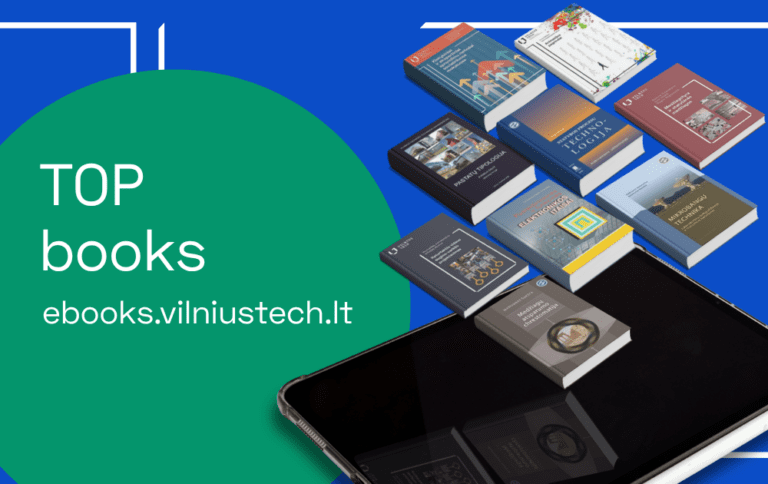
The most popular books on the VILNIUS TECH electronic book platform
On the VILNIUS TECH electronic book platform ebooks.vilniustech.lt, you will find a variety of books tailored for studies, scientific research, professional development, and personal growth.
For members of the university community, electronic versions of all books published by VILNIUS TECH are available free of charge. Institutional users can access these e-books at no cost by logging into the university’s network, either on campus or remotely via VPN.
To read e-books offline, install the Mon`k app and, while connected to the university network, download the books you need to your device. Once downloaded, they can be read without an internet connection. The Mon`k app is available on the Google Play Store and the Apple App Store.
We invite you to explore the most popular and widely read publications on the VILNIUS TECH electronic book platform ebooks.vilniustech.lt this year:
Animacijos pagrindai
(Fundamentals of Animation)Tomas Mitkus, Vaida Nedzinskaitė-Mitkė
This textbook provides a comprehensive introduction to the principles of animation, encompassing creative processes, production workflows, and the management of animated projects. The first chapter familiarizes readers with key concepts and terminology, offers a concise overview of the historical development of the animation industry, and presents significant research insights alongside future trends.
The second chapter examines the core theories and practices of animation production, with particular emphasis on established methodologies for managing large-scale projects within the global animation industry. The third chapter explores animation as an artistic practice, outlining its principal creative dimensions, key professional roles, and the specific nature of their work.
While primarily intended for students of animation, this textbook will also be of interest to practitioners and scholars across the wider creative industries in which animation constitutes an integral component of the final product, including video games, visual effects, film, and related fields.
Naratyvą turinčių kompiuterinių žaidimų dizainas: teorija ir praktika
(Design of Narrative-Driven Video Games: Theory and Practice)Ingrida Leščauskienė, Tomas Mitkus, Vaida Nedzinskaitė-Mitkė
This book introduces readers to the fundamental principles of narrative-driven video game design. It explores the nature of player motivation, the structure and function of game rules, core and meta-mechanics, as well as the design of game environments and characters. It further examines the methods and tools used in the development of both traditional and interactive narratives. In addition, the book highlights the importance of understanding player psychology, outlines strategies for enhancing player engagement, and discusses the types of user interfaces best suited to support these aims.
The textbook is primarily intended for higher education students studying video game design. However, it will also be of value to aspiring game designers and to anyone interested in gaining a deeper understanding of the complexity of video game design.
Medžiagotyra ir statybinės medžiagos
(Materials Science and Construction Materials)Ramunė Žurauskienė, Asta Kičaitė, Džigita Nagrockienė
The book presents the theoretical foundations of the topics covered, focusing on the most important methods used in materials science and in the testing and calculation of construction materials. It also describes the procedures for conducting laboratory work, outlines the methods and equipment used, and explains the ways in which results are presented. In addition, each chapter includes a list of key questions related to the topic under study. The book has been prepared in accordance with currently applicable standards in Lithuania.
This publication is intended for students of the Faculties of Environmental Engineering and Civil Engineering at VILNIUS TECH. It may be used by students enrolled in part-time evening, part-time distance, and full-time study programmes in the fields of materials science and construction materials.
Statybos procesų technologija
(Construction Process Technology)Titas Dėjus
This publication provides the theoretical material required to solve ten problems in construction process technology, along with descriptions of algorithms for solving practical tasks and worked examples that include all data necessary for each solution. A test is also included. For each problem, 30 sets of initial data have been prepared, and the relevant references are provided.
The publication is intended for students of construction engineering who are involved in the design of construction sites and the planning of construction technological processes taking place on them.
Medžiagų atsparumo chrestomatija
(Chrestomathy of Strength of Materials)
Marijonas Šukšta
The textbook concisely presents the main topics of strength (mechanics) of materials. The publication systematically covers cases of deformation: tension, compression, shear, torsion, bending, and combined deformation. Alongside these cases, it provides the theory for calculating geometric properties of cross-sections, as well as methods for mechanical testing of materials. The fundamentals of stress and strain state theory are also briefly presented, and this knowledge is used to formulate failure hypotheses and theories. The book includes engineering-relevant special cases of deformation such as stability (buckling), fatigue, and dynamic loading. Theoretical concepts are illustrated with detailed applied examples. Each chapter ends with review questions. The appendix contains assignments for independent work.
The textbook is intended for students of various engineering programs and study formats who are taking courses in mechanics of materials.
Kiekybiniai ir ekspertiniai sprendimų metodai socialiniuose moksluose
(Quantitative and Expert Decision-Making Methods in the Social Sciences)Viktorija Skvarciany, Laura Gudelytė-Žilinskienė, Renata Činčikaitė, Milena Seržantė
This publication examines statistical methods applied in social science research. It discusses methods of descriptive statistics, statistical hypothesis testing, regression analysis, forecasting models, and multicriteria decision-making techniques, among others. Special attention is given to variance, factor, and cluster analysis methods, which enable the identification of data structures and underlying patterns. Each chapter is illustrated with practical examples demonstrating how these methods are applied in real-world research.
Significant emphasis is placed on the use of statistical software packages such as SPSS, STATA, MS Excel, and EViews. These tools enable efficient data analysis, result visualization, and a wide range of computational procedures. Readers will find detailed algorithms and step-by-step instructions for performing analyses using the aforementioned software, as well as tasks based on real datasets that encourage critical thinking and the practical application of acquired methods.
The textbook is intended for first- and second-cycle students of social sciences who seek to develop a solid foundation in statistical analysis and to apply various methods in practice using different statistical software packages.
Mikrobangų technika
(Microwave Engineering)Valdas Daškevičius, Kazimieras Maceika
This publication provides knowledge on microwave engineering devices and their simulation using the Microwave Studio software package developed by Computer Simulation Technology. It describes the principles of working with the software, as well as tools for presenting and processing simulation results.
The book examines electromagnetic wave propagation modes and resonant phenomena in rectangular and coaxial waveguides. It also covers the modelling of symmetric stripline and microstrip transmission lines, as well as basic and directional antennas. The aim is to provide students with a deeper understanding of processes occurring in microwave devices without the need for expensive hardware equipment.
This publication is intended for undergraduate students in electronics engineering programmes studying microwave engineering.
Puslaidininkinės ir funkcinės elektronikos įtaisai
(Semiconductor and Functional Electronic Devices)Stanislovas Štaras
This book presents the fundamentals of semiconductor physics, along with essential knowledge of semiconductor devices and integrated circuits. It also covers devices used in acoustic, optical, and magnetic electronics, as well as information display technologies.
The textbook is intended for undergraduate students studying electronics engineering, automation, computer science, and telecommunications engineering.
Keturtakčio vidaus degimo variklio projektavimas
(Design of Four-Stroke Internal Combustion Engines)Romualdas Juknelevičius, Alfredas Rimkus
This textbook presents a comprehensive methodology for the design of four-stroke internal combustion engines, based on thermal, kinematic, dynamic, energetic, ecological, and structural performance indicators. It includes methods for calculating the strength of key engine components, taking into account fatigue and cyclic loading effects, as well as information on material selection and properties.
The publication also covers the calculation of key parameters for cooling, lubrication, and gas distribution systems. In addition, it introduces the AVL BOOST numerical simulation software and provides a computational methodology for analysing thermodynamic processes occurring within the engine. Requirements for academic documentation and technical drawings are also presented, based on applicable DIN and ISO standards.
The textbook is intended for undergraduate and postgraduate students in Transport Engineering and Aviation Mechanical Engineering. It supports the preparation of coursework projects and final theses related to engine design. It is also a useful resource for doctoral researchers in engineering sciences working on the energetic and ecological performance of internal combustion engines and conducting numerical simulations. The book may additionally be used by college students, lecturers, engineers, and professionals in the field.
Pastatų tipologija. Pirmoji dalis
(Building Typology. Part One)Gintautas Blažiūnas, Nijolė Bučiūtė, Gintaras Čaikauskas, Vytautas Dičius, Sigitas Kuncevičius, Lada Markejevaitė, Saulius Mikštas, Rolandas Palekas, Leonidas Ziberkas
The first part of this textbook describes the typological characteristics of residential buildings and selected public buildings, and provides an overview of their design requirements.
The book is intended for students of architecture and construction-related study modules.
More