Vasiliauskaitė: "Mass tourism brings more harm than good to the city in the long run"

February 4, 2025
Some cities around the world are facing the challenge of providing a quality living environment for huge numbers of inhabitants, while others are struggling with the threat of extinction. The category of endangered cities includes not only small towns like in Lithuania, but also well-known, touristic cities around the world. Can mass tourism be a salvation for small towns, or on the contrary, a danger to all cities?

Greta Vasiliauskaitė, a graduate of the Faculty of Architecture at Vilnius Gediminas Technical University (VILNIUS TECH), has been studying the phenomenon of the city-museum in the case of Venice, and her thesis has been awarded as the best Master's Thesis in Arts for 2024 at the Lithuanian Young Scientists' Union competition.

"The biggest revelation for me was to understand how a city-museum can have two very different sides: on the one hand, it is a place where tourism stimulates the economy, and on the other hand, it can stifle the life and togetherness of the local community. The study showed that the main problem is not only the high number of tourists, but also the uneven use of the city's zones, with active sites being overcrowded and passive ones going almost unnoticed. This was the impetus for me to look for solutions to bring the less used areas of the city into life and to relieve the tension in the active spots," says Vasiliauskaitė about her research in Venice.

Assoc. prof. dr. Inesa Alistratovaitė-Kurtinaitienė, thesis supervisor, points out that the effect of mass tourism brought about by globalisation can either help a city develop or start destroying it: "The constant influx of visitors not only increases the cost of living, but also contributes to the deterioration of the historical centre's cultural and social fabric. This is particularly evident and relevant for historic cities – unique in terms of location, character, architecture, etc., such as Venice, Dubrovnik, Amsterdam, Barcelona, etc. In this context, Venice is a particularly exceptional city. Venetians are forced to move off the island when they are unable to find affordable housing, the services and spaces they need. This is leading to a rapid depopulation of the historic centre, which is on the verge of decay. The city centre is in danger of becoming a museum – a much-visited but dead artefact."

Vasiliauskaitė points out that tourism can, however, provide additional economic opportunities for small towns, as it can attract additional investment as the town's visibility and visitor numbers increase. However, she also notices that it is mass tourism that is unlikely to save such towns. "Excessive and sudden increases in visitor numbers can disrupt urban infrastructure, create social tensions and damage local identity. Mass tourism does more harm than good in the long run compared to slow and sustainable tourism. Sustainable tourism, which focuses on quality and smaller groups of tourists, can be more effective in promoting local culture and small businesses," says the Master of Architecture.

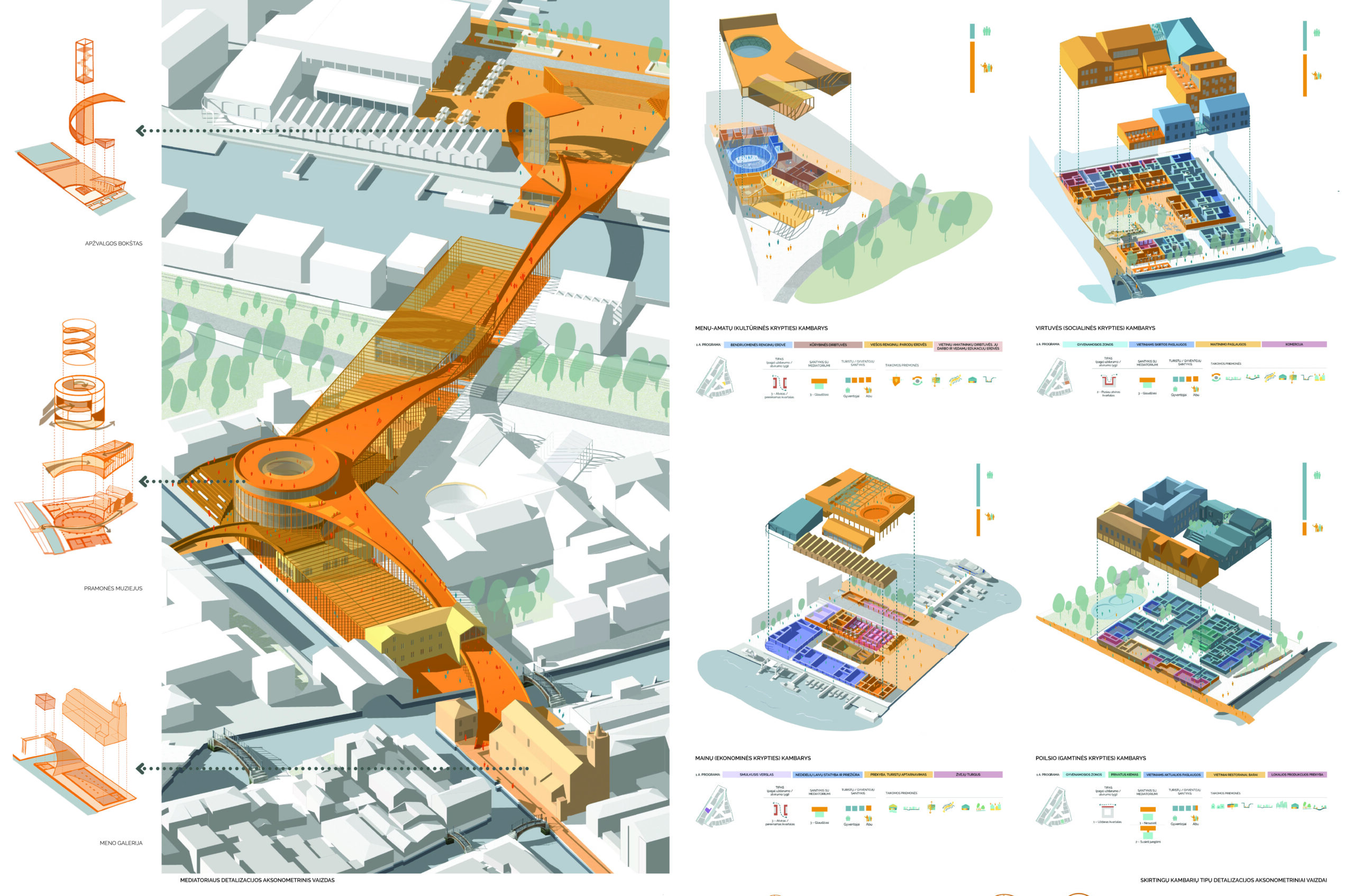
In addition to her studies, she took part in 6 architectural-urban design competitions and studied for a year in Venice (Università IUAV di Venezia) through the ERASMUS+ exchange programme. On her return, she proposed a thesis on cities-museums. She carried out an analysis of the promotion of urban vitality and drew up a matrix of practical tools, including universal approaches to improving the urban environment, which can be applied to different areas facing various challenges, such as environmental aesthetic and functional problems or the demographic and economic crisis.

"After assessing the area's problems, measures are selected from the five development axes proposed in the matrix: cultural, social, economic, communication and natural. The aim of these measures is to create an attractive environment for all users, especially local residents, so that they can live, work and play in an environment where they feel safe, comfortable and inspired to contribute to the growth of their city", says the urban designer. Vasiliauskaitė has put her research into practice and developed proposals to promote the vitality of Venice.

Since graduating from VILNIUS TECH, Greta has not only been awarded the best Master's thesis in the country, but she continues to work on issues that matter to cities around the world. Today, she is researching the housing crisis in the Netherlands – after her studies, she went to the Netherlands for an ERASMUS+ internship at an architecture and urban design firm, where she and her team analyse cities and their suburbs, looking for contextual urban solutions that can help revitalise and sustainably develop cities.

News photo: part of Master Thesis of Greta Vasiliauskaitė

Galerija
Related news

Faculty of Electronics Graduation Ceremony: A New Generation of Electronics and Energy Specialists Embarks on Their Professional Journey
Diplomas were awarded to 184 graduates of the VILNIUS TECH Faculty of Electronics during a graduation ceremony filled with congratulations, words of gratitude, and encouragement for graduates to confidently step into the rapidly evolving worlds of technology and energy. Among the guests attending the ceremony was Lithuania’s Minister of Energy, Žygimantas Vaičiūnas, who emphasized the strong demand for electronics, energy, and technology professionals. “Today, after completing your studies, you are entering a new stage of life and beginning your professional careers. Specialists in your fields are currently in great demand not only in Lithuania, but throughout Europe and around the world. I am pleased that you have a significant competitive advantage and are in an excellent position to begin your journey in the dynamic energy sector,” said Ž. Vaičiūnas. VILNIUS TECH Rector Romualdas Kliukas also congratulated the graduates, reminding them that the most valuable thing they take away from university is not merely a diploma, but the knowledge, skills, and mindset they have developed throughout their studies. “The philosopher Cicero once aptly said: ‘Everything I have, I carry with me.’ I believe that what you take from the university is more than a diploma—it is the ability to solve problems creatively, to see the bigger picture, and to create value. If you made the most of every opportunity provided by your lecturers during your years at the university, today you possess a significant competitive advantage. The engineering mindset you have gained here will help you overcome even the most challenging situations,” said the Rector. One of the most heartfelt moments of the ceremony was the speech delivered by graduate Laura Venckutė. She expressed her gratitude to lecturers for their patience and knowledge, to the university community for providing a space to grow, create, make mistakes, and learn, and to family members and loved ones for their unwavering support. “Today we receive our diplomas. However, this is not a finish line. It is a starting point, with better maps in our hands. Let us not wait for the perfect moment. Let us begin now and trust ourselves at least as much as we trusted that cup of coffee at two o’clock in the morning,” said L. Venckutė. She also encouraged her fellow graduates to hold on to the courage and curiosity that brought them this far and to continue embracing new discoveries in the years ahead. This year’s graduates of the VILNIUS TECH Faculty of Electronics completed studies in fields such as electronics engineering, telecommunications, computer engineering, energy engineering, and other technology-related disciplines. The university notes that professionals with these competencies are among the most sought-after specialists in today’s labor market. The graduation ceremony marked not only the completion of their studies but also the beginning of a new professional chapter—one in which these young engineers will have the opportunity to develop innovations, solve complex challenges, and contribute to the technological advancement of Lithuania and Europe. More photos will be posted June 22-26.
More
Delegation from Stuttgart Media University Visits VILNIUS TECH
VILNIUS TECH welcomed distinguished guests from Germany: the Rector of Stuttgart Media University, Prof. Dr. Boris Alexander Kühnle; the Vice-Rector for Academic and International Affairs, Prof. Dr. Nicolai Schädel; and the Head of the International Office, Martina Schumacher. During the visit, the delegation met with VILNIUS TECH Rector Prof. Dr. Romualdas Kliukas, Vice-Rector for Studies Prof. Dr. Živilė Sederavičiūtė-Pačiauskienė, and representatives of the International Relations Office to discuss broader opportunities for academic and international cooperation. Rector Prof. Dr. Boris Alexander Kühnle also invited the VILNIUS TECH leadership to visit their university. The main purpose of the visit was to provide a comprehensive presentation of the activities, infrastructure, and cooperation opportunities of the VILNIUS TECH Faculty of Creative Industries and the Innovation and Creativity Centre LinkMenų fabrikas. To begin, the delegation toured the Innovation and Creativity Centre LinkMenų fabrikas, where they were introduced to the technical capabilities of the virtual production studio Faux Real Studio, as well as its media creation spaces and laboratories. Throughout the visit, the guests learned about the study programs, research activities, modern creative infrastructure, and students' creative media projects at the VILNIUS TECH Faculty of Creative Industries. Participating in the discussions were the Dean of the Faculty, Prof. Dr. Vaida Asakavičiūtė; Vice-Deans Assoc. Prof. Dr. Robertas Leščinskij, Prof. Dr. Vytis Valatka, and Dr. Viktorija Šimanauskienė; Director of LinkMenų fabrikas Lina Pečiūrė; Head of the Creative Technologies Laboratory Vytautas Puidokas; and faculty practitioner-lecturers, including professional film director Ričardas Matačius, advertising, TV, and film producer Ringailė Leščinskienė, and Creative Business course lecturer Tomas Jonušas. Later, the visit continued at the Faculty of Creative Industries building in the Vilnius Old Town, where areas of mutual cooperation regarding studies, research, student exchange, and creative projects were discussed.
More