VGTU and CERN’S meeting matures vision of partnership

April 10, 2015
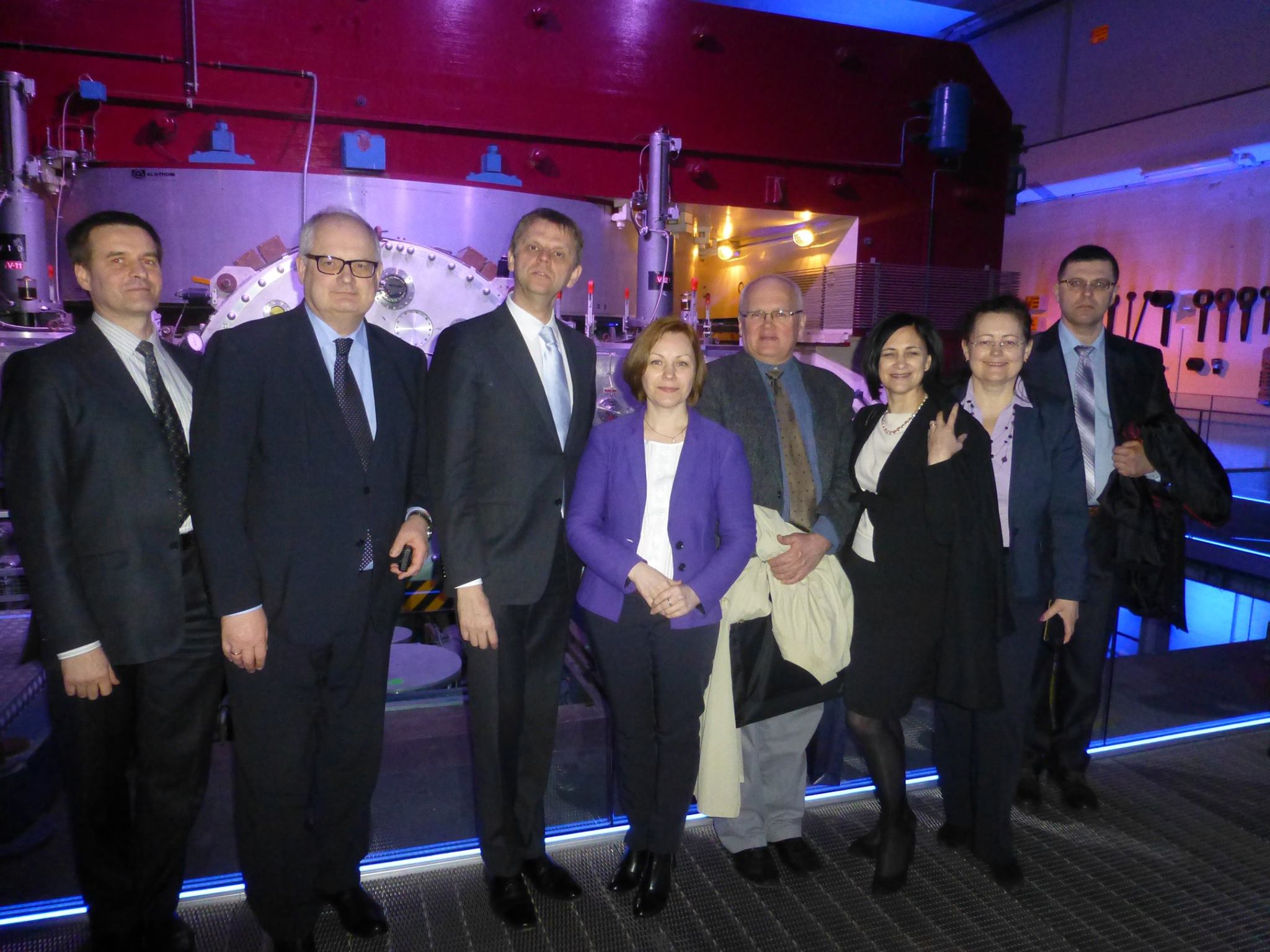
The delegation of Vilnius Gediminas Technical University (VGTU) met the leaders of the European Organization for Nuclear Research (from the French language: Organisation européenne pour la recherche nucléaire, known as CERN) and discussed the possibilities of cooperation.
 
Alfonsas Daniūnas, the Rector of VGTU, Asta Radzevičienė, the Vice-Rector for International Relations and Antanas Čenys, the Vice-Rector for Research, met Rolf-Dieter Heuer, the Director General of the European Organization for Nuclear Research CERN, and Rudiger Voss, the Head of International Relations of the European Organization for Nuclear Research CERN, as well as the leaders of laboratories and research centres. The representatives of VGTU visited several CERN laboratories and research centres, and learnt about their recent scientific and experimental activities going on at the European Organization for Nuclear Research.
 
"CERN is world famous for its projects in the field of physics. Taking into consideration their interest in technical universities, we hope that the contacts, established during the visit, will grow into a strong partnership not only in physics but also in the field of engineering," – said A. Daniūnas, the Rector of VGTU. During this visit, they discussed cooperation activities between Lithuania and CERN and programmes of internships as well as other projects. One of the planned projects in the nearest future is the "CERN Campus" in Vilnius, to be organized by Vilnius Gediminas Technical University, together with the Ministry of Education and Science and the Academy of Sciences of Lithuania. During the camp, CERN experts, researchers and scientists will share their experiences with students of information technologies and computer science.
 
The CERN laboratory is the world's largest particle physics laboratory, which at the beginning of April, after a two year‘s break restarted their ‘‘Big Bang‘‘ Large Hadron Collider. On September 29, 1954, twelve countries signed the CERN Treaty. Currently, CERN unites twenty-one member state; however, it has the cooperation agreements with more states, Lithuania among them, too. More than six-hundred universities and institutes around the world are using CERN's facilities and data. More than ten thousand visiting scientists from one hundred thirteen countries have already carried out CERN'S research and experiments.
 
The Permanent Mission of the Republic of Lithuania to the United Nations Office and other international organisations in Geneva and Ambassador Rytis Paulauskas organized the visit to CERN for the Lithuanian delegation, headed by Svetlana Kauzonienė, the Vice-Minister of Ministry of Education and Science of Lithuania. During the trip to Switzerland, they planned to visit the headquarters of the World Intellectual Property Organization (WIPO), the World Economic Forum (WEF) and the International Telecommunication Union (ITU). All these institutions act as a platform for discussions with the State and academic institutions for the promotion of education and research, technological development, research and innovation implementation, commercial application, vocational training and other areas.
 
Photo credit: CERN

Galerija
Related news

New doctoral dissertation
VILNIUS TECH Library invites you to follow the published new dissertations. The dissertation „Analysis and modeling of deformations induced by the extrusion of fiber-reinforced polymers“ prepared at VILNIUS TECH by Mahmoud Samy Mahmoud Mohammed Farh. The dissertation was prepared in 2021–2026. Scientific consultant – Prof. Dr Viktor Gribniak. The dissertation was defended at the public meeting of the Dissertation Defense Council of the Scientific Field of Materials Engineering in the Aula Doctoralis Meeting Hall of Vilnius Gediminas Technical University at 2 p.m. on 10 June 2026. Additive manufacturing via fused filament fabrication (FFF) enables the creation of geometrically complex components. Yet, its use in structural and semi‑structural applications remains limited by anisotropic mechanical response, defect sensitivity, and fabrication‑induced residual stresses that cause warpage and geometric inaccuracy. This dissertation investigates polylactic acid (PLA)- based materials manufactured by FFF, including neat and partially recycled PLA, continuously reinforced PLA, and short-fiber-reinforced composites, to develop an integrated experimental-computational methodology for evaluating mechanical efficiency and predicting process-induced distortion. The research object comprises the mechanical, thermal, viscoelastic, microstructural, and thermo‑mechanical characteristics of these materials. The dissertation develops a unified approach linking reinforcement strategy, material structure, thermal history, mechanical performance, and warpage behavior. The adopted methodology combines quasi‑static tensile and flexural testing, thermomechanical characterization, scanning electron microscopy, and finite-element simulations. Continuous aramid reinforcement developed in this study for FFF increases the load-bearing capacity of the tension specimens by 67%. Still, reinforcement efficiency was limited by toolpath continuity, interfacial defects, and the absence of in‑process fiber tensioning. Short‑fiber-reinforced composites exhibit distinct fiber‑type‑dependent behavior: carbon‑filled PLA increases stiffness, while wood‑filled PLA enhances crystallinity, stiffness retention near the glass‑transition temperature, toughness, and dimensional fidelity. Wood‑fiber reinforcement reduces edge warpage by 43% and carbon fiber by 14.3% under identical conditions. A staged thermo‑mechanical simulation framework is developed to model printing, cooling, and detachment, transferring residual stress and distortion fields into subsequent mechanical simulations. The ABAQUS model for neat PLA predicts warpage with an average error of 8.2–10.6%, whereas a Digimat workflow captures the deformation in short‑fiber-reinforced PLA with an error of 14.3–17.9%. The latter predictions were obtained for the first time. The dissertation consists of an introduction, three main chapters, general conclusions, and references. The First Chapter provides a literature review of FFF of reinforced polymers, including material combination and modeling strategies. The Second Chapter specifies the chosen materials, test program, and thermo mechanical modeling concept. The Third Chapter evaluates experimental and numerical results, integrating mechanical, thermal, microstructural, and simulation based findings. The General Conclusions summarize the dissertation work, which is supported by four publications, including three articles in Web of Science indexed journals with impact factors, and four conference presentations. Doctoral dissertation readers can search via VILNIUS TECH Virtual Library.    
More
New doctoral dissertation
VILNIUS TECH Library invites you to follow the published new dissertations. The dissertation „Interaction between currency market evolution with monetary policy instruments in the age of digitisation“ („Valiutų rinkos evoliucijos sąveika su monetarinės politikos instrumentais skaitmenizacijos amžiuje“) prepared at VILNIUS TECH by Tomas Pečiuli. The dissertation was prepared in 2020–2026. Scientific consultant – Assoc. Prof. Dr Asta Vasiliauskaitė. The dissertation was defended at the public meeting of the Dissertation Defence Council of the Scientific Field of Economics in the Aula Doctoralis Meeting Hall of Vilnius Gediminas Technical University at 10 a.m. on 10 June 2026. The emergence of decentralised cryptocurrencies has created fundamental challenges for traditional monetary policy systems. Although these digital assets have the potential to increase financial inclusion and efficiency, their volatility and the lack of centralised oversight create systemic risks that cannot be properly managed using classical models. This dissertation presents an integrated hybrid analytical framework designed to quantitatively assess the impact of cryptocurrencies on monetary policy transmission mechanisms, providing policymakers with empirically grounded tools to analyse this evolving financial domain more effectively. The dissertation is divided into three main parts. The First Chapter summarises the theoretical role of cryptocurrencies in modern monetary theory. The Second Chapter presents and substantiates a new methodology that combines machine-learning techniques with advanced econometric modelling, specifically using an Elastic Net machine learning model with ARIMA residuals and MSGARCH specifications to capture regime-dependent behaviour. The Third Chapter empirically validates the framework using data from cryptocurrency markets and central bank policy operations. The empirical results show a significant asymmetric policy transmission effect, with the price of Bitcoin reacting by USD -15,348 to a 1% change in the Federal Reserve interest rate. The analysis also identifies critical volatility thresholds (σ>80%) at which cryptocurrency fluctuations increase inflation risk. These results indicate the growing systemic importance of cryptocurrencies in monetary policy dynamics. The study contributes to the emerging field of digital asset economics. The integrated modelling approach helps overcome the long-standing limitations of analysing nonlinear financial phenomena. Practical applications include real-time financial stability risk monitoring systems and evidence-based guidelines for regulatory interventions. The modular structure of the framework allows for future expansion by incorporating evolving market structures and new digital assets. The dissertation’s results have been presented to the scientific community in eight peer-reviewed publications in scientific journals and conference proceedings. This work provides central banks with essential analytical tools to maintain monetary stability and to promote responsible financial innovation in the digital era. Doctoral dissertation readers can search via VILNIUS TECH Virtual Library.
More