
Robertas Dargis is a co-owner and chairman of the board of EIKA Group, one of the largest real estate development and management groups in Lithuania. In his professional path, he relies on engineering thinking, business experience, and active public engagement.
The VILNIUS TECH alumnus (formerly Vilnius Civil Engineering Institute) openly speaks today about the importance of his studies in shaping his worldview, principles of leadership, and the transformation of Lithuanian business over several decades – from a centralized system to a dynamic, constantly changing market economy.
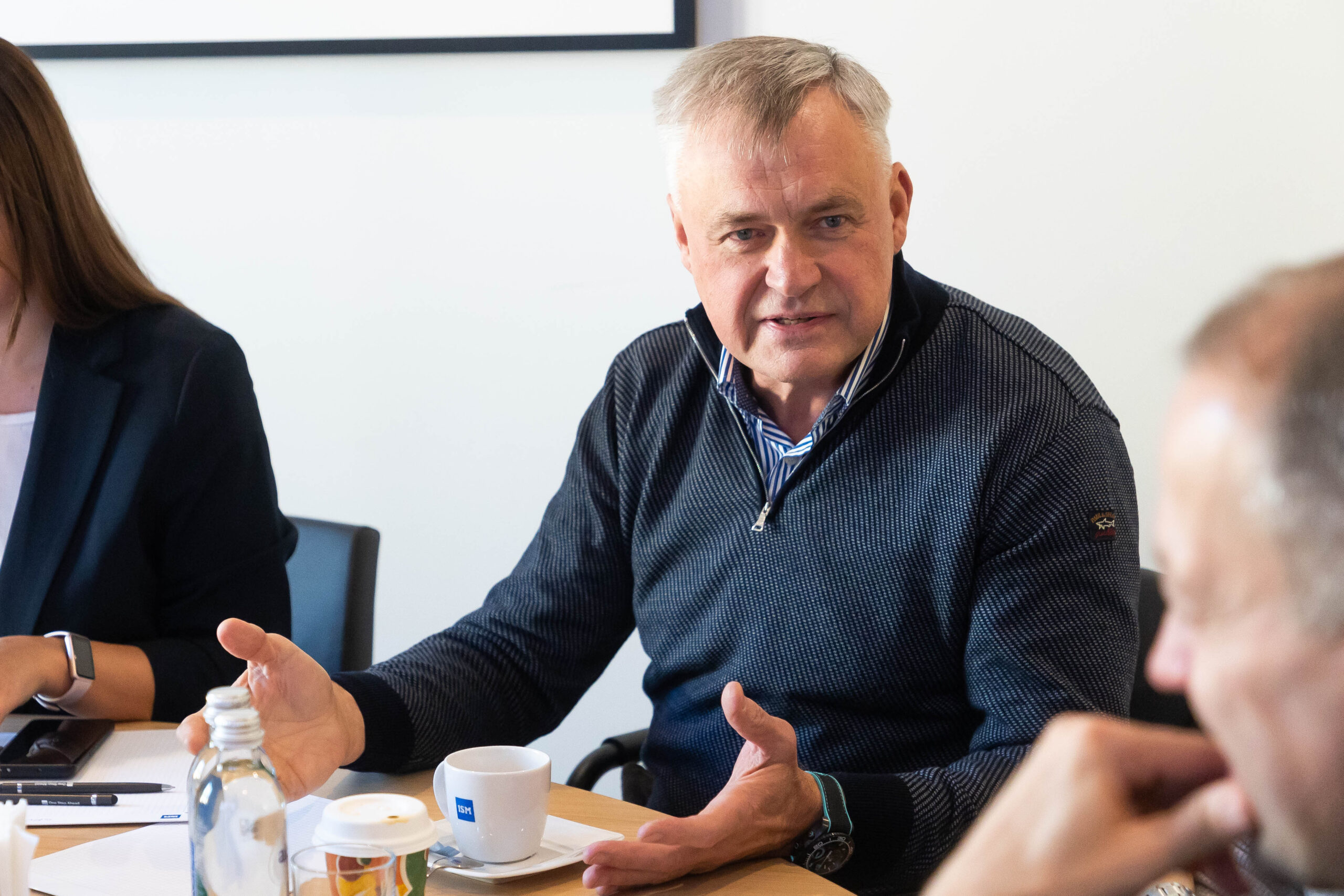
Robertas Dargis (ELTA)
According to him, it was during his university years that a fundamental shift in thinking began – from a closed, single-truth model to a broader perspective that encourages critical thinking, independence, and the ability to see the world in a complex way. At the same time, values instilled in the family had a strong influence – responsibility, respect for work, discipline, and the understanding that long-term results are achieved through consistency, not quick decisions. These experiences later became the foundation for both professional decisions and his understanding of leadership, where the most important thing is not perfect decisions, but the ability to make them and move forward.
“A key role at the university was played by its lecturers – broad-minded people who did not limit themselves to engineering knowledge and spoke about what was happening in the world and how society was changing. The study environment encouraged not mechanical repetition of knowledge, but the ability to think, collect, and systematize information. This sharply contrasted with the school model, where knowledge reproduction, not understanding, was usually rewarded,” recalls the VILNIUS TECH alumnus.
He also notes that after finishing school, moving from the smaller town of Mažeikiai to Vilnius was not only a geographical change, but also an important stage of personal growth. Studies at VILNIUS TECH provided more freedom as well as responsibility: one had to independently seek knowledge, attend seminars, communicate, and learn autonomously.
Speaking about his professional path, he shares that his engineering education became an important foundation for thinking. It taught him to structure problems, break them into parts, evaluate them, and solve them consistently. According to him, such an analytical approach is universal and applicable beyond managing an organization and affects everyday life.
“At the time when my professional journey began, the concept of business in Lithuania was still forming. There were no private companies or individual initiatives. The entire system functioned in a centralized way, and work took place in a state-regulated environment. Only after independence was restored did the real period of business formation and learning begin. This transformation was not easy – everything had to be learned from scratch: what share capital is, how the market works, what risks and business models are. Mistakes were inevitable, but it was precisely by making and correcting them that experience and understanding were formed,” notes the co-owner of EIKA Group.
An important experience for him was also working with people. Although his engineering education provided a strong technical foundation, in practice he initially lacked psychological and social skills. As a young specialist taking on managerial roles, he had to quickly learn how to work with a team, motivate it, and make decisions in real conditions.
“The essence of leadership is the ability to make decisions. A leader, in my view, cannot avoid responsibility, even if decisions are not perfect. Often one has to choose between bad and worse options, but the most important thing is to make a decision and move forward,” says R. Dargis.
The VILNIUS TECH alumnus also emphasizes that flexibility and quick response are equally important – the ability to adjust decisions when circumstances change. Excessive attachment to one option can hinder progress.
“Throughout my professional journey, I have been guided by the understanding that public activity and social connections are inseparable from professional growth. Participation in various activities, working with people and communities helped form social capital, which later became an important part of my business and leadership,” says R. Dargis.
In recent years, according to him, one of the most important changes has been digital transformation and the development of artificial intelligence. This is fundamentally changing business processes, consumer behavior, and organizational structures, making adaptation a constant necessity.
“Today universities should educate not only specialists, but also broadly thinking individuals who can understand the principles of how the world works and changes, think creatively, and solve complex situations. For students seeking their path, I advise taking an interest in the world, but not forgetting that creating value for society is an important part of personal growth. The ability to be useful to others often becomes the foundation of professional success as well,” advises the VILNIUS TECH alumnus.
Finally, reflecting on his path, he emphasizes one of the most important lessons – continuous forward movement.
“Even if decisions are wrong, the most important thing is not to stop. Mistakes and failures are part of the process, and the ability to learn from them and move forward determines the final outcome,” says R. Dargis.