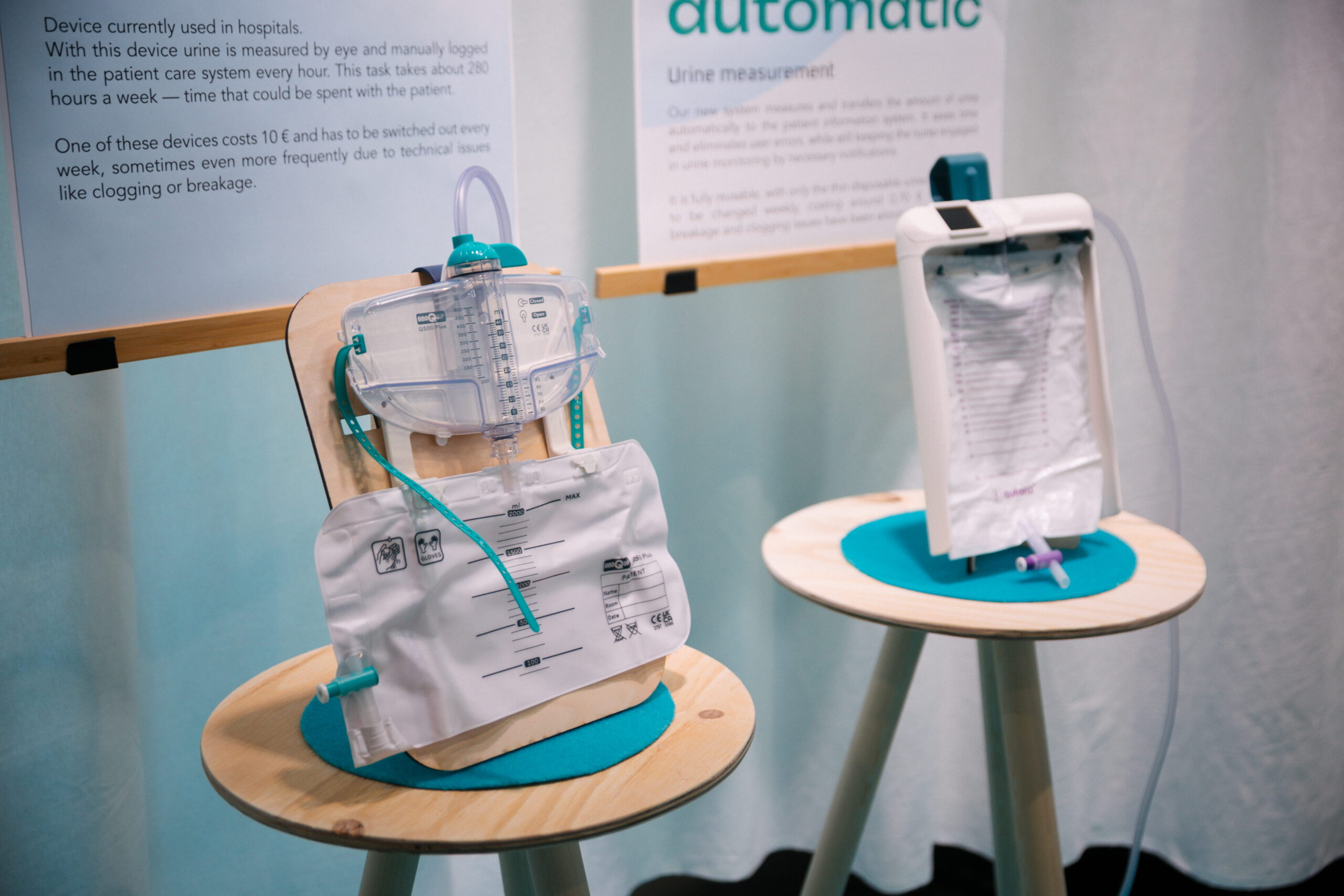
Students from Vilnius Gediminas Technical University (VILNIUS TECH), together with students from Aalto University in Finland, have developed an innovative solution designed to address one of the routine yet often overlooked challenges in hospitals: the inaccurate, time-consuming and still largely manual monitoring of diuresis, or urine output.
The challenge was set by Finland’s largest hospital, Helsinki University Hospital (HUS). The solution was developed as part of Aalto University’s nine month Product Development Project (PdP). It earned the VILNIUS TECH and Aalto University student team the Best Team award, and the team has also begun the patent application process.
VILNIUS TECH and Aalto University students automate urine output monitoring
As highlighted in the challenge set by Helsinki University Hospital, diuresis is an important indicator of a patient’s condition, particularly in intensive care and surgical care units. Even minor changes can indicate impaired kidney function, fluid imbalance or other signs of deterioration in a patient’s health.
However, in many hospitals, urine output monitoring is still carried out manually: nurses must regularly check urine drainage bags at the patient’s bedside, record the data and enter it into digital systems. This process takes up a considerable amount of medical staff time, increases the risk of human error and makes it more difficult to monitor changes in a patient’s condition in real time.
A non-invasive solution for hospital workflows
According to Pijus Gatelis, a VILNIUS TECH Industrial Product Design student and one of the members of the Aalto–HUS team, the team’s aim was to digitise and automate urine output measurement. The team sought to create a solution that would not only save medical staff time and reduce the risk of manual errors, but also fit easily into existing hospital workflows.
„In this project, together with the members of our international team, I was responsible for the final product design and its presentation to the public. I also spent a lot of time thinking about practical aspects: how the device should be attached to a patient’s bed, where it would be placed on the ward and how it could be integrated as simply as possible into existing hospital infrastructure.

We wanted the solution to be non-invasive, easy to use and not require major changes to day-to-day hospital operations. What I enjoyed most was not so much the technical challenge itself, but the idea that we were creating a product that could genuinely help people and have a tangible impact on hospital patients,“ says P. Gatelis.
From needs analysis to prototype
According to the VILNIUS TECH students involved in the project, the initial and most important task was to understand the scale of the problem and the real need behind it. HUS nurses played a key role in this process, explaining in detail their working methods and how urine output measurement is carried out in practice. The students say this was one of the main strengths of the programme: they were working on a real problem encountered by nurses every day.
„By travelling to Helsinki and visiting HUS, we were able to gain a deeper understanding of the problem and see the day-to-day work of nurses in intensive care and surgical care units. We realised that nurses work according to strict and clearly defined methods, so our solution had to meet their needs and fit their existing working practices,“ says Vilius Rudgalvis, a VILNIUS TECH Electronics Engineering student who took part in the PdP project.
The international PdP programme
The Product Development Project (PdP) is an international programme organised by Aalto University in Finland, with a history spanning 30 years. The aim of the course is to give students the opportunity to take part in a real product development process in cooperation with industry partners. The programme is based on the principle of passion-based learning, which encourages creative problem-solving.
This year’s PdP programme offered students a wide range of challenges – from developing planar hydrogen fuel cells and smarter cable connectors to visualising building data, testing satellite braking technologies and designing modular workspaces.
„There were other international students in the programme, but only three of us were Lithuanian. Each team member had their own tasks and responsibilities, but decisions were made together, so we felt responsible for the final result both individually and as a team. In the project, I was responsible for testing potential solutions. One of the solutions I tested was urine output measurement using the siphon method: assessing the colour of the patient’s urine with an RGB sensor,“ says team member Emilija Polovec, who recently completed her bachelor’s degree in Information Systems Engineering at VILNIUS TECH.
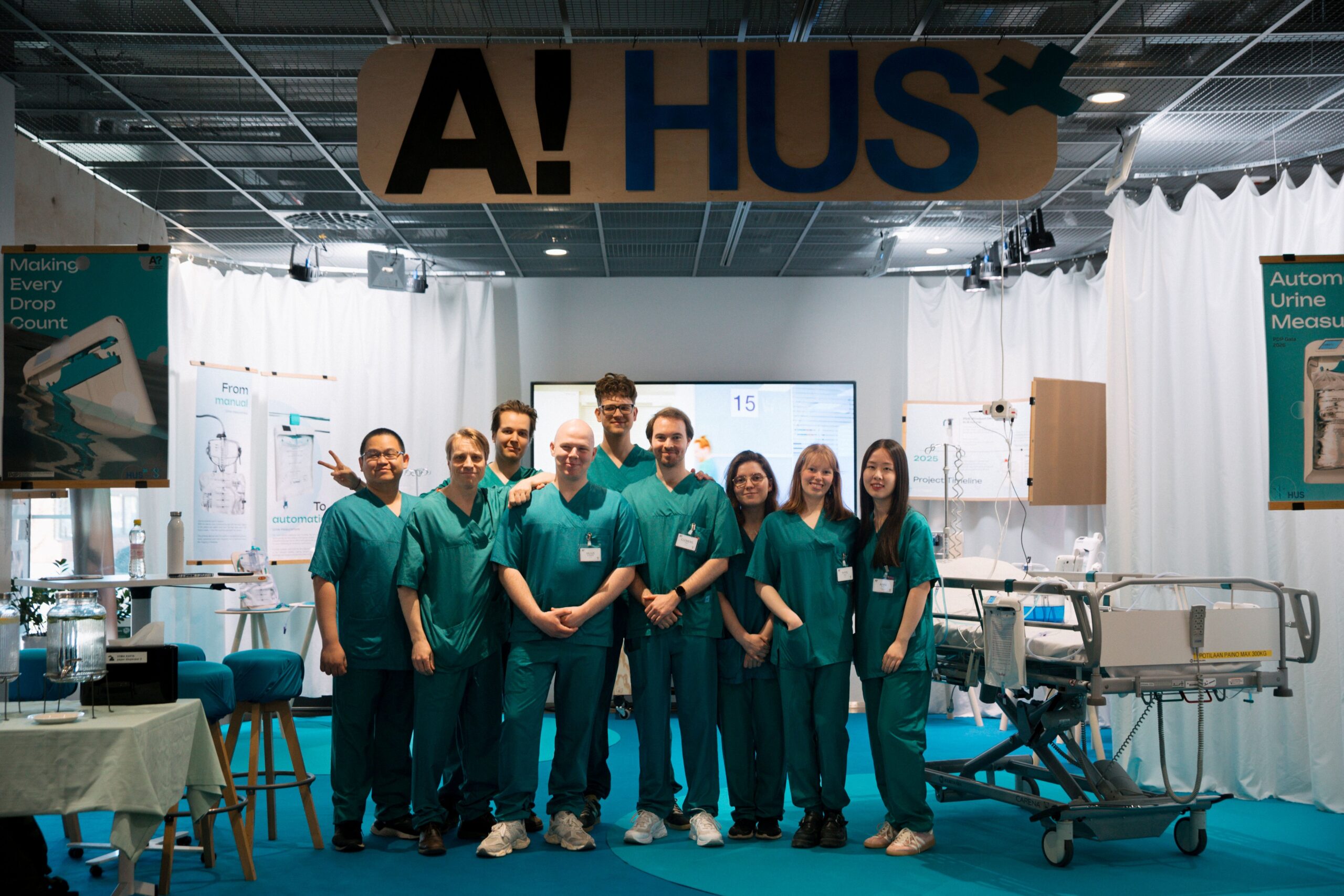
Finally, all the solutions were presented at Aalto University. The final exhibition brought together lecturers, representatives of the companies and institutions involved in the project, investors and the wider public.
„The final event of the PdP programme, known as Gala Day, marked the culmination of the nine-month programme. During the event, we had our own stand, which we set up ourselves, presented our product and answered questions from exhibition visitors and investors. We are pleased that our efforts were recognised – we won the Best Team award,“ says V. Rudgalvis.
Creativity and mentoring at VILNIUS TECH „LinkMenų fabrikas“
The VILNIUS TECH student team in Lithuania was coordinated by VILNIUS TECH Creativity and Innovation Centre „LinkMenų fabrikas“.
„At VILNIUS TECH „LinkMenų fabrikas“, students had the opportunity to test solutions, use prototyping equipment and receive technical and creative support. It is important to us that in spaces like this, students not only create, but also learn to solve real product development problems in practice,“ says Rokas Bagdonas, Head of the Prototyping Laboratory at VILNIUS TECH „LinkMenų fabrikas“.
According to R. Bagdonas, international projects of this kind demonstrate how much students gain from working in an international team: they face real deadlines, different perspectives and the need to constantly seek the best solution.
„This is an experience that develops not only technical skills, but also self-confidence, responsibility and the ability to work in an interdisciplinary environment,“ says R. Bagdonas.