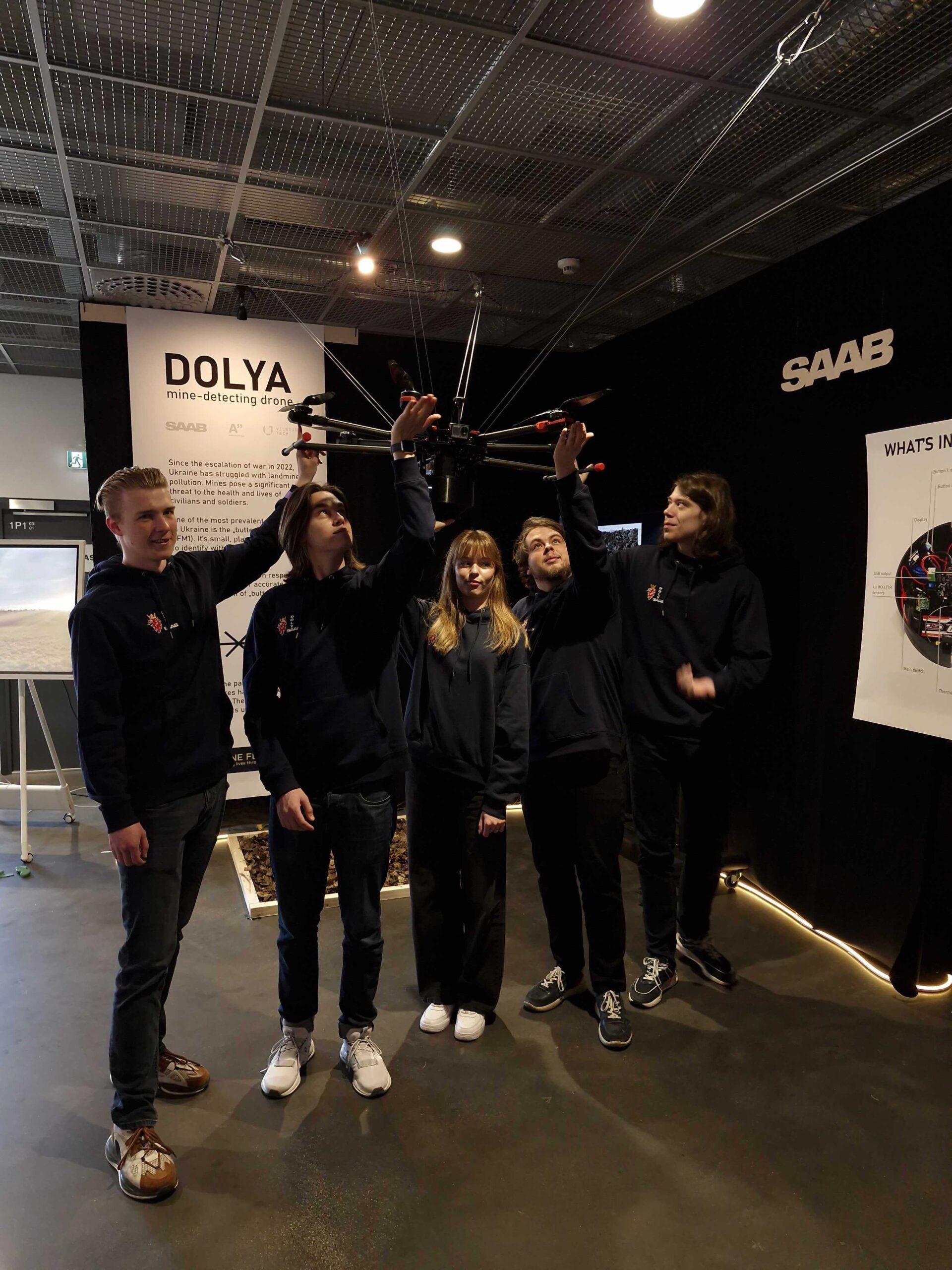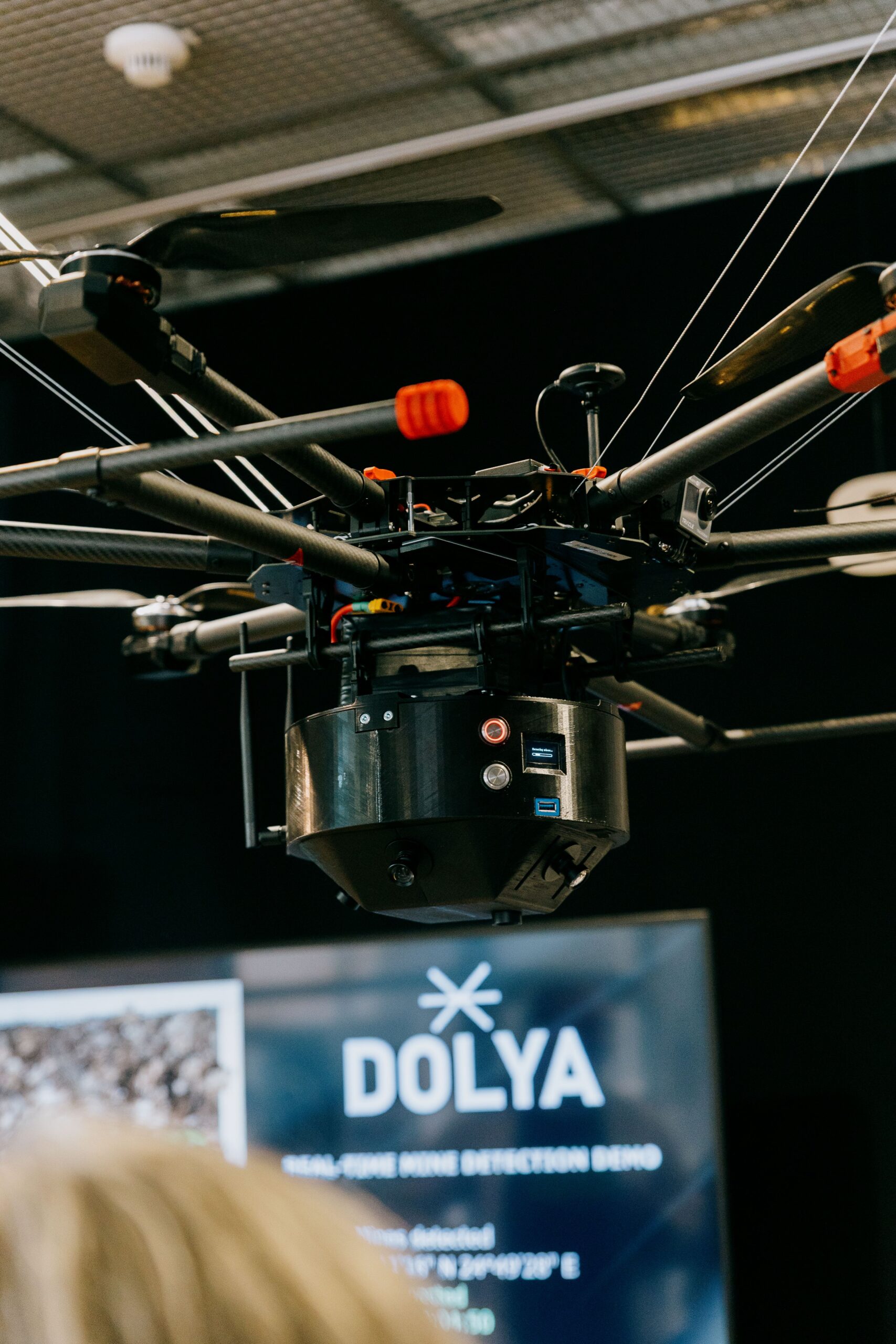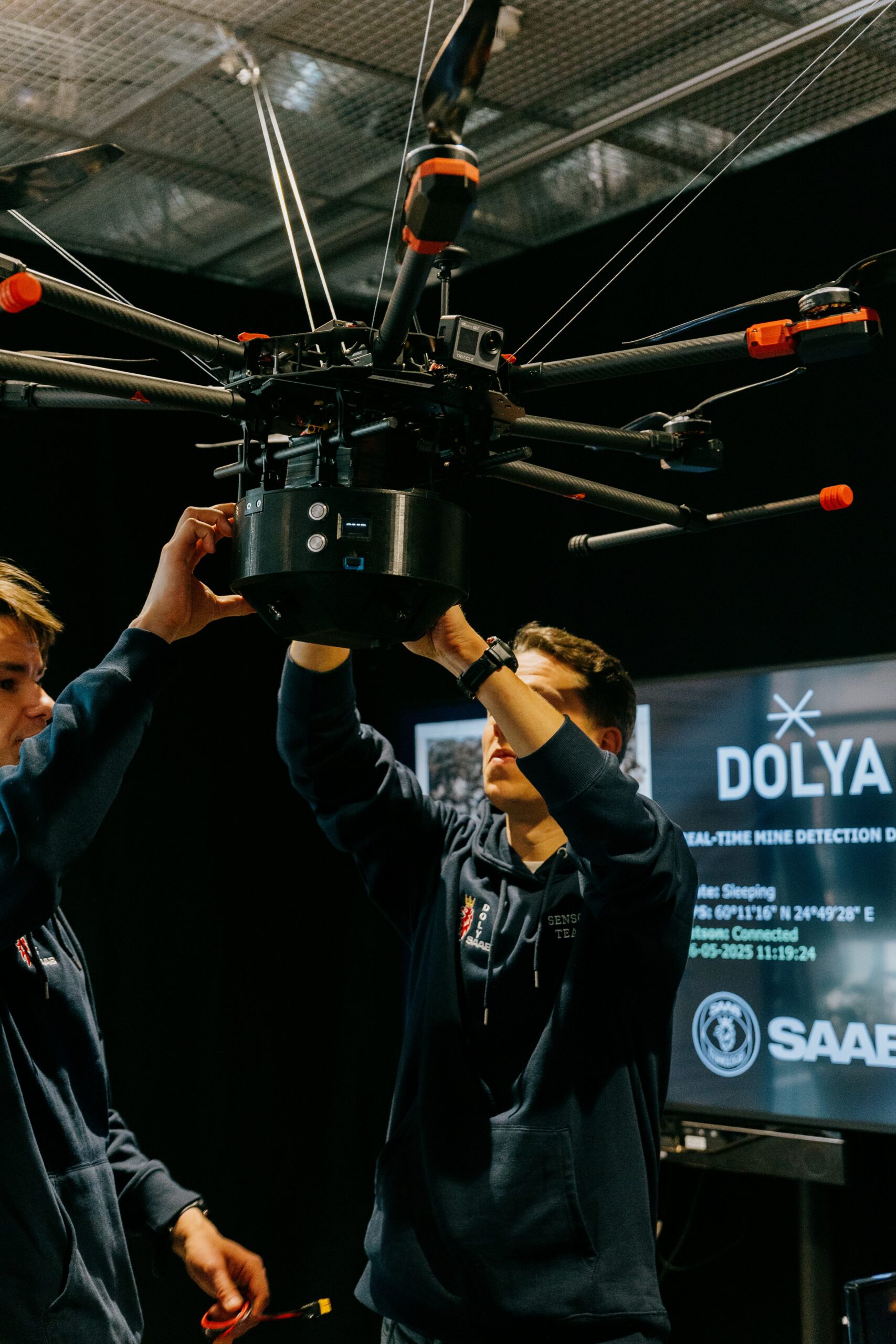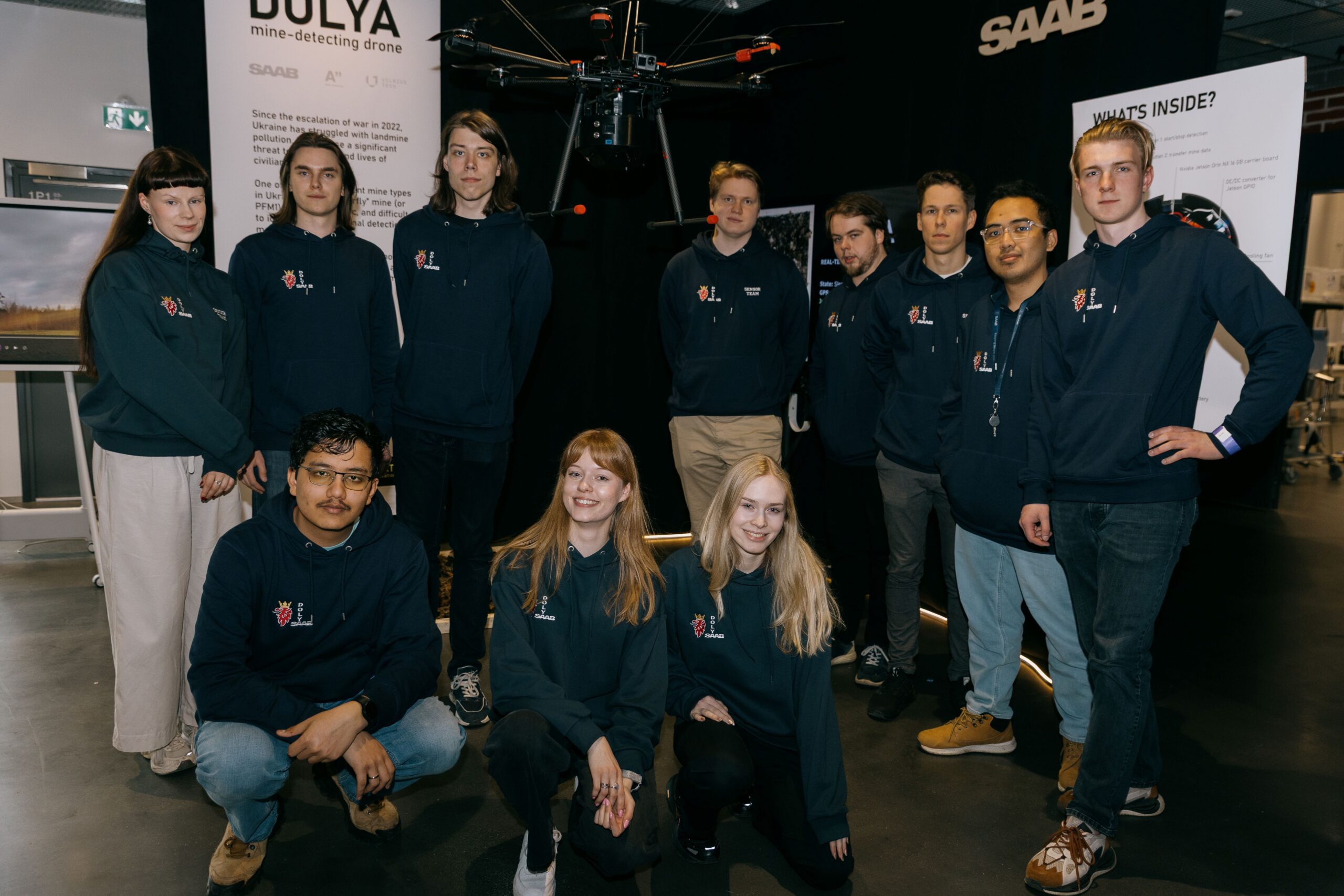
Students from Vilnius Gediminas Technical University (VILNIUS TECH), together with students from Aalto University in Finland, tackled a challenge set by the global aviation and defense company Saab – to accurately and safely identify plastic-made landmines by developing a drone specifically designed for this purpose. The resulting solution – the DOLYA drone – is the outcome of a nine-month-long Product Development Project (PdP) organized by Aalto University.
Mine Detection with a Drone Equipped with RGB Cameras and a Thermal Imager
As stated in the challenge presented by Saab, when landmines were first used in military conflicts, they were typically made of metal, making them detectable with metal detectors. However, this technology soon became ineffective – today, most landmines are made of plastic, making detection significantly more difficult and dangerous. The situation is further complicated by the fact that in Ukraine, metal detectors are still most commonly used for mine detection, which do not allow precise identification of all explosives.
According to Augustinas Stasiškis, a VILNIUS TECH electronics engineering student and a member of the DOLYA drone development team, since February 2022, mines have affected more than 1,200 Ukrainian civilians, nearly half of whom have died.
“One of the most commonly encountered mines in Ukraine is the so-called ‘butterfly’ mine (or PFMI). It is small and made of plastic, making it extremely difficult to detect using traditional methods,” the student explains.
“Responding to the urgent need for precise and safe identification of these mines, our team developed DOLYA – an advanced solution for mine detection. In recent months, the drone’s functionality has been continuously refined in collaboration with experts from The Demine Foundation to ensure its applicability in real-world situations,” says Marta Finogenova, a VILNIUS TECH Industrial Product Design student.
According to Nojus Balčiūnas, a VILNIUS TECH electronics engineering student, their drone uses RGB cameras combined with a thermal imager for mine detection. This combination ensures precise detection and safe operation, contributing to more efficient and casualty-free demining of affected areas.
The Creative Process
The PdP program is an international initiative with a history of over two decades, organized by Aalto University in Finland. The essence of this course is to provide students with the opportunity to participate in real product development processes in collaboration with actual industry partners. The program is based on the principle of “passion-based learning,” which encourages creative problem-solving.
This year’s PdP program offered students various challenges – from removing microplastics from groundwater or assessing forest biodiversity, to developing a wearable sauna prototype or a device for forest planting. However, VILNIUS TECH students unanimously chose to take on Saab’s challenge, which addressed critical security issues.
“Although we were tempted to work with other well-known companies, we chose Saab because of the project’s significance and our desire to create a life-saving innovation,” says team member Alfredas Kerulis, a VILNIUS TECH mechatronics and robotics student.
At the beginning of the project, the students, together with Saab representatives, experts from the Finnish Armed Forces, and The Demine Foundation, explored several ideas – from a ground robot capable of neutralizing mines to a drone that could autonomously detect mined areas.
“We ultimately chose the drone concept because it allowed us to fully utilize the latest technologies and ensure the operator’s safety,” says VILNIUS TECH team member Pavel Fasij, an Industrial Product Design student.
Creativity and Mentorship at VILNIUS TECH “LinkMenų fabrikas”
The VILNIUS TECH student team was coordinated in Lithuania by the university’s Creativity and Innovation Center “LinkMenų fabrikas.”
“VILNIUS TECH ‘LinkMenų fabrikas’ served as the space where the PdP program students tested their product concept and used various manufacturing technologies. We provided participants with mentoring sessions, as well as technical and creative support,” says Rokas Bagdonas, Head of the Prototyping Laboratory at LinkMenų fabrikas.
“We’re proud to have contributed to this Aalto University project, in which VILNIUS TECH students put in tremendous effort. It’s important to remember that they worked and continuously collaborated with the rest of the team located in Finland – the work pace was very intense. The entire first prototype of the drone was developed here at VILNIUS TECH’s ‘LinkMenų fabrikas’ and later transported to Estonia, where it was handed over to teammates for further testing. We saw how the students learned, tackled emerging challenges, and grew as professionals,” says Monika Grinevičiūtė, Project Manager at VILNIUS TECH “LinkMenų fabrikas.”
Galerija