VILNIUS TECH and ATHENA at EAIE 2024: Advancing International Collaboration

September 23, 2024
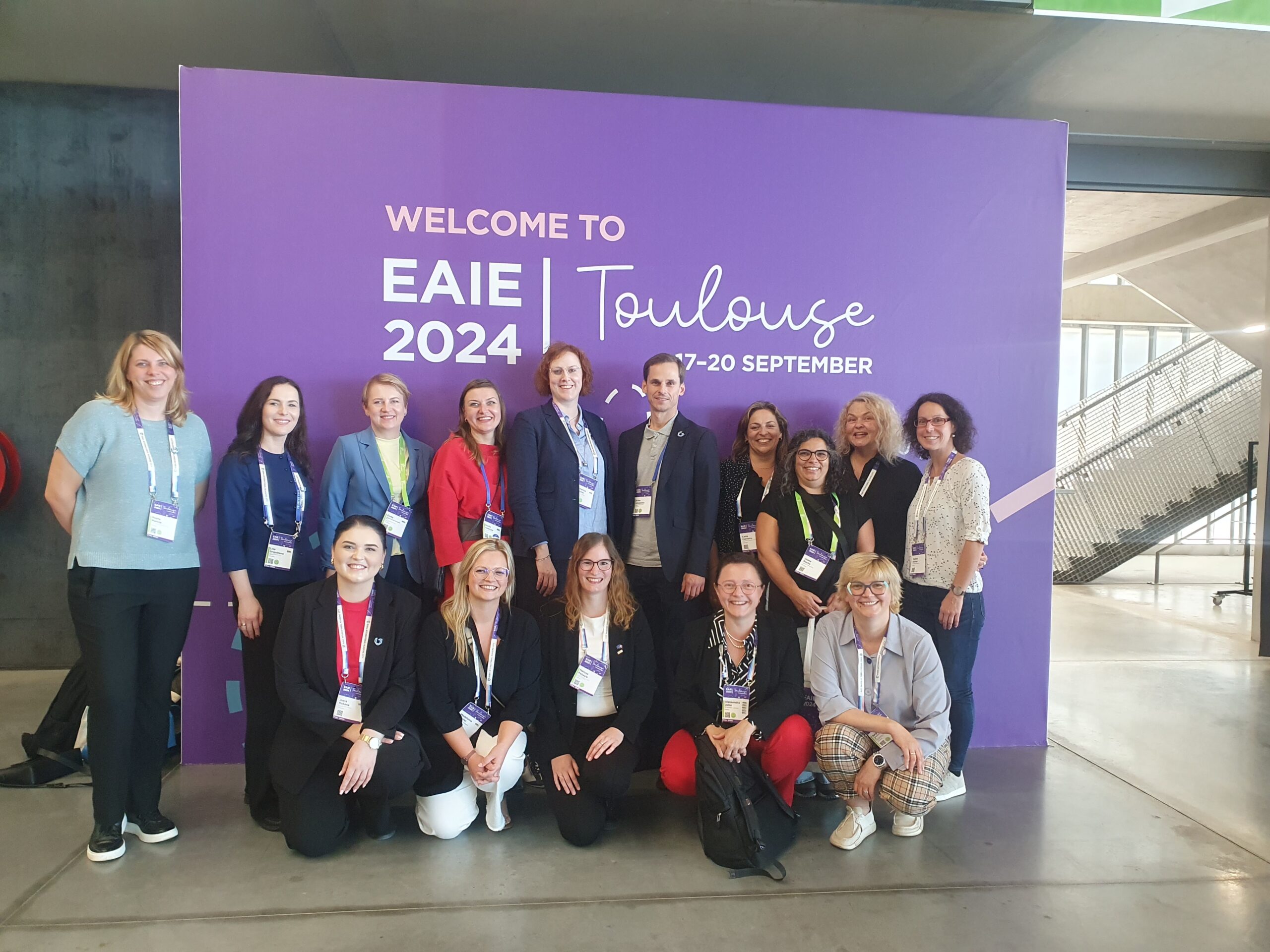
From September 17–20, Toulouse hosted the 35th annual conference of the European Association for International Education (EAIE), a key event in European higher education. This year's conference gathered over 7,000 attendees from more than 90 countries. The event featured over 240 sessions, 250 stands, and presentations from more than 900 organizations. The theme for this year was ‘En Route!’.
 
This year’s conference was especially notable as it showcased the role of European University Alliances for the first time, highlighting the importance of collective engagement in higher education. Much attention was paid at the conference to increasing internationality and inclusion in higher education.
 
VILNIUS TECH delegation at the event was led by Živilė Sederevičiūtė-Pačiauskienė, Vice-Rector for Studies, representing the institution’s strategic vision and leadership. The team included key representatives from various departments, each contributing their expertise to the conference. Representatives from the International Relations Office, International Studies Centre and the Admission and Information Centre played pivotal roles in discussions on international partnerships, student mobility and student admissions. Vice-Deans of the Faculty of Civil Engineering and the Faculty of Creative Industries discussed the perspectives of faculty engagement in international collaboration with colleagues from partner universities abroad.
 
During the conference, the VILNIUS TECH delegation had the opportunity to connect with other members of the ATHENA European University Alliance. We engaged with representatives from institutions across Europe, including Hellenic Mediterranean University in Greece, University of Maribor in Slovenia, University of Orleans in France, University of Siegen in Germany, University of Vigo in Spain, Carinthia University of Applied Sciences in Austria, Politécnico do Porto in Portugal, and Maria Curie-Sklodowska University in Poland. These interactions were instrumental in strengthening our network and exploring collaborative opportunities within the ATHENA alliance.
 
The university's participation in EAIE 2024 provided invaluable opportunities to engage with peers, exchange best practices, and explore innovative approaches to higher education. The insights and connections gained will greatly contribute to our ongoing efforts to strengthen global partnerships and enhance our academic programs.
 
As a member of the ATHENA European University Alliance, VILNIUS TECH is committed to leveraging these experiences to advance our global engagement and continue our pursuit of academic excellence. We look forward to applying the knowledge gained from EAIE 2024 to further our role in a more interconnected and resilient academic community.
 
VILNIUS TECH is part of the ATHENA European University Alliance, which constantly offers mobility and collaboration opportunities for students and staff. The ATHENA alliance partners are universities in ten European countries (Greece, Italy, Poland, Lithuania, Portugal, Slovenia, Spain, France, Germany, and Ukraine).
 
The European Association for International Education (EAIE) is a key organization promoting international higher education across Europe. Its Annual Conference gathers global professionals to discuss trends, share best practices, and foster international collaboration.
 
More information about the conference can be found here.


Galerija

Related news

€75,000 Funding Opportunity for Women-Led Deep Tech Startups
Women-led deep tech startups are invited to apply for the European Union-funded "Women TechEU 2" program. This initiative aims to strengthen women's entrepreneurship in the technology sector, foster innovation, and help promising startups prepare for further growth and attract additional funding. Selected participants will receive a €75,000 grant and the opportunity to take part in a six-month tailored business development program. During this period, startups will be provided with mentoring, consulting, and training services designed to accelerate business growth and enhance competitiveness in the international market. The total budget for the "Women TechEU 2" program is €12 million. The plan is to fund 160 women-led startups from across Europe. Application Process The application process for the new call consists of two stages. First, applicants must submit an application for the Eligibility Strand to verify whether the startup meets the program's requirements. Applicants deemed eligible will then be invited to submit a Full Proposal. The eligibility assessment stage began on June 1, 2026. Applications are accepted on a rolling basis, with evaluations conducted weekly – the weekly submission deadline is every Tuesday by 18:00 (17:00 CEST). The first deadline is June 30, 2026, and the final deadline is July 13, 2027. Applicants will receive their eligibility assessment results no later than one week after the respective submission deadline. Who Can Apply? The program is designed for women-led, early-stage deep tech startups. To be eligible for funding, the following conditions must be met: At least one founder or co-founder of the startup is a woman; A woman holds a top-level executive position (CEO, CTO, or equivalent); Women hold at least 25% of the company's shares. Program Objectives The "Women TechEU 2" program aims to: Promote women's entrepreneurship in the deep tech sector; Help innovative startups scale up and attract additional European Union funding; Strengthen European innovation ecosystems; Support the development and commercialization of new technologies. Potential applicants are encouraged to review the application guidelines in advance and avoid waiting until the final deadline to submit their proposals. More information can be found here: https://womentecheurope.eu/active-calls/
More
New doctoral dissertation
VILNIUS TECH Library invites you to follow the published new dissertations. The dissertation „Performance investigation of a hybrid car engine fuelled with gasoline and gaseous mixtures“ („Benziną ir dujų mišinius naudojančio hibridinio automobilio variklio efektyvumo tyrimas“) prepared at VILNIUS TECH by Tadas Vipartas. The dissertation was prepared in 2021–2026. Scientific consultant – Prof. Dr Alfredas Rimkus. The dissertation was defended at the public meeting of the Dissertation Defence Council of the Scientific Field of Transport Engineering in the Aula Doctoralis Meeting Hall of Vilnius Gediminas Technical University at 9 a.m. on 12 June 2026. This dissertation investigates the use of alternative fuels (natural gas and hydrogen) to increase the efficiency of a spark-ignition engine. The impact of different fuels and engine control algorithms on the combustion process and on energy and ecological indicators was determined and evaluated by analysing the emerging technological constraints within the context of a power-split (series-parallel) hybrid powertrain. The dissertation presents a review of scientific literature, analysing the directions for internal combustion engine improvement, the properties of gaseous fuels and the challenges of their application, along with the operating principles of automotive hybrid powertrains. Bench tests were conducted to investigate the effect of late intake valve closing timing on an engine operating on natural gas, and the influence of hydrogen additives on the combustion process and knock control. The numerical analysis of the engine’s combustion process was performed using AVL BOOST™ software, while the energy and ecological indicators of the hybrid vehicle were evaluated through experimental research and numerical simulation in the AVL CRUISE™ software. The following main results were obtained in the dissertation: retarding the intake valve closing timing increased the brake thermal efficiency and NOx emissions while reducing carbon dioxide emissions when the engine operates on natural gas. It was determined that a hydrogen additive in the fuel improves the engine’s energy indicators, but increases nitrogen oxides emissions and the risk of engine knock. Engine knock is effectively managed by retarding the ignition advance angle. Numerical simulation results confirmed that these trends persist during the Worldwide Harmonized Light-duty Vehicles Test Cycle: the use of hydrogen reduces fuel consumption and carbon dioxide emissions, but increases nitrogen oxides emissions. The dissertation results revealed the potential of these technologies and strategies for their application. The obtained data can be applied in the development and selection of advanced engine control algorithms and in the formulation of technologically sound environmental standards. Nine scientific articles have been published on the topic of the dissertation: six in scientific journals indexed in the Clarivate Analytics Web of Science database with an impact factor, one in a scientific journal indexed in the Clarivate Analytics Web of Science database without an impact factor, one in conference proceedings indexed in the Clarivate Analytics Web of Science Conference Proceedings Citation Index, and one in peer-reviewed conference proceedings not indexed in international databases. The research results were presented at three scientific conferences in Lithuania and Poland. Doctoral dissertation readers can search via VILNIUS TECH Virtual Library.
More