Students tackle real-world energy challenges through the RECREATE programme
The interdisciplinary RECREATE programme (Rethinking Energy: Combining Research, Economics, and Technology), implemented by seven Lithuanian universities in cooperation with Massachusetts Institute of Technology (MIT) partners and business companies, is gaining momentum. Students have already formed teams and started working on real-world challenges presented by Lithuanian Railways (LTG), LTG Infra and Ignitis.
The first study block of the programme is coordinated by Vilnius University, while in February–March 2027, students will continue their studies at VILNIUS TECH. Here, they will explore the transformation of energy systems and develop solutions to help ensure a reliable, sustainable and efficient energy future for Lithuania.
Seven universities, one interdisciplinary programme
RECREATE is the first initiative of its kind and scale in Lithuania, bringing together the expertise of leading universities, business experience and international academic content in a single study programme. It involves Kaunas University of Technology, VILNIUS TECH, Vilnius University, Vytautas Magnus University, Vilnius Academy of Arts, Klaipėda University and Mykolas Romeris University. The studies are organised in separate blocks, each delivered in turn by a different university. The programme is complemented by MIT's online course, *Sustainable Energy*.
The first cohort consists of 32 students from a wide range of academic backgrounds, including engineering, energy, economics, politics, architecture and management. Bringing together students from different disciplines is a deliberate choice: the energy transition requires not only technological expertise but also economic, social and environmental perspectives.
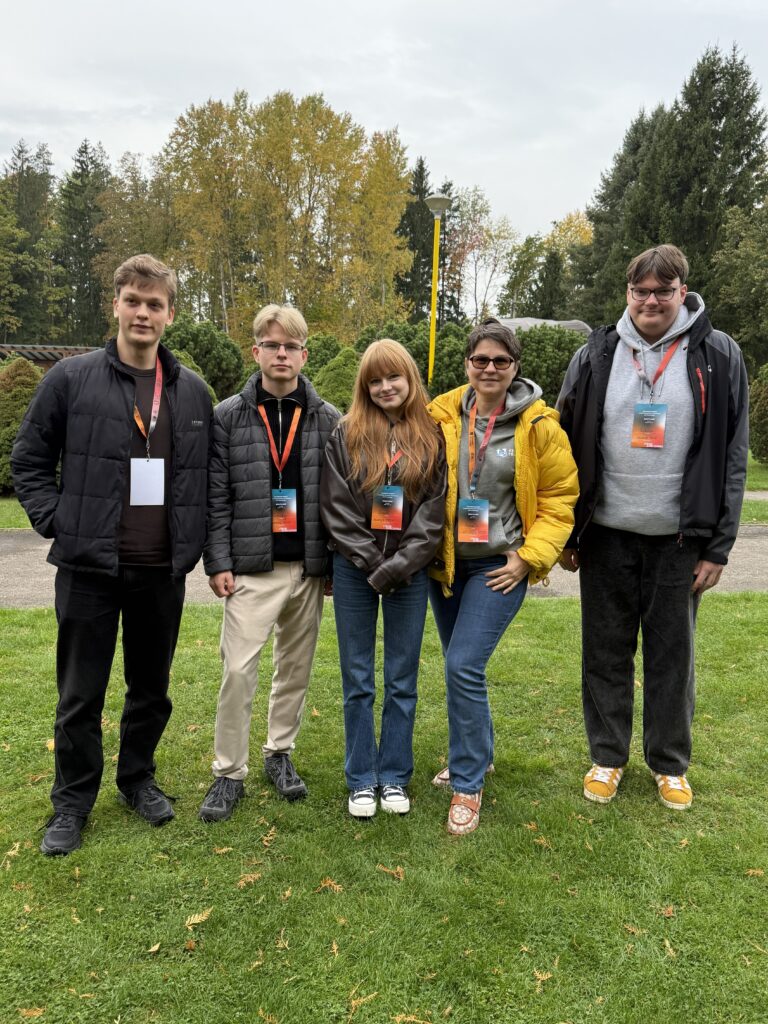
Five students from the Electrical Power Engineering study programme at the VILNIUS TECH Faculty of Electronics are taking part in RECREATE: Emilis Eriksonas, Robertas Stasiūnas, Rokas Šadauskas, Timofej Gaivoronskij and Dovilė Greičiūtė.
[caption id="attachment_137145" align="alignnone" width="1920"] VILNIUS TECH team[/caption]
The programme officially began on 14 October with an introductory event bringing together students and lecturers from all seven universities. During one of the practical activities, VILNIUS TECH lecturers invited participants to become Lithuania's electricity system for three minutes. Students took on the roles of electricity consumers, solar, wind and hydropower plants, gas-fired power stations and energy storage batteries. Their task was to maintain the electricity grid frequency at 50 Hz and ensure the system remained stable.
"It is great to see how quickly students from different universities and academic backgrounds have come together as one team. Within just a few minutes, driven by enthusiasm and curiosity, they became part of an electricity power system. This is exactly what we aim to achieve: to make the energy transition more than an abstract concept for students, but a challenge they want and are able to solve. I am proud that VILNIUS TECH is part of this programme, and we are looking forward to welcoming the students in February," says Prof. Dr Sonata Tolvaišienė, Head of the Department of Electrical Engineering at the VILNIUS TECH Faculty of Electronics.
First challenges address real energy issues in Lithuania
Regular online meetings began in November, giving students an opportunity to explore the content of the first study block and the MITx "Sustainable Energy" course. Throughout November and December, they are studying topics related to sustainable energy, climate change, economic feasibility, fossil fuels, biomass, nuclear fission and fusion energy.
"What I find most exciting is that we are not working on hypothetical assignments but tackling real problems faced by LTG and Ignitis. Our team includes engineers, economists and architects, so everyone approaches the same question from a different perspective, which is where the most interesting ideas emerge. The MIT course provides a solid theoretical foundation, while meetings with lecturers help us put that knowledge into practice straight away. I am really looking forward to the in-person study week in Vilnius," says Robertas Stasiūnas, a student on the Electrical Power Engineering programme at VILNIUS TECH.
An important part of the programme is teamwork on challenges proposed by business partners. Students are analysing three pressing issues facing Lithuania's energy and transport sectors.
LTG challenge: Solar power plants and energy storage in an electrified railway network.
As railway electrification progresses, electricity demand is growing rapidly. It is projected to increase from 60 GWh in 2026 to 137 GWh in 2030. Students are exploring how solar power plants and battery energy storage systems could be most effectively integrated at traction substations along the Vilnius–Klaipėda railway line. They are assessing potential locations and capacities, investment returns, opportunities to participate in electricity balancing markets, as well as energy and cybersecurity considerations.
Ignitis ON challenge: Smart charging infrastructure for Lithuania's cities in 2035.
Student teams are analysing the opportunities and barriers to the development of electric mobility, assessing the needs of public and private EV charging networks and exploring how electric vehicles could contribute to the operation of the electricity distribution grid. The urban planning perspective is equally important: how can charging infrastructure be integrated into historic city areas, residential neighbourhoods and motorway environments? Using official data and consulting with Ignitis experts, students are developing a vision for Lithuania's smart urban charging infrastructure by 2035.
LTG Infra challenge: The smart railway station.
For this challenge, students are developing a concept for an autonomous, energy-efficient railway station that can adapt to passenger flows. They are examining how solar energy systems, batteries, building and energy management solutions, sensors and video analytics could help optimise station operations at different times of the day, during peak hours and in emergency situations.
Students to gain first-hand insight into the energy sector
From 30 November to 4 December, programme participants will meet in person at the Institute of Chemistry of the Faculty of Chemistry and Geosciences and the Life Sciences Centre at Vilnius University. Their schedule includes lectures, seminars and laboratory sessions focusing on climate change, renewable energy, energy storage, nuclear fusion and other emerging technologies.
Students will also visit Vilnius Railway Station together with LTG representatives. This will give them an opportunity to explore first-hand the infrastructure for which they are developing solutions.
VILNIUS TECH to focus on the transformation of energy systems
The third RECREATE study block, titled "Energy Systems Transformation", will take place from 1 February to 31 March 2027 and will be coordinated by the Department of Electrical Engineering at the VILNIUS TECH Faculty of Electronics. The study block is worth 5 ECTS credits.
Over seven weeks, students will explore the operation and transformation of energy systems and future solutions through online learning. Live online sessions will be held every week, providing opportunities to discuss key topics, consult with lecturers and work in teams. Independent study will be complemented by materials from the MITx course.
An important part of this study block will be an in-person week taking place on 22–26 March at Building P2 of VILNIUS TECH (25 Plytinės St.). Students will have the opportunity to meet lecturers, exchange ideas, collaborate and deepen their understanding of the energy transition.
"At first glance, these are three different topics – railways, electric vehicles and railway stations. In reality, they are all about the same thing: how to generate, store and consume electricity at the right time to maintain the balance of the grid. This is precisely what we will examine during the VILNIUS TECH study block, looking at the energy system as a whole across Lithuania," says Assoc. Prof. Dr Audrius Grainys, coordinator of the "Energy Systems Transformation" study block and a lecturer at the VILNIUS TECH Department of Electrical Engineering.
The study block will be coordinated by Assoc. Prof. Dr Audrius Grainys, while organisational matters and liaison with the university will be overseen by Prof. Dr Sonata Tolvaišienė, Head of the Department of Electrical Engineering at the VILNIUS TECH Faculty of Electronics.
Learning beyond the final results
RECREATE focuses not only on the solutions developed by student teams but also on the individual development of students' competencies. Their ability to analyse information, think systematically, collaborate, co-create and learn independently is also assessed.
Students are not compared against one another. Instead, their progress is monitored throughout the programme. Assessment records accompany them as they move from one university to another, allowing each student to track the development of their competencies.
The first months of the programme have demonstrated that combining MIT-developed study materials, the expertise of lecturers from different universities and real-world business challenges gives students an opportunity to apply theoretical knowledge directly in practice.
About the Lithuanian Consortium and Its Cooperation with MIT
The RECREATE initiative emerged from a partnership between the Lithuanian Consortium and the Massachusetts Institute of Technology (MIT). The Lithuanian Consortium brings together 14 Lithuanian research and business organisations committed to developing cooperation with MIT. An agreement signed with the MIT Center for International Studies in January 2025 became one of the foundations of this partnership.
MISTI Lithuania is part of MIT's International Science and Technology Initiatives (MISTI) programme, which aims to strengthen ties between Lithuania and MIT in research, education, technology and innovation.
The cooperation includes initiating joint research projects, exchanging knowledge and creating opportunities to strengthen the competencies of students and early-career researchers.
The Lithuanian Consortium is coordinated by Vytautas Magnus University, with its activities supported by the Research Council of Lithuania.
More