VILNIUS TECH "LinkMenų fabrikas" hosted a hackathon "Rethinking Hardware" – 11 prototypes presented

December 16, 2022

On 9-11 December, Vilnius Gediminas Technical University's (VILNIUS TECH) Creativity and Innovation Centre "LinkMenu fabrikas" hosted a three-day hackathon "Rethinking Hardware". The hackathon, organised with the "Bridgio Tech Accelerator", involved students from VILNIUS TECH and other higher education institutions, as well as representatives from the hardware industry, in developing prototypes of advanced electronic solutions. The first-place winner – "The Box" team, presented a hardware-based solution which will be able to place rentable items all over the living districts.

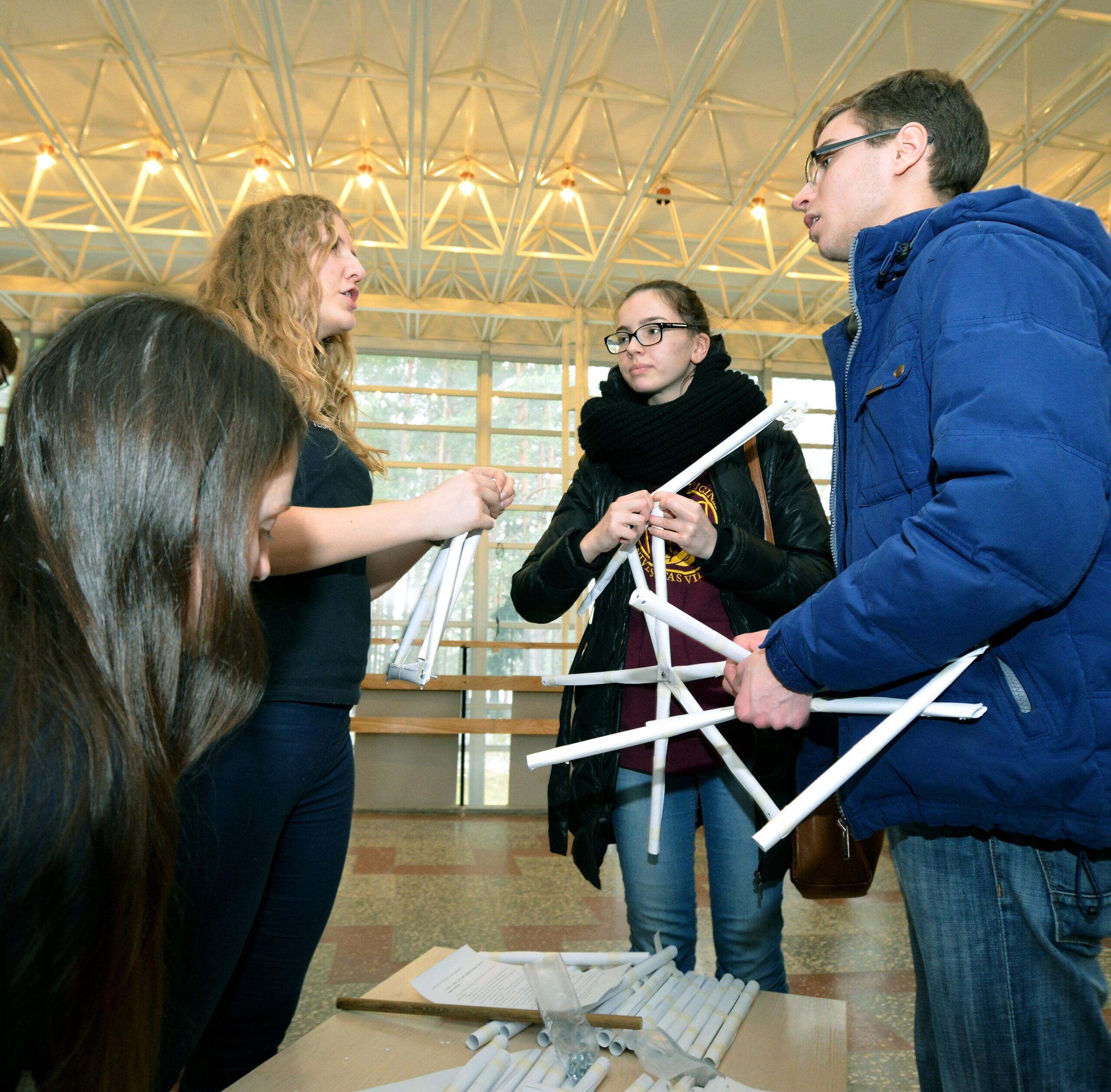
The "Rethinking Hardware" hackathon aimed to redefine how and why we use electronics and rapid prototyping. From Friday evening onwards, participants created solutions with the help of VILNIUS TECH "LinkMenu fabrikas" and other partners, mentors, and lecturers. During the hackathon, participants could choose one of 11 pre-defined challenges. Participants who wanted to submit their challenge participated in an idea generation workshop beforehand. After the hackathon's opening on Friday, makers built and strengthened their teams, consulted with experts on their chosen challenges, and spent Saturday prototyping. Using the VILNIUS TECH "LinkMenu fabrikas" workshop, the participants, worked in electronics, 3D printing, metal, and wood workshops. 

On Sunday, the prototypes of the hackathon participants were evaluated by a competent jury –Roman Pakholkov (Chairman at "Promwad", mentor at "Bridgio"), Ričardas Leščinskas ("Arrow Electronics Solutions" Field Application Engineer), Donatas Šumyla (Head of Startup Partnerships between "ROCKIT Vilnius" and "Swedbank Lithuania"), Jolanta Zubkauskienė (Manufacturing Innovation Valley, Head of Development), Dovilė Kurpytė-Lipnickė (Electronics and informatics engineer, international Speaker, lecturer at VILNIUS TECH).

The cash prize of €1,500, a 2-month "Bridgio Tech Accelerator" pre-acceleration programme and access to any NVIDIA Deep Learning Institute self-paced course, was awarded to "The Box" team. The team members – Dovydas Valančius, Ginta Ambražaitė and Lukas Žavlovskis, ¬presented an idea based on the sharing economy – a prototype of automated sharing stations where people could rent and lease various items. Second place went to the "Aces" team. The prototype developed by this team called a "Lightsdown" – a smartphone-linked street lighting control system. The third-place winner, "Cool & Creative", presented an energy-efficient solution for street lighting. An additional prize – a three-month membership to VILNIUS TECH "LinkMenu fabrikas" – went to the team "EM EI EI", who presented the prototype "City/Park", a network of small cameras installed on lighting poles and traffic lights. In addition to the prizes mentioned above, "Würth Group electronics" and "Tele2 Lietuva" provided special prizes for participants. 

The hackathon brought together more than 60 technical creativity enthusiasts, the participants were supported by 20 VILNIUS TECH and business world mentors, and the total prize fund of the hackathon amounted to EUR 3 500.

The event's main sponsors were "Promwad Electronics Design House", "Softeq", and "Anodas electronics".


Galerija
Related news

New doctoral dissertation
VILNIUS TECH Library invites you to follow the published new dissertations. The dissertation „Research and application of machine learning methods for migraine attack prediction“ prepared at VILNIUS TECH by Viroslava Kapustynska. The dissertation was prepared in 2021–2026. Scientific consultant – Prof. Dr Šarūnas Paulikas. The dissertation was defended at the public meeting of the Dissertation Defense Council of the Scientific Field of Electrical and Electronic Engineering in the Aula Doctoralis Meeting Hall of Vilnius Gediminas Technical University at 2 p.m. on 9 June 2026. Migraine is a complex neurological disorder characterized by strong inter- and intra-individual variability, which makes early forecasting difficult using only clinical observations. Wearable biosensors combined with machine learning offer new opportunities to detect subtle physiological changes that may precede migraine attacks and to develop individualized prediction models. This dissertation investigates migraine analysis and next-day prediction using physiological recordings collected under real-life monitoring conditions. Data were obtained with the Empatica Embrace Plus wearable device and include electrodermal activity, pulse rate, skin temperature, and movement-related signals. The analysis focuses on nocturnal recordings, since the night period provides a more stable physiological context with fewer external disturbances. Nights were standardized using sleep-based contextual selection and consistent night-level rules. The experimental framework is organized in two stages. In the first stage, a window-level binary classification task is used as an exploratory methodological analysis to examine how design choices influence model performance. Night recordings are segmented into analysis frames ranging from 5 to 120 minutes, statistical features are extracted, and the influence of signal preprocessing and feature representation is evaluated across several classifier families, including Random Forest, XGBoost, histogram-based gradient boosting, support vector machines, and k-nearest neighbors. In the second stage, the research evaluates next-day migraine prediction based on whole-night recordings. This stage refines the experimental methodology to obtain more reliable estimates of predictive performance under a stricter validation framework. The analysis focuses on the effect of temporal aggregation while comparing the same classifier families under consistent evaluation conditions. The results demonstrate considerable variability across participants in achievable prediction performance and optimal modeling configurations. Shorter analysis frames generally preserve informative short-term physiological changes, whereas longer windows tend to smooth these variations. Signal preprocessing shows a window-dependent effect and does not consistently improve performance. Overall, the results highlight the importance of temporal resolution, rigorous validation, and individualized modeling for wearable-based migraine prediction systems. Doctoral dissertation readers can search via VILNIUS TECH Virtual Library.
More
Expert Evaluation: VILNIUS TECH’s Progress Exceeded Expectations
VILNIUS TECH has received a highly positive assessment from international experts. In their recently published conclusions, it is noted that since the 2022 institutional evaluation, the university has achieved significant, evidence-based progress across all four evaluation areas: governance, quality assurance, studies and research activities, and impact on regional and national development. In 2022, VILNIUS TECH was granted a seven-year accreditation. At that time, the expert panel provided the university with 19 recommendations for further improvement. The latest progress review concludes that the university responded to these recommendations responsibly, systematically, and constructively, and that the implemented changes have become part of long-term institutional development. „We are pleased that external experts have highly evaluated the progress achieved by VILNIUS TECH across all four assessment areas. It was noted that the university demonstrates a mature quality culture, a strategic vision, and the ability to consistently sustain growth and increase its impact on society. This ensures that we are entering the next institutional evaluation period with a strong position,“ says Nora Skaburskienė, Director of the Studies Directorate. International experts particularly highlighted the consistently strengthened system of strategic management, the quality culture, active collaboration with business and alumni, leadership within the ATHENA European Universities Alliance, the development of new interdisciplinary study programmes, and significant progress in innovation and technology transfer. The rapid expansion of lifelong learning activities was also noted — VILNIUS TECH has broadened its micro-credential offerings, strengthened partnerships with social and business partners, and is creating favourable conditions for knowledge commercialization and startup development. According to the expert panel, the university has already moved beyond the stage of merely responding to recommendations and is now ready to purposefully leverage its accumulated potential to achieve even higher performance results. In summarizing the evaluation, the experts concluded that VILNIUS TECH is entering the next phase of institutional assessment with a solid foundation for continued successful development.
More