VILNIUS TECH scientists participation in HORIZON "META-MUSEUM" project

January 14, 2025
This is a large multi-stakeholder project funded by Horizon Europe. It will run 2024-2027.

META-MUSEUM – Moving Emotions towards confidence in the Transformative Appropriation for a Meaningful Understanding of cultural heritage: a neuroScientific approach to EUropean Museums.

Call: [HORIZON-CL2-2023-HERITAGE-01] — [Research and innovation on cultural heritage and CCIs-2023].

META-MUSEUM proposal is based on the role that empathy can play in understanding the constantly changing nature of CH, and on the role that empathic emotions, co-creation and individual interpretation play in sharing this understanding, and in helping citizens to face current and future societal transformations, with greater confidence.

META-MUSEUM redefines how people experience cultural heritage (CH) by fostering empathy, co-creation, and inclusion. The project empowers individuals to engage with CH as a dynamic entity while addressing societal challenges. Through innovative methodologies and pilot studies, META-MUSEUM enhances resilience, confidence, and well-being.

Coordinator of the project: Politecnico di Torino (coordinator), Italy

Partners:
Università Sapienza di Roma, Italy
Vrije Universiteit Amsterdam, Netherlands
Kentro Merimnas Oikogeneias Kai Paidiou, Greece
Friedrich Schiller University-Jena, Germany
National Information Processing Institute, Poland
Nordic Center of Heritage Learning and Creativity (NCK), Sweden
Vilnius Gediminas Technical University, Lithuania
European Academy Museum, Netherlands
Beia Consult International, Romania
VILNIUS TECH project leader – Head of the Department of Construction Management and Real Estate prof. habil. dr. Artūras Kaklauskas.

Associated Partners:
Agència catalana del patrimoni cultural – Museu d’Arqueologia de Catalunya, Spain
Cultural Foundation of the National Bank, Greece
Museoparc Alesia, France
Fondazione Museo delle Antichità Egizie di Torino, Italy
In addition, many European archaeological museums have joined the project with a Letter of Interest and willingness to host experiments: Louvre-Lens (France); Museo Nazionale Etrusco di Villa Giulia (Italy); Neues Museum (Germany); Moesgaard Museum (Denmark).
Moreover, also a policy maker (Municipality of Turin, Italy), joined the project with a Letter of  Commitment.

Methodology. The META-MUSEUM project aims to improve understanding of the transformative nature of cultural heritage (CH) and how this understanding can support EU citizens in facing change with confidence. The project recognises that deep understanding, confidence, and resilience are fundamentally emotional responses and states. Building on existing research that highlights the under-researched role of heritage in building social capital, META-MUSEUM’s vision centres on the crucial role emotions play in human experience and the premise that these emotional states and responses can be measured to develop evidence-based principles. The project explores three core concepts: “confidence” a complex construct encompassing positive thinking, a sense of security, mental openness, a sense of control, feelings of well-being, inner peace, active engagement, and social relations; “resilience” defined as the ability to cope with and overcome dramatic changes, accepting crises as opportunities for positive evolution without losing one’s core identity, encompassing positive thinking, an active role, a sense of control and challenge, feeling heard, and strong social ties; and “empathy” the ability to share another’s feelings or experiences, arising from a neurophysiological reaction linked to mirror neurons, generating identification and inner transformation.
The project’s work is structured around theoretical work (WP2-WP4) and experimental work (WP5-WP8), based on a strong interaction between theory and robust experimentation. 

Outcomes. META-MUSEUM’s pathways to impact are structured around a defined timeframe, focusing on delivering tangible results, outcomes, and long-term impacts.

Expected Results (by project end)

These include:

  • experimental data and reports on the emotional understanding of CH’s transformative nature, linked to confidence and resilience;
  • a final version of the TMt;
  • the “attaCHbox” app;
  • a fully qualified M4 system;
  • a replicable format for a travelling “hybrid event”;
  • initial training modules/workshops on TMt skills;
  • the concept for a META-MUSEUM Competence Centre; and
  • several testable prototypes (digital, co-creative, and museographic) made available to the three associated partner museums.
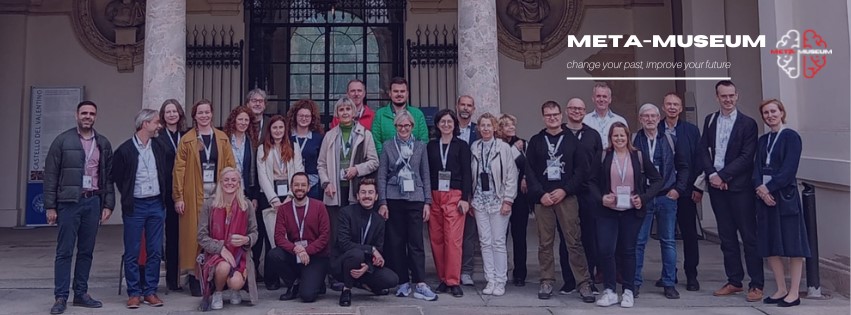
The first meeting was already held by Politecnico di Torino (coordinator), Italy  in 2024 October 14-15.

More information about the project can be found here:

https://meta-museum-project.eu/project/


Galerija
Related news

New VILNIUS TECH eBook
Nauja VILNIUS TECH elektroninė knyga: Kristina Stankevičiūtė, Jūratė Černevičiūtė, Stasys Mostauskis, Liutauras Labanauskas, Marius Salynas Reflecting Popular Culture: Theories and Research (Reflektuojant popkultūrą: teorijos ir tyrimai)Collected Monograph The book is written in Lithuanian This book is the first volume of the planned five-volume monograph series Popular Culture in Lithuania. Its principal aim is to examine the understanding of the phenomenon of popular culture and the nature of its perception as they are relevant in the Lithuanian context, thereby establishing a theoretical foundation for the further analysis of the field of popular culture, which is intended to be presented in the subsequent volumes of the series. The overall objective of the monograph series is to chart the field of popular culture in Lithuania and to survey its current situation, assessing both its historical development and possible prospects for future research. The first volume presents theoretical discussions outlining the concept of popular culture as a phenomenon, its philosophical, aesthetic, and industrial characteristics, and its history of emergence. These discussions are grounded in the traditional conception of popular culture as standing in opposition to serious or high culture. Taken together, the contributions may be broadly described as belonging to a field of academic research oriented toward the theoretical reflection on popular culture. The volume is intended for researchers and students in the field of cultural studies, as well as for all those interested in processes within the cultural sphere. eBook edition >>> * VILNIUS TECH extends complimentary access to its entire library of e-books to members within the university community. Institutional users are granted cost-free access to the e-books by logging onto the University's computer network, whether on-site or remotely through a Virtual Private Network (VPN). To facilitate offline reading without an internet connection, it is requisite to install the IPC Reader offline application. Users can subsequently download the desired e-books while connected to the institutional network and read them offline at their convenience. For additional details concerning e-books, please refer to the provided link >>>
More
New doctoral dissertation
VILNIUS TECH Library invites you to follow the published new dissertations. The dissertation „A framework for assessing food loss and waste along the food supply chain: the case of Lithuania“ prepared at VILNIUS TECH by Ovidija Eičaitė. The dissertation was prepared in 2025–2026. Scientific consultant – Dr Tomas Baležentis. The dissertation was defended at the public meeting of the Dissertation Defence Council of the Scientific Field of Economics in the Aula Doctoralis Meeting Hall of Vilnius Gediminas Technical University at 10 a.m. on 11 June 2026. Food loss and waste (FLW) represents a global challenge with serious environmental, economic, and social implications. It contributes to inefficient use of resources, increased greenhouse gas emissions, and financial losses across the food supply chain (FSC), while also undermining efforts to achieve food security. To address this issue, the United Nations (UN) set Sustainable Development Goal 12.3, which aims to halve food waste at the retail and consumer level by 2030 and reduce food loss in production and supply chains. Achieving this goal requires a comprehensive assessment of FLW and systematic data collection across all stages of the FSC. This dissertation develops and applies a framework for assessing FLW across the key stages of the Lithuanian FSC. The framework clearly defines FLW, determines the scope of the assessment, and establishes a methodological approach for measuring and analysing FLW based on primary data collection using questionnaire-based surveys in primary production, the food industry, and retail trade, as well as food waste diaries in households. The application of the developed framework delivers the first comprehensive FLW estimates for primary production, the food industry, and households in Lithuania, while also providing more precise food waste estimates for retail trade than previously available. The results show that estimates of food loss in primary production vary substantially across products, ranging from 0.1% for milk to 20.1% for beets. Environmental factors and stringent consumer or buyer standards are the main contributors to crop losses, while diseases represent the main cause of livestock losses. The food industry generates an estimated 10.9 thousand tonnes of edible food loss annually, corresponding to approximately 4 kg per capita, mainly due to inefficiencies in processing operations and product non-compliance with commercial standards. Retail trade generates 36.4 thousand tonnes of food waste each year, equivalent to about 13 kg per capita, largely driven by product expiration and spoilage. Household food waste averages 74.5 kg of edible food per capita per year, with common causes including spoilage, over-preparation, and over-serving. The estimates generated in this research establish a baseline for FLW across the key stages of the Lithuanian FSC, enabling monitoring of changes and supporting more refined and comparable assessments over time. They also provide an empirical basis for formulating and evaluating measures aimed at reducing FLW. Doctoral dissertation readers can search via VILNIUS TECH Virtual Library.
More