We are sharing an invitation from GO VILNIUS to the international community celebration “Vilnius Is My City”

September 2, 2026

VILNIUS TECH is sharing an invitation from the city development agency GO VILNIUS to an international community celebration:

Dear Guest,

You are warmly invited to the fifth anniversary edition of Vilnius Is My City, a celebration of Vilnius’ international communities, taking place on 5 September, from 11:00 AM to 20:00 PM, in Bernardine Garden.

This year, a shared table will become the symbol of the celebration. At 12:30 PM, we will invite you to take a seat, meet one another, share stories, and discover the flavours and traditions of different cultures.

Another special highlight this year will be the inaugural Vilnius Is My City Awards. During the ceremony at 17:30 PM, Vilnius will honour people who have come from abroad and made the city their home, contributing to its growth through their work, businesses, creativity and initiatives.

Join us in discovering multicultural Vilnius through personal stories, music, flavours, creativity and a shared sense of community. And that is only the beginning: enjoy captivating a cappella performances, stylish presentations of cultures from around the world as part of Vilnius Wears the World, and a wide variety of creative, educational and entertaining activities to experience for yourself.

Please let us know by 3 September at info@vilniusismycity.lt whether you will be able to attend – we very much hope to meet you at the shared table on 5 September!

More information about the event:
🔗 Vilnius Is My City website
🔗 Facebook event

Warmest regards,
GO VILNIUS

GO VILNIUS

Related news

A new academic year has begun at VILNIUS TECH: students invited to be curious, bold, and shape the future [Photo Gallery]
You can find the photo gallery at the bottom of the page. September is a time of new beginnings for the VILNIUS TECH community. Familiar faces have returned to the university, while first-year students have opened the university doors as official students for the very first time. During the September 1st celebration, the academic community was invited to start the new academic year with curiosity, boldness, and no fear of making mistakes. In his welcoming speech, Rector Romualdas Kliukas encouraged the more than two thousand new students to experiment, explore, and discover: "We are here to help you prepare to live and work in an increasingly smart world. So that in a few years, you will be able to make high-quality, responsible, and ethical decisions in a world where intelligence is no longer exclusively a human trait. We promise that, like everyone at our university, you will eventually acquire the 'techno-gene'. We will experiment a lot and explore patiently until we find solutions. And we will keep reminding you that every invention starts with play," the Rector said. Recalling his own experience as a graduate of the university's Faculty of Civil Engineering, Dainius Dundulis, Chairman of the VILNIUS TECH Council, highlighted how drastically technology and the work of an engineer have changed over the past few decades. However, according to the alumnus, technological advancement does not eliminate human responsibility. On the contrary, it requires the ability to understand not just individual calculations, but their broader context as well. "An engineer, a technical person, must not only plug numbers into formulas but also understand the structure and be able to modify the entire process even without technology," said the Chairman of the VILNIUS TECH Council. Gabrielė Kovalevskytė, President of the VILNIUS TECH Students' Representation (SA), also welcomed the new students and the entire academic community. Recalling her own first year at the university, she repeated the words she had once heard: the university will offer a student countless opportunities—the most important thing is not to be afraid to seize them. "Be bold, creative, and determined. Ask questions, don't be afraid to make mistakes; fall down, get back up, help your friend up, and move forward with your head held high!" G. Kovalevskytė told the first-year students. According to her, student life is not just about lectures, exams, and assessments. It is also about new friendships, events, discussions, shared experiences, and even mistakes that later turn into fond memories. Therefore, for the new academic year, she encouraged them not only to strive for academic results but to truly experience student life. Following the official part, first-year students were invited to a special first lecture titled "Instructions on How to Fall in Love with the University," hosted by lecturer Žilvinas Beniušis. Meanwhile, international students attended the "Finding Your Way: Real Stories from Senior Students" lecture, organized by the International Studies Centre. In the evening, VILNIUS TECH invited residents of Vilnius to the fifth annual CREATORS' FEST, where guests enjoyed musical performances, entertainment, and a spectacular start to the new academic year. You can find all the moments from the event here: Morning part of the celebration, photos by Aleksas Jaunius Morning part of the celebration, photos by Simas Bernotas Evening part: CREATORS' FEST, photos by Simas Bernotas.
More
Fundamentals of sciences faculty dean prof. dr. Simona Ramanauskaite: "A smart city is impossible without smart residents"
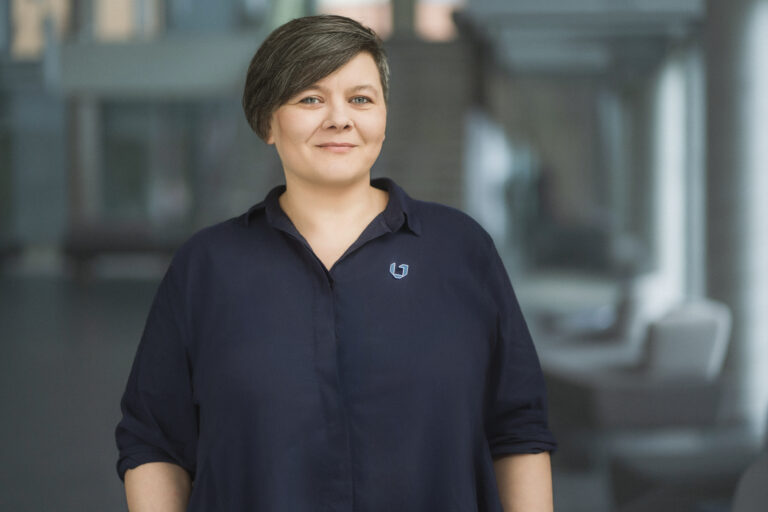
Artificial intelligence (AI), data analysis and other advanced technologies are transforming cities as well as our everyday lives. However, the origins of these solutions lie in the fundamental sciences. Prof. dr. Simona Ramanauskaite has begun leading the VILNIUS TECH Faculty of Fundamental Sciences (FMF), taking over as dean from prof. dr. Dalius Mažeika. Her vision focuses not only on scientific and technological progress, but also on an open, curious community that is ready to grow. We spoke with the new faculty dean about people, technology and the future direction of FMF. – What encouraged you to take on this challenge and accept your new position? – To be honest, I have never sought leadership positions. However, my desire to look for new opportunities, implement technologies and explore new ways of working, collaborating gradually led me to a such position. I accepted this challenge as an opportunity to implement the ideas I have. Together with members of the FMF community, we can create an environment that encourages personal as well as university development in the areas of science, studies and service to society. I believe that leadership in itself is not the goal. It is a means of bringing people together, motivating them and creating change collectively. – How do you see FMF's place and role within the university in the future? What, in your opinion, could make the faculty stand out? – I am convinced that the Faculty of Fundamental Sciences holds an important place within the university, and its significance will only increase in the future. Our activities and expertise in information technology, mathematics, physics and chemistry can become an important connecting component between different university departmentts. It could also strengthen the university's links with the wider environment. These competencies form the foundation for digital transformation, automation and the development of new technological solutions in various fields. I believe that the faculty's distinctive feature could be its ability to combine fundamental knowledge with an applied approach. This would not only create new knowledge, but also turn it into solutions valuable for science, business and society. However, to fully realize this potential, we must work together and look for opportunities to collaborate among faculties and different institutions. – What kind of FMF would you like to build as dean? – I would like to build an inclusive, open and curious community that shares its experience and actively learns from others. I would like this openness and curiosity not to be limited to the faculty. I believe that a strong, learning-oriented and collaborative FMF community can not only grow itself, but also contribute to the development of VILNIUS TECH as a whole. – Fundamental sciences can sometimes seem quite distant from people's everyday lives. However, their results form the basis of many technologies we use today. How close are fundamental sciences really to our everyday lives? – Fundamental sciences are much closer to our everyday lives than they may sometimes appear. The knowledge they generate forms the basis of many technologies we use today, but their value extends beyond technology and its commercialization. Fundamental sciences also directly contribute to quality of life – they help create a safer, more convenient, more efficient and more sustainable environment as well as address issues that are important to society. Therefore, I believe that the fields developed by our faculty are very closely connected to how we will live in the future. – What role do fundamental sciences play in creating the city of the future? – Knowledge of mathematics, information technology, physics and chemistry makes it possible to develop smarter, more efficient and more sustainable urban solutions. In addition to data-driven management and automation solutions it also includes systems for monitoring and ensuring environmental quality. I believe that the most important thing here is not only the technologies themselves, but also the ability to apply them to improve people's quality of life. Therefore, fundamental sciences can serve as an important link between on one side – university developed knowledge and technologies and on the other – the real needs of cities and society. – A smart city is no longer just a vision – it uses AI, data analysis and smart infrastructure solutions. In your opinion, how will these technologies change cities and their people's lives over the next 10-20 years? – For me, a smart city is impossible without smart residents. Therefore, when I think about the city of the future, I focus less on how many of the latest technologies it will have and more on how the people who use them will grow and change. Over the next 10-20 years, technology, AI and data analysis will undoubtedly become even more integrated into our everyday lives. However, the most important thing will not only be to know how to use them effectively, but also to learn how to apply them creatively, sustainably and flexibly. Therefore, I believe that the true measure of a smart city will not be the amount of technology it has, but its creative, curious and responsible residents, who are capable of using these technologies in meaningful ways. – Technology can help cities become more convenient, safer and more sustainable, but it also raises new questions. What risks or challenges should we not forget when creating a city that increasingly relies on technological solutions? – I believe the greatest risk is to think that technology will solve all of a city's problems on its own. Technology should be a tool that helps address real urban and societal challenges, so it is important to continuously evaluate the benefits and impact it creates. Consequently, when developing a smart city, it is important to maintain a balance: use technology where it creates value for people as well as the environment, while preserving critical thinking, freedom of choice and human connection.
More