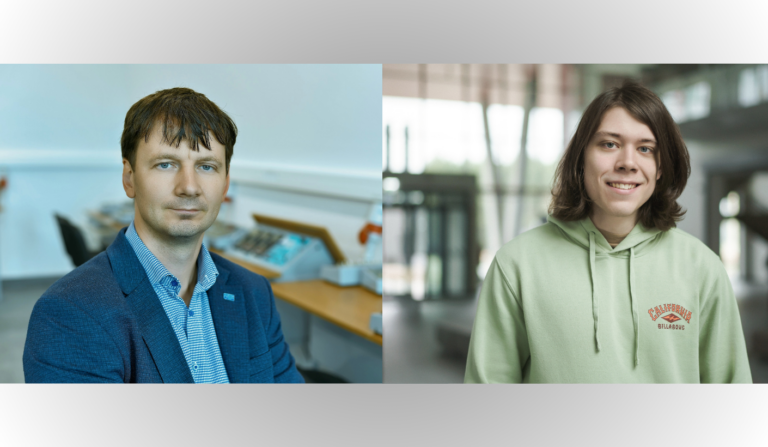
Last year, the new ATHENA Alliance Career Service-initiated project “Alumni Talks” began gaining momentum. Graduates from Vilnius Gediminas Technical University (VILNIUS TECH) are actively participating in this project as well. In these discussions, ATHENA alumni share their experiences, insights, and knowledge with the student community. This time, we dive deep into the world of physics with ATHENA alumnus Dr. Konstantinos Papastergiou, a Power Electronics Engineer in the CERN Systems Department.
The Main Projects of CERN
Dr. Papastergiou is currently engaged in projects critical to the future of scientific research at CERN. His work primarily focuses on designing power equipment essential for conducting reproducible experiments in particle accelerators and improving energy efficiency. One notable project involves developing power supplies for accelerator electromagnets that achieve remarkable precision, crucial for guiding particle beams.
This precision, as Dr. Papastergiou explains, is akin to hitting an ace in golf from 20 kilometers away. His ongoing efforts also include the development of a new system for powering kicker magnets, which could revolutionize the next generation of particle accelerators aimed at probing mysteries like the origin of dark matter.
The scientist also adds that he personally enjoys the processes and designs in view of making them better, more efficient, easier to use, and more performant.
“At CERN, I enjoy getting ownership of a mission and accomplishing it in ways that exceed people's expectations. To give you an example of our recent accomplishments, I can mention our latest regenerative power converter design that is now powering all transfer lines at CERN with an average of 30% lower power consumption. I recently started working on a niche technology for kicker magnet generators, and I will contribute with semiconductor and magnetics expertise to the inductive adders project pioneered at CERN,” he adds.
How Do Advancements in Power Electronics Technology Contribute to the Success of Experiments at CERN?
“Power electronics is a very dynamic field of engineering mainly driven by advances in power conversion for renewable energies, the transportation sector, and of course, consumer electronics, all of which require high energy efficiency and size reduction,” says Dr. K. Papastergiou.
The scientist explains that particle accelerators make use of technologies such as wide band-gap devices (silicon carbide, gallium nitride semiconductor switches) and advanced magnetic materials (grain-oriented silicon steel, nanocrystalline, and ferrite technology) to achieve faster and more reproducible/controllable accelerator cycles.
“One can think of the accelerator as a factory that needs to produce the same high-quality product (particle beams) with minimal time and material waste and with best-in-class reliability,” he adds.
Interdisciplinary Approach
As Dr. Konstantinos Papastergiou explains, the operation model of CERN is unique right from its inception. It is run by physicists whose role is to bridge the gap between theoretical physics and experiments. They collectively decide the direction for the next 10-30 years in strategy meetings, defining the accelerators and the instruments that need to be built.
“Engineers translate the experiment requirements to technology requirements and then design R&D programs to develop the parts of the technology that are missing. When a technology becomes available, CERN is first to adopt it, and engineers will start designing the accelerators,” says Dr. K. Papastergiou.
Thus, at this stage, many disciplines get involved, from planners to purchasing officers and civil engineers.
“Industries from member states will get involved to produce the equipment needed for the new accelerators, and then our own technicians and electromechanical technicians will help install everything in the tunnels. This project structure is unique for an organization that needs to work with the efficiency of a factory and with the creativity of a university; and it has proven itself with the most well-known of its projects, like the discovery of the Higgs boson,” says Dr. K. Papastergiou.
Careers at CERN
“CERN careers are attractive for the freedom and breadth they offer to people, hence the high demand. My advice for students is to get a first experience through trainee and technical student programs at the later stages of their studies. This is good both for their networking and for a better understanding of the work environment. But they should do this more than one time and in different companies during their studies,” highlights Dr. K. Papastergiou.
The scientist also has some other advice for students: “Following graduation, I suggest making up your mind between these two options: starting a career at CERN with our 2-3 year Graduate contracts and then moving for a career in industry, or starting a career in industry before landing a job as an experienced engineer at CERN. In other words, there are aspects of the job you can learn in industry while other skills can best be learned at CERN.”
Solving the Mysteries of Nature
“Dark matter is a term coined to describe a mystery mass that interacts with the cosmos as we know it and that we actually cannot see and measure using existing scientific instruments, hence the name 'dark matter',” explains Dr. K. Papastergiou.
The scientist adds that future particle accelerators, such as the “Future Circular Collider” and their experiments, will be designed to maximize the chances of detecting new particles that could, among other things, answer the 'dark matter' question.
“And just like the Nobel-winning discovery of the electron in 1898 had us scratching our heads for about 40 years prior to the appearance of the domain of 'electronics', it is likely that new discoveries such as the Higgs boson or the future dark matter-related particle could take another half-century before yielding useful results for humankind,” explains Dr. K. Papastergiou.
Dr. K. Papastergiou also adds, “What matters most is that on the path to discovery, CERN makes contributions that improve our lives, such as the invention of the World Wide Web, among others. And just like the Greek Nobel laureate Odysseus Elytis wrote in his poem 'Ithaka', what really matters in life is the journey itself, rather than reaching the destination.”
In the ATHENA Alumni Talks series, Dr. K. Papastergiou delved into even more aspects of CERN's importance and projects conducted there.
Watch the video recording of Dr. K. Papastergiou's discussion here: Link to the video
What is the ATHENA European University Alliance?
VILNIUS TECH is part of the ATHENA European University Alliance, which constantly offers mobility and development opportunities for students and staff. The ATHENA alliance partners are universities in ten European countries (Greece, Italy, Poland, Lithuania, Portugal, Slovenia, Spain, France, Germany, and Ukraine).
Stay in tune with ATHENA news – sign up for the newsletter, follow ATHENA on social media, and regularly check our website for more.
Galerija