
University of the future: dialogue between the past and the present

July 27, 2026

How does the role of a university change when viewed from two different perspectives: that of a former student who has now become a lecturer, and that of a current student just beginning their academic journey? How does university appear to someone who started there as a student and today teaches others, and how is it perceived by a student only taking one’s first independent steps in life?

Representatives of the VILNIUS TECH Faculty of Electronics – Prof. Dr. Andrius Katkevicius from the Department of Electronic Systems and electronics engineering student Nojus Balciunas – are two different generations taking a fresh look at today’s university and its future.

Prof. Dr. Andrius Katkevicius, Department of Electronic Systems, Faculty of Electronics
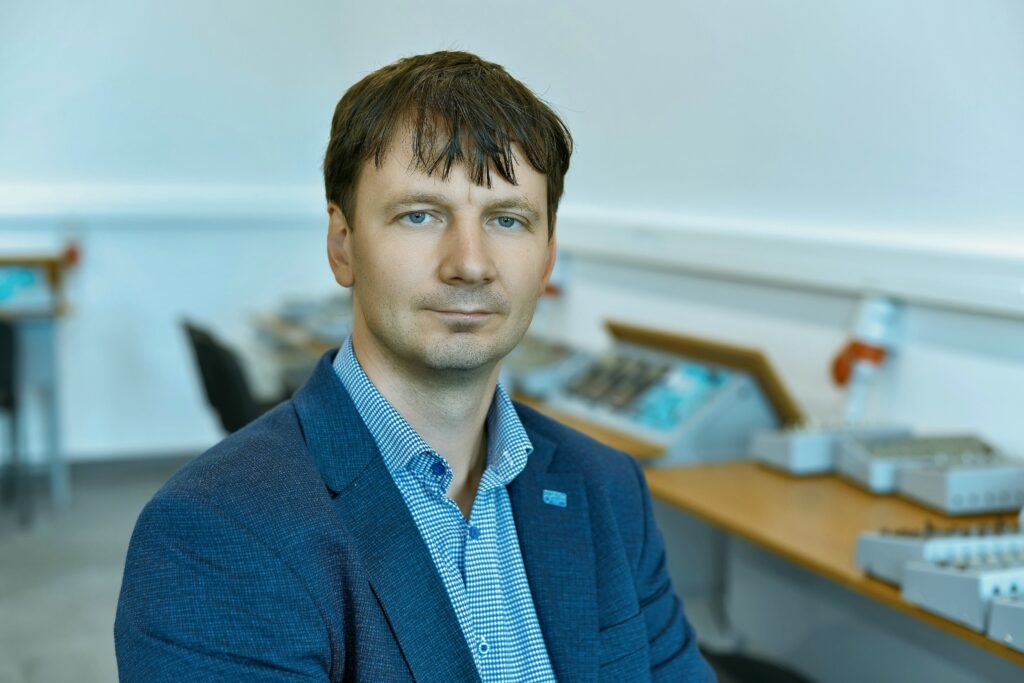
How has your view of the university changed from your student years to now as a lecturer?

My perspective has changed significantly over time. When I studied electronics engineering at the Faculty of Electronics, I only saw a small part of university activity – mostly the teaching process. At that time, the university was associated with lectures, laboratory work, practical classes, and exams. During my bachelor’s studies, I naively believed that successfully passing all exams was enough to secure a future in engineering career. Practice showed that in order to become a professional in your field, it is necessary to do extra work and actively participate in the chosen area of electronics, deepen your knowledge independently, and continuously improve yourself. Only during my master’s studies did I begin to clearly understand that active scientific work is also carried out at the university.

Today, after completing all stages of higher education and gaining pedagogical and scientific experience, I see the university as a multifaceted institution encompassing a wide range of activities and opportunities – from educating first-year bachelor’s students to carrying out scientific and commissioned projects with local as well as international partners.

How are student generations and their relationship with learning changing?

Today’s students are more focused on practical benefits and quick results. They have much broader and faster access to information, so they are increasingly less limited to material presented during lectures. At the same time, however, they face challenges related to information overload and evaluating information quality, especially when many answers can be obtained through artificial intelligence. There is a growing need for practical learning, understanding how knowledge is applied in real contexts, and seeing the value of studies in future professional activities. Students’ expectations toward lecturers are also changing – dialogue, feedback, and a clearly structured learning process are increasingly valued. Although some students lack patience for long-term and consistent work, they are also more open to new technologies, digital tools, and flexible forms of learning. This encourages lecturers to constantly review and update their teaching methods.

If you could compare the university from your student years with the current one, what has changed the most?

One of the most noticeable changes is the study and research environment. A few years ago, after moving into new facilities, a modern and well-designed infrastructure was created, which clearly focused on study quality, scientific research, and collaboration. This environment not only improved technical possibilities but also changed the academic culture and daily work at the university. Fundamentally, the understanding of the university’s role has changed – from an institution mostly focused on the study process, the university has become a much more active center for science, innovation, and project-based activities. Today, the university creates opportunities for students to participate in scientific, applied, and international projects, something that was previously less visible or accessible.

Another important change is the advancement of learning tools and technologies related to digitalization as well as the application of artificial intelligence. Today, students have access to advanced digital learning platforms, virtual laboratories, simulation tools, and AI-based support systems that can help analyze, model, and deepen their knowledge. This fundamentally changes the learning process – from passive absorption of information to active, independent, and individualized learning.

What should universities do differently today to better prepare students for the future?

Universities should enhance the connection between studies and real practical experience even more, so that students can more clearly understand how acquired knowledge will be applied in professional activities. This includes closer cooperation with businesses and scientific partners, project-based learning, and involving students in applied and scientific projects as early as possible.

It is important to develop not only subject-specific competencies but also general abilities – critical thinking, independence, responsibility for the learning process, and the ability to adapt to constantly changing technologies. Universities should encourage students to learn throughout life, experiment, make mistakes, and learn from experience, while also providing a suitable academic environment, which encourages that.


Nojus Balciunas, 3rd-year Electronics Engineering Student, Faculty of Electronics
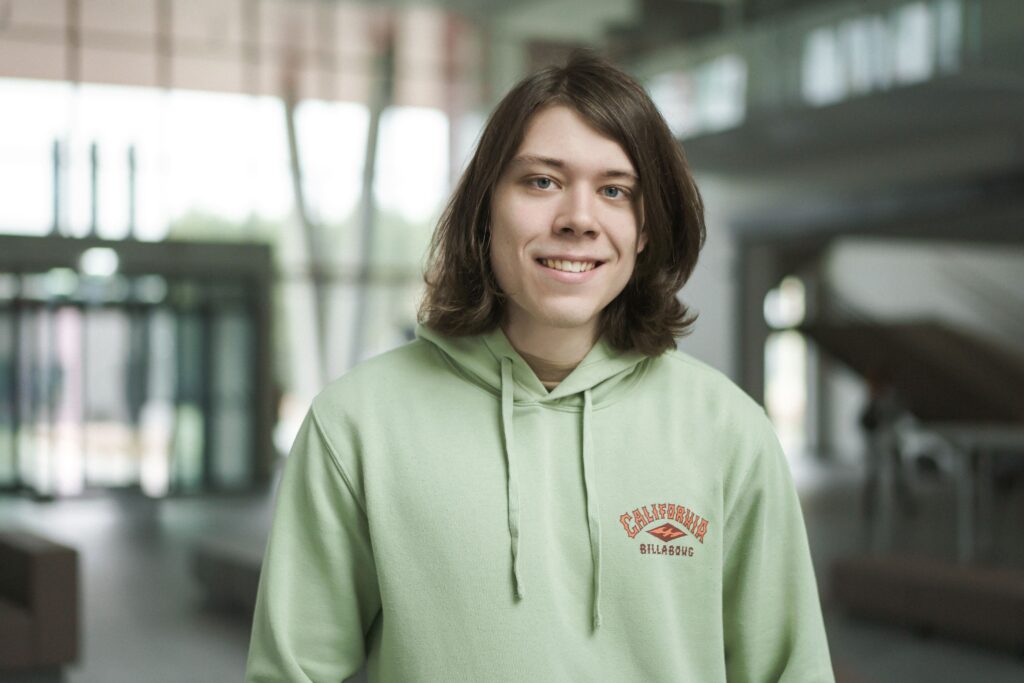
How would you describe the university and the significance of studies?

For me, the university is first and foremost a community. Members of the VILNIUS TECH community are very warm and supportive people who constantly encourage participation in various activities organized both within and outside the university.

Studies at VILNIUS TECH are an extremely significant stage of life. I can acquire not only academic knowledge but also practical skills, while developing critical thinking, independence, and responsibility. Of course, it is also a kind of transition into adult life, but even more importantly, it is a stage of growth, self-improvement, and self-discovery. I believe this is one of the most important periods in life.

What expectations do you currently have for the university, and are they different from what you imagined before starting your studies?

When I started studying at the university, I expected to gain more practical experience during lectures, but I soon realized that opportunities to gain such experience are provided beyond lectures. The university offers various additional activities, programs, and internships that students can join to deepen their knowledge and become more involved in practical activities. These opportunities are one of the university’s greatest advantages – it provides space to grow, improve, and shape your own study path.

What experiences or skills gained during studies are the most valuable?

I believe the most important acquired skills are the so-called soft skills: being proactive, the ability to present your work and ideas, adapt to new environments, and respond quickly to changing situations.

How do you imagine the university of the future – what should be different there compared to today?

It is difficult to imagine the university of the future being very different from what it is now. Of course, laboratories and the equipment in them will become even more modern over time, but even today it is clear that VILNIUS TECH is constantly updating, expanding, and implementing the latest technologies.

However, I believe that in the future laboratories will become even more open, giving students more opportunities to independently work on projects and implement their ideas outside of study hours.

What motivates you the most today to study and improve yourself?

What motivates me the most is my love for electronics and the desire to understand things I do not yet understand. And there are still very many such things.

Related news

From Childhood Jenga Towers to Lasers and Global Projects: Silvija and Deividas Launched Their Careers While Still Studying
From geography textbooks to laser technologies, from childhood building-block bridges to professional product design – the path to mechanical engineering can be highly diverse. The stories of Silvija, a student at the VILNIUS TECH Faculty of Mechanics, and Deividas, an alumnus, reveal that a successful start in this field doesn't require dreaming of an engineering career from a young age or being a physics olympiad champion. From a Love for Geography to Mechanical Engineering Silvija laughs that she knew almost nothing about mechanical engineering in school. Even in the twelfth grade, she was convinced she would study geography. "I really liked geography; it was the top choice on my list. I knew almost nothing about mechanical engineering and didn't really even know what it was," she recalls. "However, that very ignorance became one of the main reasons to try it. I thought it would be interesting to go into something I knew little about. I wanted something new, something that would broaden my horizons." Today, Silvija is deeply immersed in her mechanical engineering bachelor's studies, having chosen a specialization in renewable energy. For nearly a year and a half, she has been working at one of the largest laser technology companies in Lithuania "Light Conversion". There, she contributes to the assembly, testing, and quality control of various components, as well as the preparation of technical documentation. Although she didn't choose advanced (A-level) physics in high school and didn't study chemistry at all, this wasn't an obstacle at the university: "In my first year, it was a bit scary when the professors asked who had taken the national physics exam, and almost the entire lecture hall raised their hands. But they truly explained everything from the basics, so it wasn't as difficult as I thought." Today, she encourages other high school graduates not to fear the stereotypes surrounding this science and to let go of any preconceived notions. "If even a part of you thinks it would be interesting—you have to try. Mechanical engineering is definitely not a dry or boring science," says the student. Early Engineering Attempts – Starting in Childhood For Deividas Bajorūnas, on the other hand, the choice was much clearer right from childhood. He remembers that engineers always seemed to him like people who could create almost anything. "In the movies, an engineer was a person who achieved great things with limited resources. That fascinated me," says Deividas. As a child, he loved constructing bridges out of building blocks and building various structures, and those around him constantly noticed his strong spatial reasoning. According to the young engineer, this definitely contributed to his decision. Today, Deividas holds both bachelor's and master's degrees in Mechanical Engineering and has been working as a design engineer at the company "MK technika" for three years. He designs, optimizes, conducts inspections, and contributes to design solutions. According to him, one of the greatest strengths of mechanical engineering studies is the incredibly broad spectrum of knowledge it provides. "The university taught us more than just design. We studied electrical engineering, fluid mechanics, materials science, and the use of measuring instruments. Even in everyday life, I still get to use that knowledge," Deividas explains. "However, the most important thing, in my opinion, wasn't the specific subjects, but the critical thinking that was developed. The university cultivates an engineering mindset. You start thinking about the conditions under which a product will operate, which materials are suitable, how it can be assembled and repaired, and what its ergonomics are." Received Job Offers While Still Studying Both Silvija's and Deividas' stories share one common feature: they both started working during their studies. Silvija got her job at the laser company after an acquaintance from the Student Representation offered her his recently vacated position: "I thought—why not? I wanted to test myself." The student shares that today at work, the things she learned at university come in handy—drafting, design knowledge, spatial reasoning, and an understanding of how various mechanisms work, as these are an integral part of her daily routine. Meanwhile, Deividas gained his first experience during an internship at an optics company, where he manufactured optical lenses: "Because their production had strict requirements and the lenses themselves are extremely fragile, the work had to be done with immense care, precision, and diligence. If you missed the required tolerances or didn't get the roughness right, the lens had to be thrown away, and you had to start over. But it was one of the first jobs where my engineering education proved useful." When asked what excites them most about their work, both interviewees unhesitatingly mention creativity and the opportunity to see a tangible result. For Silvija, the most important thing is that the work isn't monotonous—she can communicate with colleagues and solve arising challenges, while at the same time working independently. Deividas, meanwhile, says he feels the greatest pleasure when he can see the product he designed in real life. According to him, design work allows for the combination of technical and creative thinking. "Sometimes I even draw various options on paper, fold paper models, or go for a walk to find a solution. The technical part is easier to figure out, but making the product aesthetically pleasing—that's much harder. However, the absolute best feeling in life is being able to touch and see how the object you designed comes together in reality." It's Not Just About Numbers in Engineering Although mechanical engineering is often associated solely with technical skills, both interviewees emphasize that soft skills, which they acquired during their studies, are equally important. "The university taught me independence and problem-solving. During your studies, there isn't a single template for how to do everything—you have to find your own way to solve challenges and get the work done," says Silvija. Her involvement in the Student Representation also had a major impact on her. She says that this is where she blossomed as an individual, had the opportunity to expand her circle of like-minded people, and learned a crucial lesson that also helps at work: when you need help or advice, don't be afraid to ask your colleagues. Deividas highlights the importance of communication and leadership: "In projects, I often had to take the initiative myself, ask the important questions, and guide the team, because one of the most vital things in engineering is knowing how not to get lost in problems. Also, attention to detail and the ability to gather information, as this helps prevent future mistakes." A Field Where There is Definitely No Shortage of Work Both interviewees agree—one of the greatest strengths of mechanical engineering is the endless career opportunities. "It's a very broad field. There are many different manufacturing and tech companies, so there's certainly no shortage of job opportunities. Furthermore, employers value your motivation—even if you don't have much experience and your CV doesn't perfectly match the criteria, if you show that you're curious and willing to learn, getting a job becomes much easier," says Silvija. Deividas agrees: "Mechanical engineering provides a vast wealth of knowledge. It requires a lot of effort, but with such knowledge, you will definitely find your place in the world." Silvija also encourages girls not to be afraid of this field, which was once considered "masculine," and to boldly choose engineering studies. "No one is going to ask, 'What are you doing here?' Professors are often actually happy to see more and more girls in the lecture halls. If you have curiosity and desire—everything is absolutely possible!" You can find more information about studies at the VILNIUS TECH Faculty of Mechanics here: https://vilniustech.lt/en/faculty-of-mechanics/ 
More