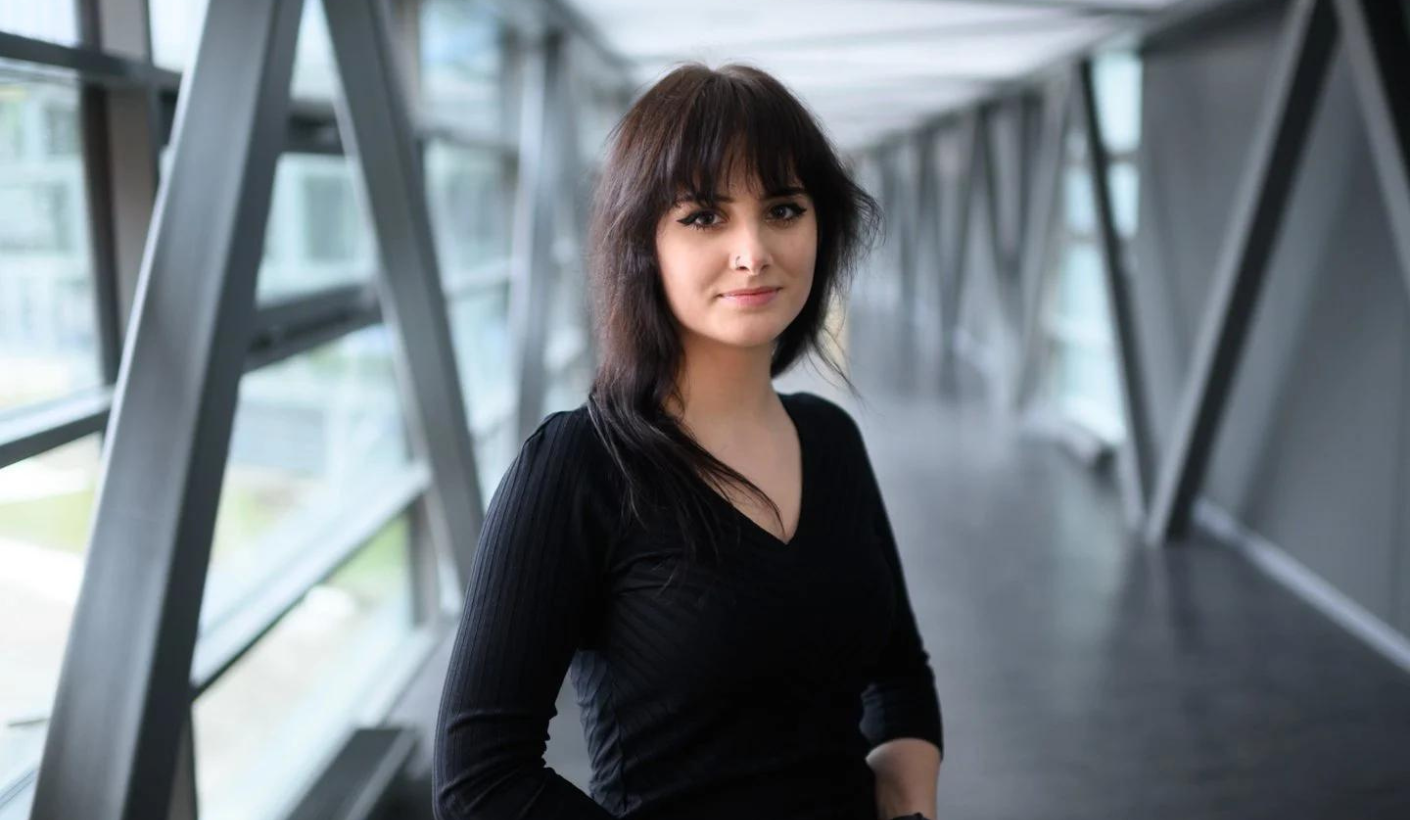
Construction engineering student Gabija: "Studies helped me see the city differently"

April 9, 2024
When she was young, Gabija Bajorinaite (20), a native of Kaunas, Lithuania, loved assembling puzzles and building objects with LEGO. As she grew up, her hobbies evolved, but the essence remained the same: Gabija is now studying Civil Engineering at Vilnius Gediminas Technical University (VILNIUS TECH) and is determined to "construct" real, sturdy buildings in the future.

The first-year student revealed that her choice of studies was unexpected not only for her relatives but also for herself, but she is very happy she has made it.

Gabija did well in school, excelling in both sciences and arts. When she was in the tenth year, she started to vert seriously about what she wanted to study. "Once, during dinner, I asked my family where they saw me in the future. They listed various options, but one thing my dad mentioned stuck with me: architecture," Gabija recalled.

After some further consideration, Gabija decided she wanted to study architecture and started the preparation by attending drawing classes.

Confident in her decision, Gabija attended open days at VILNIUS TECH last spring.

"There I had a chance to listen to Rimvydas Berzonskis, the Chairman of the Alumni Association of the Faculty of Construction, talk about the field of Civil Engineering. Whilst casually listening there was something that captured my attention – the lecturer was charismatic, engaging, and said that some people imagine that the graduates of this program are just construction workers with diplomas, but it's so much more than that…," the student remembered.

After that, Gabija told herself not to doubt and hesitate, as she was firmly determined to study architecture. However, thoughts about Civil Engineering never left her mind. These two disciplines are closely related, with architecture focusing more on the artistic side of structures, while engineering focuses on the technical aspects. Moreover, Gabija has always enjoyed drawing and applied mathematics.

Applied only for one study program

She initially hesitated to tell her relatives that she had doubts about her previous choice, but after researching and considering more, she admitted that she had changed her mind and wanted to study Civil Engineering. Her relatives supported her decision, although her grandmother said that the profession seemed too masculine – something Gabija had never considered before.

The only doubt Gabija's parents had was the news that their daughter was going to study in Vilnius instead of Kaunas. Although the same program could be done in Kaunas, Gabija, after researching the rankings, saw that VILNIUS TECH offered better-quality studies – and she was determined to choose the best option.

So, just a month before the application deadline, Gabija decided to study Civil Engineering in the capital city. She was so determined that she didn't even write down any other programs in her application – she thought that if she didn't get in on the first try, she would wait a year and try again.

Luckily, Gabija succeeded in getting accepted on her first attempt. She remained very happy with her choice – the studies are genuinely interesting, classmates are friendly, and professors are supportive.

Although she imagined that most of her classmates would be boys, there are many girls there. Gabija gets along well with her room-mate from the dormitory. According to her, they both study and live surrounded by forests in the Sauletekis area – and they find it very enjoyable.

"Starting my studies, I was worried about not doing physics and chemistry in the eleventh and twelfth grades, and they are necessary here. However, there were additional classes fo these subjects for those who hadn't studied them, the professors were willing to help, and I studied on my own which led me to receiving a perfect score for the physics exam," said the student, whose overall average for the first session exams was 9 points.

Seeing the city through different set of eyes

During introductory lectures, students, along with the lecturer, went on excursions around the old town of Vilnius, where they assessed buildings through the lens of their discipline. "The lecturer explained what certain cracks on buildings mean, what their causes are, and it was very interesting. After that, I started looking at the city with different eyes, always thinking about what caused a certain defect on a building," observed Gabija.

She has no doubt that her choice was right, and she is convinced that she will enjoy working as a Civil Engineer (and there is no shortage of jobs for such specialists).

One of the introductory lectures was attended by Rimvydas Berzonskis mentioned earlier – after the lecture, Gabija approached him and thanked him for his presentation during the open days, which really changed her life.

"Many other specialists also attended the lectures, telling us about this discipline, and I got the impression that they are all very cool people, and they all seemed happy," the student said enthusiastically.

Girls are not afraid of engineering

Juste Rozene, Director of the Admission and Information Center of VILNIUS TECH, shared: "We sometimes still encounter prevalent beliefs in society that VILNIUS TECH is more suitable for boys, and it takes time to refute those beliefs.

The proportion of girls studying at VILNIUS TECH remains similar – a third, but looking at the engineering study direction over the past decade, the situation is indeed changing, and female students sometimes get annoyed that stereotypes about women in engineering are still being perpetuated. Their choice of such a study direction goes far back to school when they never even considered that such studies were not for them.

In 2018, 113 women and 444 men chose engineering studies at VILNIUS TECH (women accounted for 20.3%); in 2023 – 135 women and 494 men (women – 21.46%).

Girls most often choose industrial product design (70.8% in 2023), environmental engineering (66.7%), geodesy and geo-informatics (44.4%), flight management (50%), bioengineering (90%), medical engineering (55.6%), multimedia and computer design (50%).

There are also quite a few girls in Civil Engineering, which Gabija is studying – currently, there are 407 students in total, including 296 boys and 111 girls (27%).

Although girls do not constitute the majority in engineering disciplines, their results are certainly not worse than boys', and some girls' results are even significantly better; girls' averages exceed 8, and more than half of them even score 9. They are diligent, careful, and brave. They are not afraid to gain practical experience in companies and engage in additional activities, combining not only a passion for engineering but also, for example, event organisation.

Engineering studies can ensure career success and financial stability. No need to doubt yourself and expect the subjects taught at university to be impossibly difficult. Another piece of advice for those who doubt and fear – come to the open days and open lectures organised by universities and try the role of a student. It will definitely help you decide," noted Dr. J. Rozene.

The Career Day VILNIUS TECH GRAVITY will take place on April 18 this year. It is the epicentre of synergy between scientific talents, leading country businesses, and modern organisations, whose gravitational force attracts people capable of not only overcoming existing laws of the universe but also creating new, ambitious, and promising business rules. The VILNIUS TECH Career Festival (Sauletekio al. 11) will bring together not only students, alumni, but also schoolchildren, the most promising companies, and various organisations. Over 9000 participants attended the event in 2023. Students will have the opportunity to interact with lecturers and students, listen to discussions on relevant topics, and see how many important companies are interested in VILNIUS TECH talents to strengthen their teams. More about the Career Day – karjerosdienos.vilniustech.lt

Photo by V. Skaraitis.

Galerija
Related news

University of the future: dialogue between the past and the present
How does the role of a university change when viewed from two different perspectives: that of a former student who has now become a lecturer, and that of a current student just beginning their academic journey? How does university appear to someone who started there as a student and today teaches others, and how is it perceived by a student only taking one’s first independent steps in life? Representatives of the VILNIUS TECH Faculty of Electronics - Prof. Dr. Andrius Katkevicius from the Department of Electronic Systems and electronics engineering student Nojus Balciunas - are two different generations taking a fresh look at today's university and its future. Prof. Dr. Andrius Katkevicius, Department of Electronic Systems, Faculty of Electronics How has your view of the university changed from your student years to now as a lecturer? My perspective has changed significantly over time. When I studied electronics engineering at the Faculty of Electronics, I only saw a small part of university activity - mostly the teaching process. At that time, the university was associated with lectures, laboratory work, practical classes, and exams. During my bachelor's studies, I naively believed that successfully passing all exams was enough to secure a future in engineering career. Practice showed that in order to become a professional in your field, it is necessary to do extra work and actively participate in the chosen area of electronics, deepen your knowledge independently, and continuously improve yourself. Only during my master's studies did I begin to clearly understand that active scientific work is also carried out at the university. Today, after completing all stages of higher education and gaining pedagogical and scientific experience, I see the university as a multifaceted institution encompassing a wide range of activities and opportunities - from educating first-year bachelor's students to carrying out scientific and commissioned projects with local as well as international partners. How are student generations and their relationship with learning changing? Today's students are more focused on practical benefits and quick results. They have much broader and faster access to information, so they are increasingly less limited to material presented during lectures. At the same time, however, they face challenges related to information overload and evaluating information quality, especially when many answers can be obtained through artificial intelligence. There is a growing need for practical learning, understanding how knowledge is applied in real contexts, and seeing the value of studies in future professional activities. Students' expectations toward lecturers are also changing - dialogue, feedback, and a clearly structured learning process are increasingly valued. Although some students lack patience for long-term and consistent work, they are also more open to new technologies, digital tools, and flexible forms of learning. This encourages lecturers to constantly review and update their teaching methods. If you could compare the university from your student years with the current one, what has changed the most? One of the most noticeable changes is the study and research environment. A few years ago, after moving into new facilities, a modern and well-designed infrastructure was created, which clearly focused on study quality, scientific research, and collaboration. This environment not only improved technical possibilities but also changed the academic culture and daily work at the university. Fundamentally, the understanding of the university's role has changed - from an institution mostly focused on the study process, the university has become a much more active center for science, innovation, and project-based activities. Today, the university creates opportunities for students to participate in scientific, applied, and international projects, something that was previously less visible or accessible. Another important change is the advancement of learning tools and technologies related to digitalization as well as the application of artificial intelligence. Today, students have access to advanced digital learning platforms, virtual laboratories, simulation tools, and AI-based support systems that can help analyze, model, and deepen their knowledge. This fundamentally changes the learning process - from passive absorption of information to active, independent, and individualized learning. What should universities do differently today to better prepare students for the future? Universities should enhance the connection between studies and real practical experience even more, so that students can more clearly understand how acquired knowledge will be applied in professional activities. This includes closer cooperation with businesses and scientific partners, project-based learning, and involving students in applied and scientific projects as early as possible. It is important to develop not only subject-specific competencies but also general abilities - critical thinking, independence, responsibility for the learning process, and the ability to adapt to constantly changing technologies. Universities should encourage students to learn throughout life, experiment, make mistakes, and learn from experience, while also providing a suitable academic environment, which encourages that.   Nojus Balciunas, 3rd-year Electronics Engineering Student, Faculty of Electronics How would you describe the university and the significance of studies? For me, the university is first and foremost a community. Members of the VILNIUS TECH community are very warm and supportive people who constantly encourage participation in various activities organized both within and outside the university. Studies at VILNIUS TECH are an extremely significant stage of life. I can acquire not only academic knowledge but also practical skills, while developing critical thinking, independence, and responsibility. Of course, it is also a kind of transition into adult life, but even more importantly, it is a stage of growth, self-improvement, and self-discovery. I believe this is one of the most important periods in life. What expectations do you currently have for the university, and are they different from what you imagined before starting your studies? When I started studying at the university, I expected to gain more practical experience during lectures, but I soon realized that opportunities to gain such experience are provided beyond lectures. The university offers various additional activities, programs, and internships that students can join to deepen their knowledge and become more involved in practical activities. These opportunities are one of the university's greatest advantages - it provides space to grow, improve, and shape your own study path. What experiences or skills gained during studies are the most valuable? I believe the most important acquired skills are the so-called soft skills: being proactive, the ability to present your work and ideas, adapt to new environments, and respond quickly to changing situations. How do you imagine the university of the future - what should be different there compared to today? It is difficult to imagine the university of the future being very different from what it is now. Of course, laboratories and the equipment in them will become even more modern over time, but even today it is clear that VILNIUS TECH is constantly updating, expanding, and implementing the latest technologies. However, I believe that in the future laboratories will become even more open, giving students more opportunities to independently work on projects and implement their ideas outside of study hours. What motivates you the most today to study and improve yourself? What motivates me the most is my love for electronics and the desire to understand things I do not yet understand. And there are still very many such things.
More
Photography Exhibition "Leaving My Body" by Ieva Mizgeraitė
We invite you to visit the photographic exhibition "Leaving My Body" by VILNIUS TECH alumna Ieva Mizgeraitė. This collection is a journey through a woman's inner world – through the body, emotions, self-discovery, and the attempt to look at oneself from the outside. In her work, the photographer explores a body that does not always conform to society's expectations, situations beyond our control, the masks we see around us and sometimes put on ourselves, as well as the constant demand to be strong, equal, and always ready. “Each project was born from a specific emotion – from the noise and dialogue in my mind that arose at that moment. Searching for answers, I left my body and looked at everything from the outside – through the states of my models, their poses, gazes, and bodies. I understood that when you look at yourself from the outside, emotions become temporary. Inner dilemmas that once seemed permanent begin to dissolve,” the photographer says about the concept behind the exhibition. The exhibition brings together anger, resistance, masks, expectations, and freedom. These are not merely personal themes – they are experiences familiar to many women. The photographer says that she captures not faces, but psychological states. For her, photography has become a way of self-discovery and self-reflection – a form of meditation that helps her step away from the noise of the outside world and better understand what truly matters. The author works predominantly in black and white. She has been professionally active in photography since 2025. The exhibition "Leaving My Body" is an introduction to a deeper journey, which is planned to be presented in Gallery A of the library in November 2026.   The exhibition is on display in the foyer on the second floor of the Central Library.
More