Creating a solution for a smarter city: drones and artificial intelligence to monitor the capital’s streetlights

October 28, 2026

Smart cities today are not limited to smart traffic lights or data analysis platforms. Technology is increasingly being used to address everyday urban maintenance tasks as well. One such solution is being developed in the final thesis of Laurynas Zalaga, a master’s student at the Faculty of Fundamental Sciences at VILNIUS TECH. Studying in the „Management of Artificial Intelligence Solutions“ programme, the student decided to explore how drones and artificial intelligence (AI) could be used to automate the monitoring of urban lighting systems and identify faults more quickly.

Laurynas Zalaga

Laurynas Zalaga

„The idea came from looking for a practical solution to one of the everyday problems associated with maintaining urban infrastructure. Approximately half of the streetlights within the territory of the Vilnius City Municipality do not have controllers that would allow faults to be detected automatically. As a result, the responsible services often learn about a malfunctioning streetlight only after receiving reports from residents. This created a need for a reliable yet cost-effective solution allowing the condition of the city’s lighting systems to be monitored more efficiently,“ explains L. Zalaga.

Both drones and AI play an important role in the solution proposed by the student. First, a flight route is planned and transmitted to the drone. At a predetermined time, the drone automatically takes off from a docking station and follows the route, photographing locations where lighting poles are recorded according to their coordinates. After the flight, the collected data is transferred to a cloud platform, where it is analysed by a pre-trained AI model. By evaluating the images, the model can accurately determine which streetlights are not working and which ones require repairs.
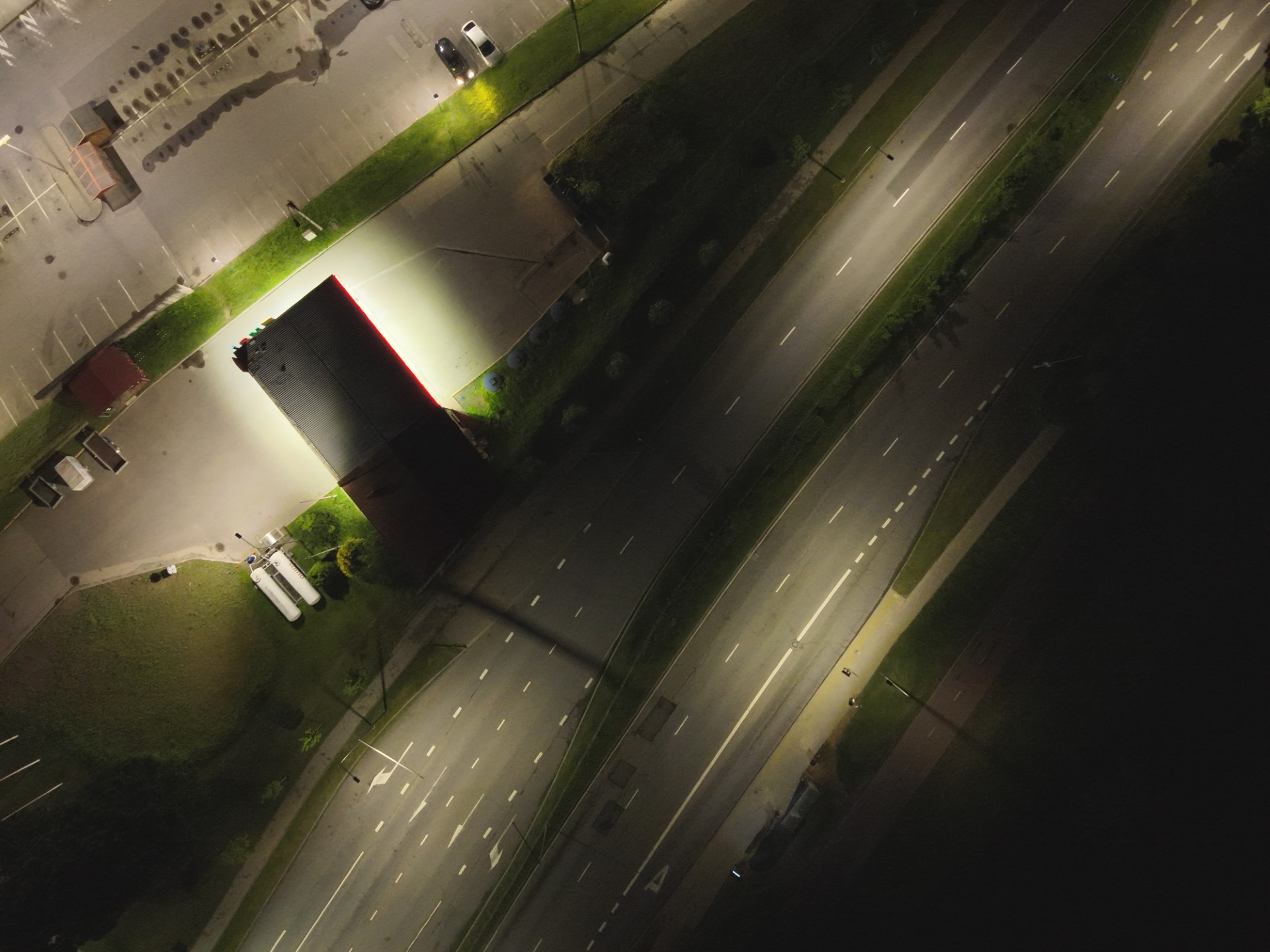
Images collected by drones

Image collected by drones

„Such a solution would provide tangible benefits to the city. Faults would be detected more quickly and therefore repaired more promptly, while the quality of urban lighting would improve. At the same time, infrastructure maintenance work could be organised more efficiently and dependence on random reports of faults could be reduced,“ the VILNIUS TECH student explains, describing the benefits of the solution.

However, according to L. Zalaga, urban lighting is only one of the potential areas where the technology could be applied. Images collected by drones could also be used to assess the condition of other parts of urban infrastructure. Even images captured during nighttime could be analysed to assess road surface conditions, traffic control infrastructure, bicycle paths, road markings, and other urban elements. This would make it possible in one flight to collect data that could be useful for different areas of urban maintenance.

„The biggest challenge in developing the solution was preparing the dataset required to train the AI model. This required the shutdown of specific streetlights during nighttime to coincide with the drone’s flight and photography schedule. The process had to be carried out efficiently and promptly, as prolonged lack of lighting could cause inconvenience or even pose a danger to residents.
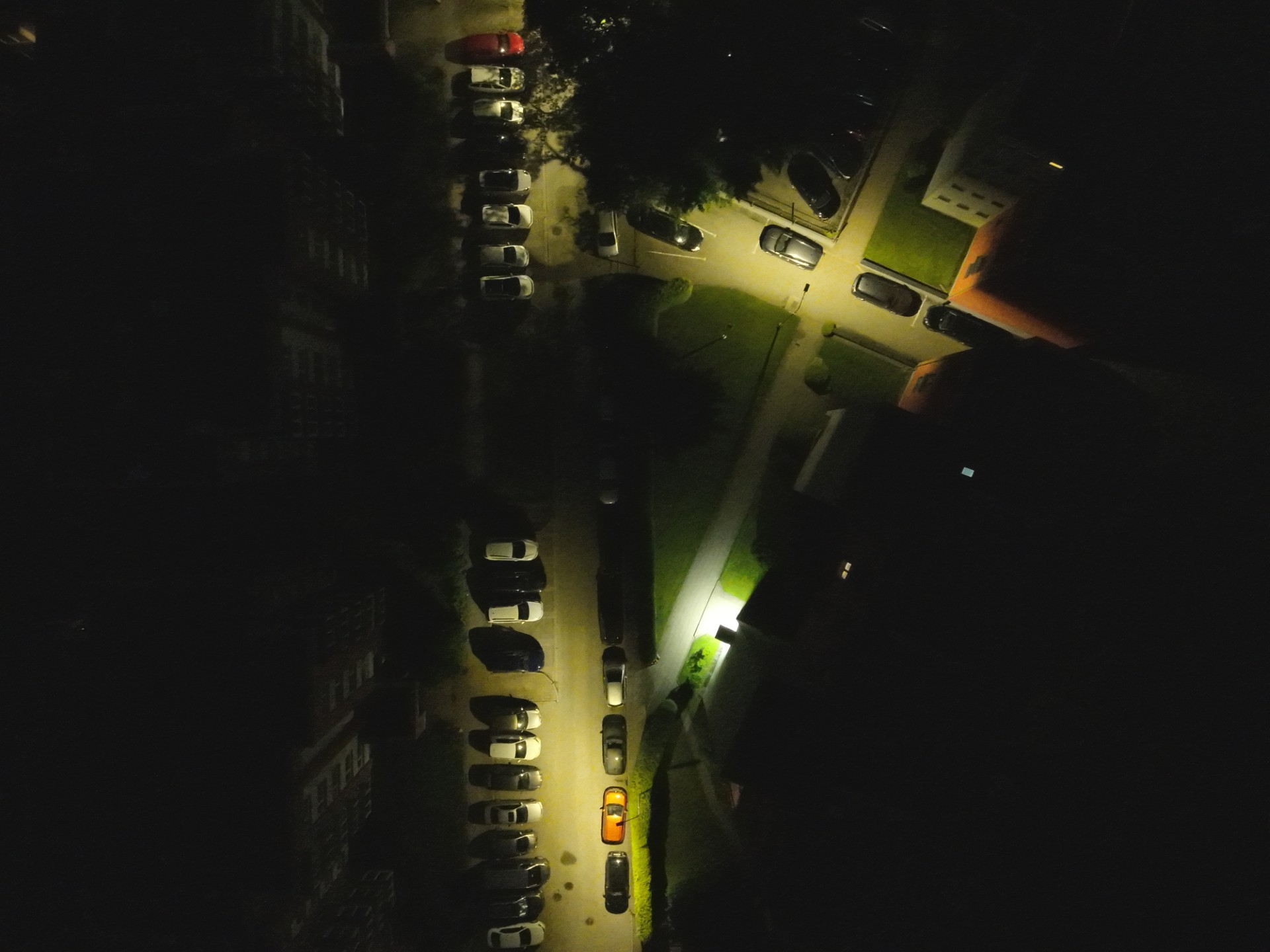
Images collected by drones

Image collected by drones

Additional challenges also arose when annotating the images. Sometimes, even when we knew which streetlights had been switched off, they were difficult to locate because of insufficient lighting.

Nevertheless, every stage of the project provided valuable practical experience and helped me better understand both AI and the possibilities for managing urban infrastructure,“ L. Zalaga shares.

In the opinion of the VILNIUS TECH student, in the future the management and maintenance of cities will increasingly become data-driven and based on real-time information. More and more processes will operate autonomously, while AI and other advanced technologies will help identify problems more quickly as well as make it possible to predict them before they become serious challenges. This would open up opportunities to create cities that operate more efficiently, are safer and smarter.

You can find this article in the September 2026 issue of Sapere Aude.
Related news

Join the International RobotHack 2026 Hackathon!
The international AI and robotics hackathon “RobotHack 2026” will take place on 24–28 November, bringing together students, technology enthusiasts and professionals from various fields to develop innovative solutions to real-world challenges. VILNIUS TECH students are invited to put their ideas into action, gain practical experience and compete for a total prize pool of €8,000. Registration is open until 19 November. RobotHack 2026 offers students an opportunity to apply their knowledge in practice, collaborate with people from different backgrounds and explore innovative solutions using artificial intelligence, robotics and automation technologies. This year's hackathon will focus on three main challenge areas: Logistics – developing smarter and more efficient solutions for moving goods, resources and autonomous systems. Humans + Robots – exploring technologies that improve interaction and collaboration between people and robots. Smart Cities – using artificial intelligence, robotics and connected technologies to address urban and public-sector challenges. Open to students from all academic backgrounds The hackathon is not limited to engineering or IT students. Participants from design, business, creative disciplines and other fields are equally welcome. No prior robotics experience is required. Curiosity, creativity and a willingness to collaborate are what matter most. Each team must include at least one student enrolled at a higher education institution in the European Union. Five days of innovation and expert mentoring RobotHack 2026 will take place in a hybrid format, combining online activities with in-person events in Riga, Latvia. The hackathon will kick off on 24 November at the Transport and Telecommunication Institute (TSI) in Riga. The opening event will also be livestreamed. From 25 to 27 November, participants will take part in online workshops, teamwork activities and mentoring sessions with experts. Optional in-person laboratory visits will be available on 26 November. The hackathon will conclude on 28 November with an in-person Demo Day at Riga Technical University (RTU), where teams will present their solutions. Register by 19 November Participation is free of charge, and the total prize pool is €8,000. Don't miss this opportunity to turn your ideas into practical solutions, connect with like-minded innovators and contribute to the development of future technologies! Registration closes on 19 November.
More
Lina Vai's Exhibition “She. A Journey on Earth” at the VILNIUS TECH Library
We invite you to explore “She. A Journey on Earth”, a painting exhibition by artist Lina Vai that explores the journey of human life, connections with ancestors, and the passage of time through personal experiences, family stories, and reflections on feminine identity. Lina Vai (Lina Vaicekauskaitė-Maslenskienė, born in 1978 in Vilnius) earned a Master's degree in Design from the Vilnius Academy of Arts in 2005. Throughout her career, she has worked in furniture and graphic design and has also created educational cardboard toys for children. Since 2017, however, her primary focus has been painting. According to the artist, painting has become a space where, through colours and brushstrokes, she seeks self-discovery, reflects on life experiences, and engages in a dialogue with her inner world. The origins of the exhibition “She. A Journey on Earth” can be traced to several family photographs of special significance. These images capture the final moments of the artist’s grandmother living in her home and on her land. The photographs inspired reflections on the path of human life from youth to old age, a sense of belonging to family, and the enduring connection between generations. The first painting of the series, which later lent its title to the entire exhibition, was created on All Souls’ Day Sunday in 2025 and became the starting point for further artistic exploration. The works exhibited explore themes of female identity, memory, and inherited connections. In the triptych “Janina”, “Jadvyga”, and “Self-Portrait”, the artist presents herself as a continuation of her grandmothers’ stories and experiences. One of the central symbols throughout the exhibition is the headscarf, representing a bond between women of different generations and embodying their legacy. The diptych “Twelve Headscarves” invites viewers to reflect on family roots and the unbroken chain of generations extending far beyond personal memory. According to the artist, these works offer a glimpse into the brief journey of a human life on Earth, which, from the perspective of the soul, becomes significant, meaningful, and eternal. It is symbolic that the paintings were begun during the All Souls’ Day period and are now being exhibited at a time when we remember those who have passed away and reflect on our connection to previous generations. Exhibition presentation and meeting with the artist on November 11 (Wednesday), 4:00 p.m. The exhibition will be on display at Gallery A of the VILNIUS TECH Library (Saulėtekio al. 14) from November 3 to 27. Virtual exhibition >>> Virtual Exhibitions Archive >>>
More