
The myth that working in the IT sector is solely about programming is still prevalent; however, a degree in information sciences can open many more doors and even lead to executive roles. With technologies evolving rapidly, today’s job market is facing a shortage of artificial intelligence (AI), cybersecurity, and cloud experts, as well as data analysts.
Doubts and uncertainty often hinder the decision-making process when choosing a study program or career path. Aurelijus Juozapavičius, who has been working in this field for almost three decades, shares his advice with those currently wondering whether a career in IT is worth pursuing.
Endless Career Opportunities
The IT expert explains that the choice of career paths in this field is extremely broad. Juozapavičius himself started his career as a programmer at the then Lietuvos telekomas (Lithuanian Telecom). Later, he worked as an analyst and an IT project manager, headed various departments, and eventually led an entire IT company.
Today, he is the Chief Operating Officer (COO) of the NRD Companies group, responsible for the entire operational “mechanics” of the organization: “In my work, I ensure that the organization not only creates technological solutions for clients but also operates reliably, securely, predictably, and professionally itself. It’s a highly diverse role: from strategic decision-making and operational planning to process improvement, risk management, team coordination, security matters, quality assurance, and collaboration with different company departments.”
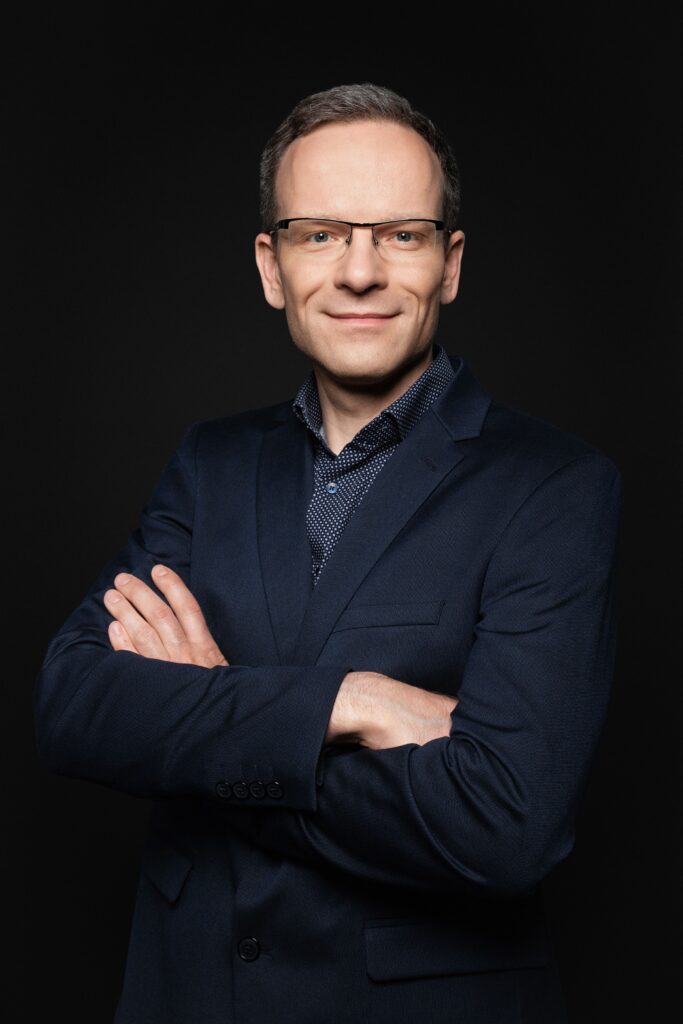
Aurelijus Juozapavičius
According to the interviewee, each career stage developed different competencies: working as a programmer taught technical precision; as an analyst – how to understand needs and formulate solutions; as a project manager – how to plan and work with people; and managerial positions taught him to see the department or organization from a broader perspective.
“I consider my most important achievement to be not a specific job title or a single project, but my entire professional journey—from a programmer to executive roles in the IT sector. A technological education can open up a very wide path; you start with programming, and later you can rise to positions managing projects, teams, organizations, or even strategic decisions. The IT field is constantly changing, so one of the greatest achievements is the ability to stay relevant, continuously learn, and adapt to new technologies,” emphasizes the interviewee, adding that professional growth is often determined by how quickly you learn, take responsibility, and are able to work with other people.
A Practical Form of Creation
While the choice of career paths in IT is abundant, it is also important to understand the characteristics of the sector itself. When discussing the challenges of modern IT work, the biggest one is the extremely rapid pace of change, claims Juozapavičius. Technologies, client expectations, security threats, standards, regulations, and work organization models are constantly evolving, requiring professionals not only to react but also to anticipate a few steps ahead.
“In this field, you have to balance several things daily: speed and quality, innovation and security, flexibility and processes, human creativity and organizational discipline. In IT, mistakes can cost a lot—reputation, data security, and client trust. Therefore, it is crucial to build systems and processes that help avoid mistakes, and when they do occur, to react quickly and professionally,” the expert advises.
He adds that a modern IT specialist needs a combination of competencies: technological understanding, management, communication, process-oriented thinking, responsibility for security and quality, and the ability to make decisions under conditions of uncertainty. As AI becomes a daily tool in almost all IT professions, AI literacy is also becoming increasingly important—the ability to properly formulate a task, critically evaluate the generated result, recognize errors, and handle data responsibly.
Juozapavičius is fascinated by this dynamic and versatile field because of the opportunity to create solutions that provide clear, tangible value to people and organizations: this way, technology becomes a meaningful way to meet a real need.
“I like that IT is a very practical form of creation. Here you can have an idea, design it, assemble a team, implement it, and see a real result. It is not an abstract activity—a good solution comes to life, people use it, and it changes processes,” says the interviewee.
Advice for Those Considering the Path and Those Still Studying
Is a degree in information sciences required to work in IT? Juozapavičius confirms that it is, while simultaneously emphasizing that it is important to gain not only knowledge at the university but also to develop systemic thinking.
The interviewee himself graduated from the then Vilnius Technical University (today Vilnius Gediminas Technical University – VILNIUS TECH). Almost thirty years ago, he enrolled in the newly launched Engineering Informatics study program.
“During our studies, we learned a wide variety of subjects. Of course, we studied informatics and programming, but there were also quite a few disciplines that, at first glance, seemed less related, such as theoretical mechanics, humanities, and other general university and engineering courses. However, looking back from today’s perspective, it was precisely that broader foundation that was extremely valuable.
The university taught me not only discipline, a systemic approach, or specific technologies, but also a way of thinking: how to analyze a problem, break it down into parts, look for a solution, and not get lost in uncertainty. In the AI era, such a foundation becomes even more valuable: university studies teach you not just to use rapidly changing tools, but to understand how algorithms, data, and systems actually work. Such preparation allows you not only to follow technological changes but to become their creator. If this way of thinking appeals to you, this direction is seriously worth considering,” Juozapavičius shares.
To those undecided about studying in the IT field, he advises not to look at informatics too narrowly. According to him, it is not just programming or working with a computer. Informatics studies open up various career paths: you can build systems, analyze data, take care of cybersecurity, design solution architectures, manage projects or products, work with organizational processes, and, having gained experience, lead teams or organizations.
“If you are curious, have a desire to understand how systems work, and are ready to constantly learn, these studies can be a very good choice. The most important thing is not to fear that today you don’t yet know exactly what you will be doing in ten years,” assures the expert.
Meanwhile, for those who are already studying, he advises trying out different IT directions as early as possible. Programming will suit one person better, while systems analysis or data analytics will suit another. IT is a very broad sector, so it is important not only to study informatics but also to discover in which area you can be the strongest and where you find it most interesting to grow, says the expert.
“When we entered the university almost thirty years ago, both the informatics study environment and the IT market itself were just forming in Lithuania. Today, there are incomparably more opportunities, and artificial intelligence opens up even more ways to turn ideas into working technological solutions. However, the most important thing hasn’t changed: this path is best suited for curious people who want to understand a technology-driven world and create real value themselves,” summarizes Aurelijus Juozapavičius.
Galerija