Simplicity, functionality, durability, and the ability to meet real consumer needs – this is the direction industrial design is moving in. In the noise of information and solutions, value is created not by an elaborate form or an abundance of technology, but by the ability to solve specific problems accurately. Design experts explain what drives this change, how the role of the designer is evolving, and what competencies the market requires.
“Less is being created, but better, so that the product can be used longer and maintained more easily,” says Assoc. Prof. Mindaugas Užkuraitis, Head of the Department of Design at the Faculty of Architecture of VILNIUS TECH University.
According to him, this direction is related to the increasingly established logic of “Frugal Innovation,” where products with as many functions as possible are replaced by precise, justified, and clear value-creating solutions.
“‘Frugal Innovation’ essentially teaches discipline – to select what truly creates value and what is just a superfluous layer. This is not just about the desire to save – it is a conscious design process that often requires even more creative and analytical work. We see this design direction all over the world; it is related to sustainability, limited resources, and changing consumer expectations,” he explains.
In Lithuania, according to the speaker, the direction of frugal design may not always be explicitly identified by this term, but evaluating the solutions of recent years reveals a clear trend towards rationality.
Solving Real Problems
This shift inevitably changes the very purpose of design. Lukas Misiūnas, a lecturer at the Department of Design at the Faculty of Architecture of VILNIUS TECH University, argues that design should not exist for its own sake.
“In recent years, there has been a growing discussion in the design field that design should return to its essence – solving real human problems. For a long time, the design discourse strongly emphasized visual expression and distinctiveness, and today, a significant number of solutions are born from following trends circulating on social media,” he shares.
According to him, this creates a paradox: for example, the good design principles of the German industrial design legend Dieter Rams are often referenced, but in reality, only their aesthetic interpretation is adopted.
“However, D. Rams constantly emphasized that good design must first and foremost be functional, understandable, and help a person solve specific problems. In other words, design should not exist just for the sake of design,” emphasizes L. Misiūnas.
According to the lecturer, design often moves away from real human needs when the connection with the context in which the object will be used is lost in the design process.
“Contemporary designers, using artificial intelligence tools and platforms like Instagram or Pinterest, have access to a huge amount of visual examples and can see thousands of solutions in a few minutes. This can be inspiring, but at the same time, there is a danger of starting to create based on existing images, rather than real situations in which people act. In this case, the design process is turned upside down: instead of the object arising from the needs of human activity, it arises from aesthetic references,” he describes the situation.
According to L. Misiūnas, aesthetics in itself is not a problem, as it has always been an important part of design. The problem arises when aesthetics becomes the starting point, not the result.
“In fact, many of the best design solutions are born not in the studio, but by observing real use. When a designer sees how people work, cook, play sports, or use certain tools, a much more specific understanding of what really works and what just looks good emerges,” he says.
Both Creator and Researcher
Užkuraitis agrees that as the concept of design changes, the role of the designer inevitably changes as well.
“Today, a designer can no longer be just a ‘creator of form.’ He becomes a researcher, an analyst, sometimes even a strategist. One has to understand not only the object but also the context – how, where, and why it will be used. There is no less creativity – it just changes direction. Fewer spontaneous searches for form, more meaningful solutions. In essence, creativity becomes the ability to solve complex things simply,” he believes.
This also redraws the design process itself, which must inevitably be based on research, experimentation, and feedback from the user.
“The designer creates not for an abstract audience, but for a real person whose daily life is full of small and large challenges – from uncomfortable tools to complex user experiences. The designer’s task is not only to create an aesthetic object but also to help reduce these daily frictions. Good design is often manifested precisely in the fact that it imperceptibly facilitates human activity – makes it simpler, clearer, or more effective,” says L. Misiūnas.
It is in everyday solutions, according to him, that the greatest potential of design lies.
“Everyday problems are often not very obvious because people just get used to them. Therefore, it is important for a designer to be able to notice what users themselves already consider a normal part of their daily life: small inconvenient details, extra steps, unnecessary complexity,” he shares.
In his opinion, curiosity and the ability to observe are very important for this.
“For young designers, it is often worthwhile to start with activities they are familiar with – sports, cooking, or technology, where it is clear what tools are needed to achieve a result. In such situations, design arises not from an abstract pursuit of aesthetics, but from a specific need,” advises L. Misiūnas.
Another necessary skill, according to the specialists, is the ability to quickly test ideas.
“Prototyping, testing, observing user reactions allow us to understand whether the solution really helps. Design is rarely born as a single correct solution – more often it is an iterative process in which the solution gradually approaches what is truly useful to a person,” explains L. Misiūnas.
A Necessary Balance of Decisions
According to M. Užkuraitis, several essential criteria must be taken into account in the process of creating industrial design: functionality, materials, durability, price, and aesthetics. However, the most important thing is the whole:
“All these criteria are important, but they never work in isolation. Functionality is the foundation – if the thing doesn’t work, everything else loses its meaning. Then come materials, durability, price, aesthetics – and this is where the real design begins. Because design is essentially a balance of decisions. Sometimes you have to sacrifice one aspect for another, but a good product is one in which those compromises are invisible to the user.”
Misiūnas adds that when it comes to modern design, value is created not by the object itself. Design works as a system consisting of the product, related services, the context of use, and the entire user experience.
“The object in this system is just one link. For example, a kitchen tool can be perfectly designed in terms of form and function, but the real value comes when it allows a person to more easily achieve the desired result – to cook food, share it with others, and create a social experience. Therefore, the designer’s job today increasingly means not only creating a product but also understanding the entire product-service-experience system. In essence, design can be understood as a discipline of tool creation, which creates means that allow people to act, achieve results, and have desired experiences,” he emphasizes.
According to Užkuraitis, a designer does not have to become an expert in all fields, but it is important for him to see the bigger picture: to understand technology, to feel the person, to talk to business, and to think about the impact on the environment. L. Misiūnas emphasizes that it is important for a designer to realize that the center of human life is not the object itself, but the experience. Objects exist to help achieve a certain result, and results create experiences that form emotions and a sense of satisfaction.
“If we look at this process as a sequence of actions, it looks something like this: a person is engaged in a certain activity or hobby, in it, he seeks a result, to achieve the result he needs a method, and for the method – a specific tool. The tool allows to achieve the result, the result creates the experience, and the experience forms emotions. It is at this point that design appears,” says the lecturer.
However, in order for such a tool to be created, the designer must understand the entire chain: from human activity and its desired results to the experience that this result creates.
“Only by understanding this whole cycle can one create not only an aesthetic but also a truly meaningful design solution that a person needs,” he says.
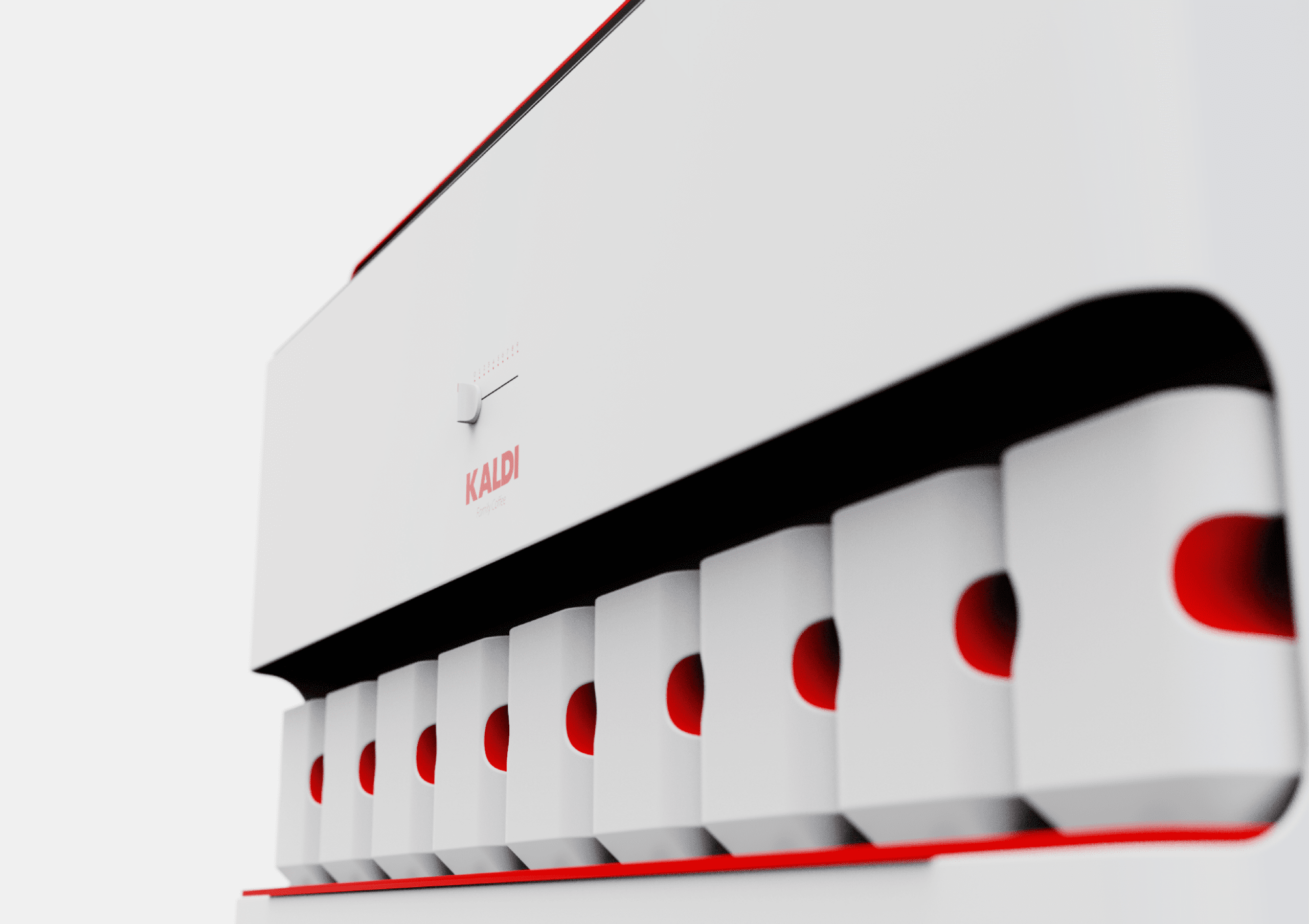
L. Misiūnas illustrates this approach with his conceptual project “KALDI Family Coffee.” The project’s name comes from the legend of the Ethiopian shepherd Kaldi, who is said to have been the first to notice the effect of coffee beans when his goats became unusually energetic after eating the berries. This story is considered the symbolic beginning of coffee culture. Over the centuries, coffee has become not only a drink but also an important social tradition. “KALDI Family Coffee” is a coffee machine designed for a shared coffee ritual in the family or at gatherings of loved ones.
“In a larger group, it is difficult to prepare coffee for everyone at the same time – the machine allows serving up to nine cups at once, so that everyone gets it at the same time and at the same temperature. The object is created as a central element of the table, so not only the function but also the social experience is important. The machine works mechanically, without electronics, so it is more reliable and easier to maintain. In this case, design is a tool that allows creating a shared experience, not just performing a function,” shares L. Misiūnas.
Design Principles in the Study Process
Such market changes also shape how future designers are trained. M. Užkuraitis says that in VILNIUS TECH studies, attention is paid not only to form but also to function and user needs – students of the Industrial Product Design program are taught to create well-founded ideas, test them, and adapt them to the market.
“We very consciously use project-based learning. Students not only create form – they analyze the user, test, make prototypes, think about production. It is important that the solutions are based not on the principle of ‘beautiful – not beautiful,’ but on real benefit: ‘why it works this way.’ And that ‘why’ becomes an essential part of design,” says M. Užkuraitis.
He explains that the Industrial Product Design study program aims for students to be able to integrate design and engineering principles, understand market needs and trends, create environmentally friendly, ergonomic solutions, and implement projects from idea to final product.
“A large part of the projects takes place in cooperation with companies – students receive real technical tasks and work as small design teams. So far, this is mostly the development stage: prototypes are created, solutions are tested, they are coordinated with partners. This is a very important experience because students see what the real process looks like: with restrictions, deadlines, compromises. And although the final implementation is still pending, the process itself is already very close to what happens in the industry,” he summarizes.
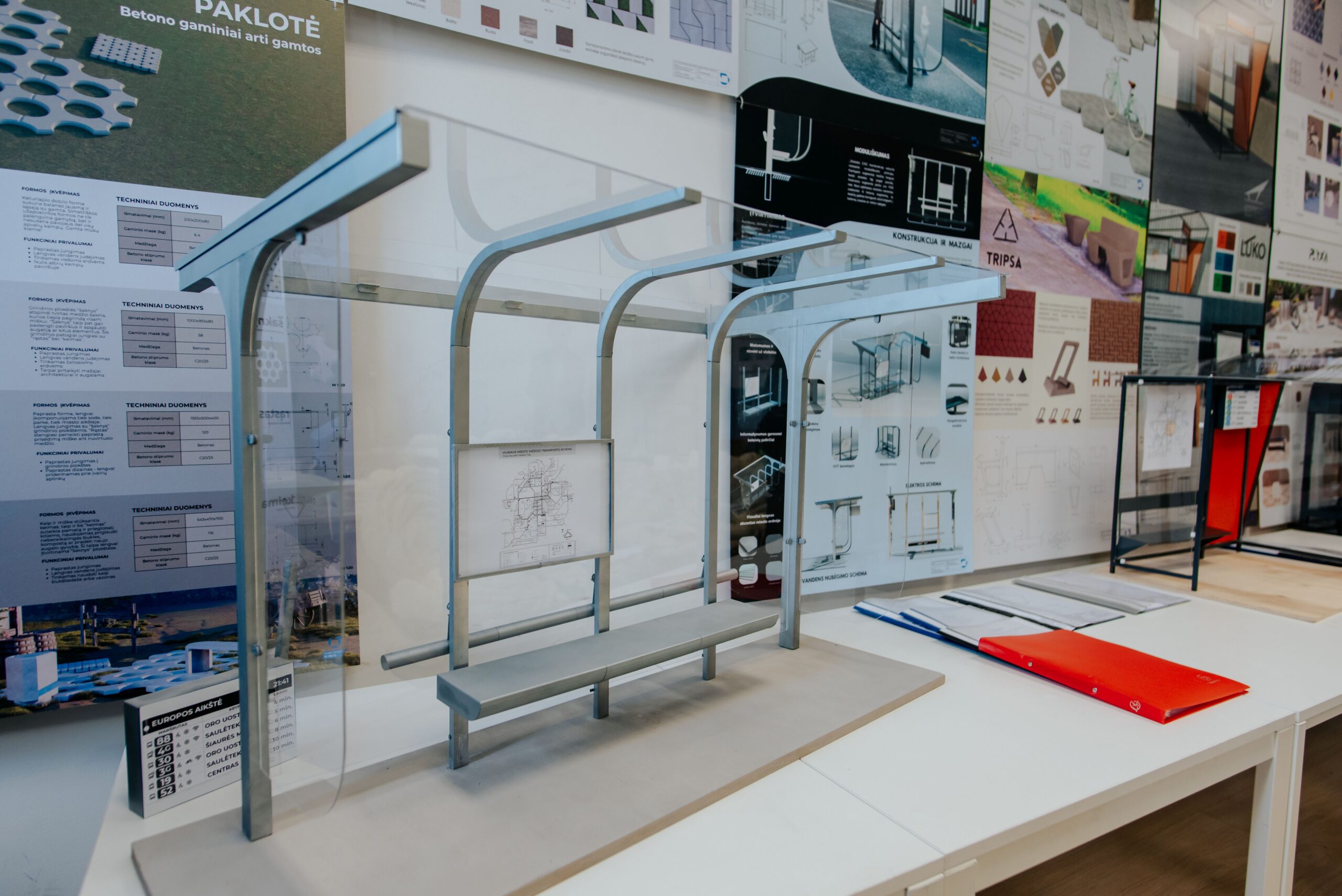
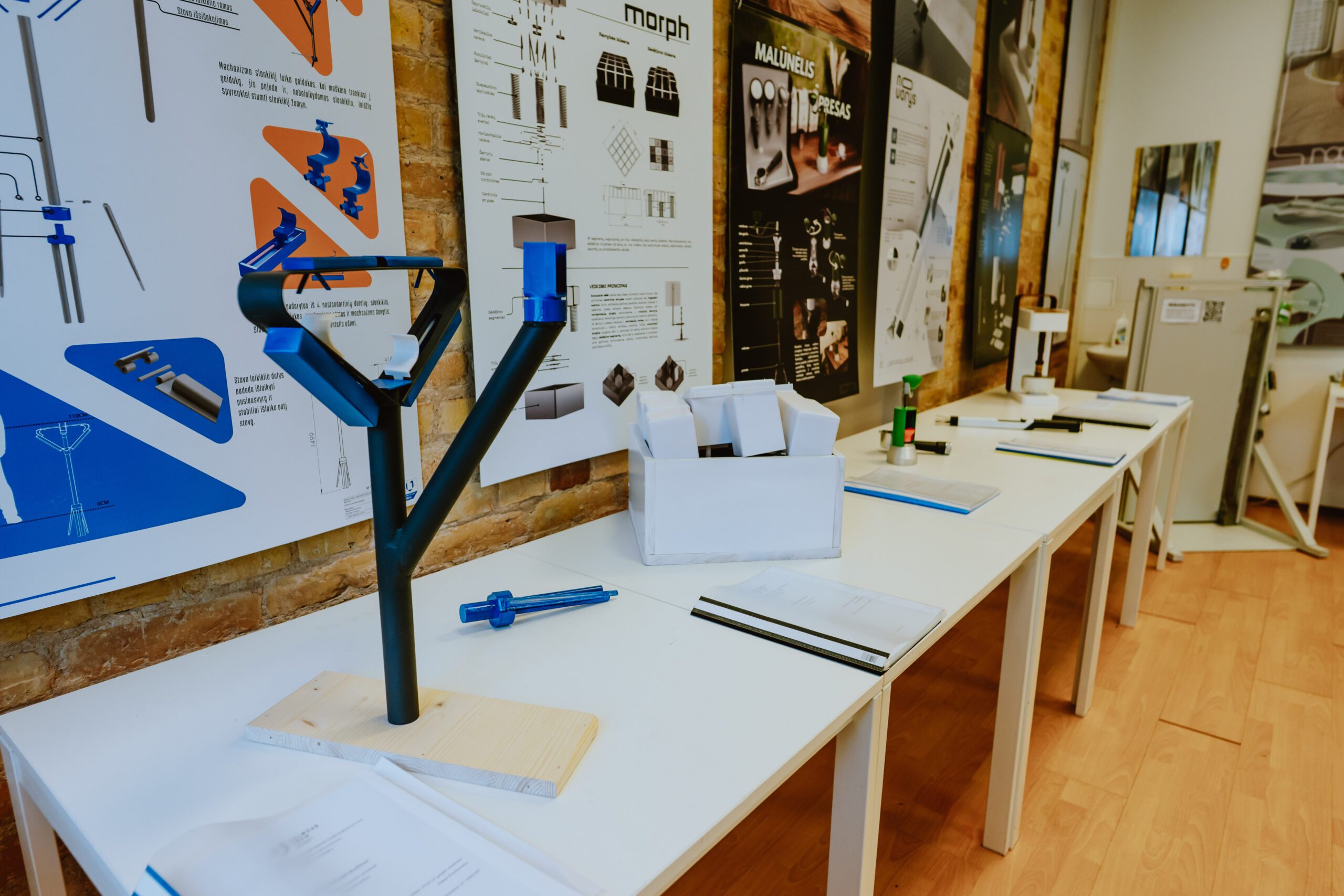
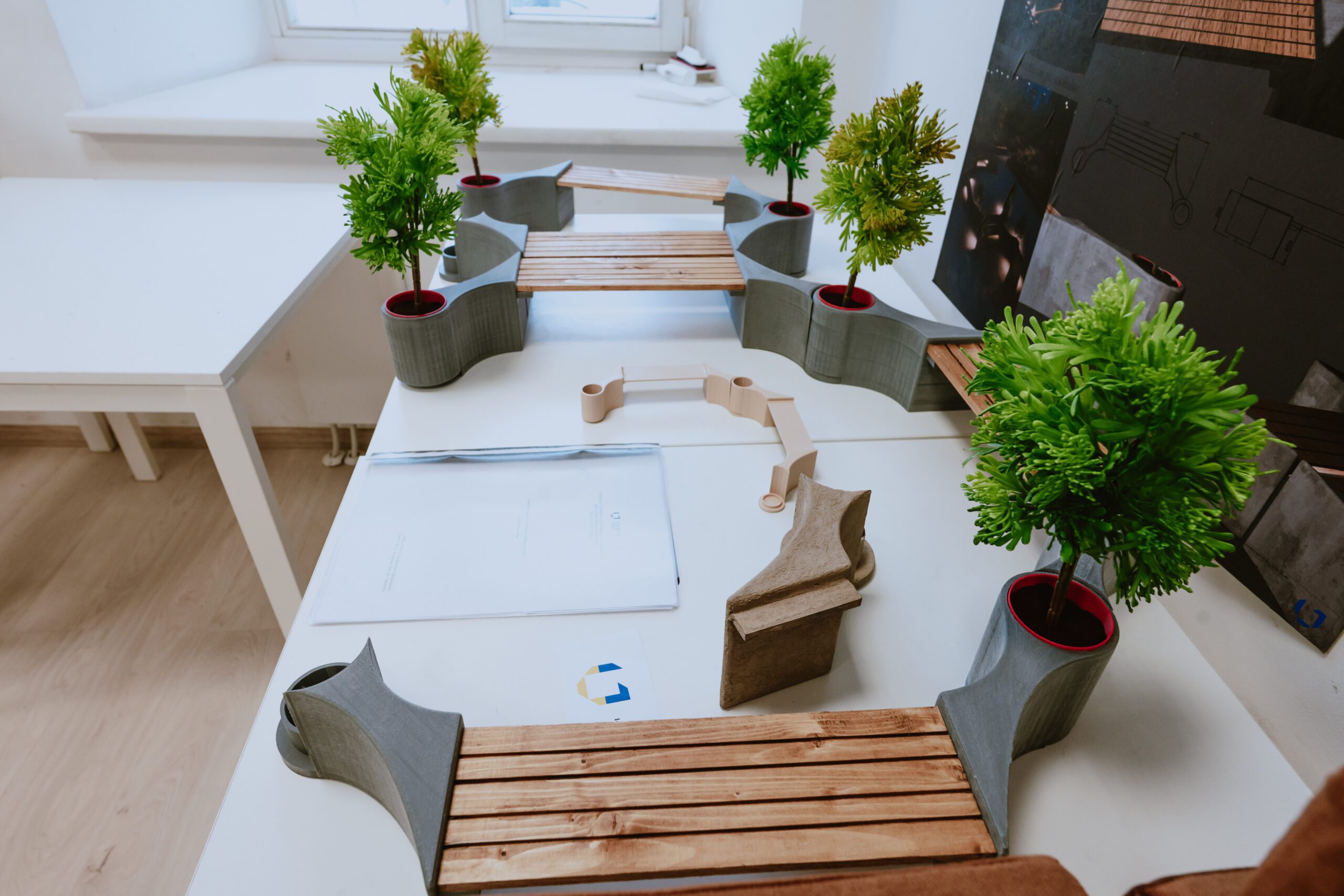
How these principles are applied in practice is shown by student works. One of the examples is the bus stop concept EXO by third-year students Dovydas Stančius, Enida Kaminskaitė, and Laura Palčiauskaitė. The idea of the course project, prepared in cooperation with JUDU and Vilnius City Municipality, is to create a more comfortable environment for people waiting for the bus.
“Developing this urban equipment object, we aimed to take into account the real needs of users. We ourselves use public transport every day, so the project was shaped by the desire to improve the waiting experience. For the shape of the stop, we were inspired by the structures of mollusks, which we refined into a clear, segmented modular system. It is adapted for industrial production and is easily integrated into the city’s infrastructure. The two-support solution simplifies installation, and rainwater is directed within the internal structure, eliminating superfluous external details. The project also forms an additional waiting area – a space at the back of the stop,” say the authors.
The modern forms of the EXO stop, according to them, are not just decorative – they are structurally sound and create an impression of lightness in the urban environment. All solutions are focused not only on user comfort – they are easy to install and maintain.
Galerija