
Invisible weapons: why radio communication was crucial in many battles?

July 25, 2019

It may sound unexpected, but war is a key driver of the technological advancement,” says associate professor Andrius Ušinskas from the Department of Electronic Systems at Vilnius Gediminas Technical University (VGTU). Recently, the researcher participated in a project on secret communication technologies, which are especially popular in the military. There are many examples when establishing communication and detection of communication of an enemy were crucial to the outcome of the battle. In the interview, A. Ušinskas tells us about this yet little known type of communication, shares its intricacies, possible application and future prospects.

Please tells us about the project and VGTU’s role in it

VGTU closely cooperated with business in this project. We analysed the latest technologies, research and solutions, and also provided our suggestions. The project focused on secret communication technologies, which currently are very relevant. The military needs various technological solutions and communication is one of the important areas for development. I speak about communication between different groups or units, when fast radio communication is needed, and ways to make this type of communication secret; because the fighting parties aim to remain undetected by the enemy. We were deepening our knowledge in the field and tried to understand better what possibilities do these type of technologies provide, how to detect such communication, its methods and location. The first step to deeper understanding – analysis of theories. Later, one needs complex modern technologies, which are produced only in technologically advanced countries. Most often, the only way to do it is to buy separate components, and then to programme and combine them. We can buy different parts of hardware, but we have to finish the job ourselves. I believe that the coding part is what makes us unique. In a way it could be compared to human body and soul, intellect. This step faces a lot of challenges, and our – the university’s – role was to analyse the methods, understand the concept, while businesses took care of the implementation part. We are very happy to contribute to such project and to be part of high-tech development. One thing is to read about the topic, but something else entirely is to be part of the development process.

 
What are the main goals for the military radio communication?

It is very important to keep the transmitted information and the location from which it is transmitted secret. In general, theories focus on three aspects of information secrecy. First, the data must be encrypted so the enemy doesn’t understand what is being transmitted. The second aspect covers data integrity and incorruptibility. For example, if there is a request to carry out a bank transfer, it should be secured that the is not possible to manipulate the bank account number. Third thing is to secure the authorship of the data. One should be sure from whom the message is received. During the World War II, it was quite common to intercept the message, read its content and to pretend to be the sender. The aim is to keep the communication undetected. Sometimes, only the fact of detected communication signal leads to the decision to destroy the location where the signal was detected; thus, the secrecy has the key importance and calls for thorough understanding and application of modern technologies. 

A specific frequency is chosen to transmit information via radio communication. Frequency is one of the characteristics of radio waves. Only a limited number of people know which frequency is used to transmit messages and they listen to it. It is similar to us listening to radio stations when we know its frequency. The difference in military is that the frequency is secret and fighting parties look for the enemy’s radio communication signals. Radio scanners are used to detect the frequency transmitted by a radio transmitter, and if several scanners and specific software is used then it is possible to detect the exact location of the transmission. One scanner determines the direction from which the signal is transmitted, and two scanners determine the location. The higher the number of scanners, the higher the precision of the location. The aim is to create a radio transmission, which is not detectable with scanners, or could be detected too late, when it is not relevant anymore.  
 
Which technologies help us to reach the desired results?

There are many different technologies. One of them – frequency-hopping, when transmission is started through one frequency channel and then rapid switching to other channels occurs. Even if the enemy detects the first frequency, they do not know what frequency will be next. It’s a game. Another technology – time-hopping, the transmission is divided into parts, which are sent separately in varying periods; thus, the enemy does not know when the next part of the message will be transmitted. When both technologies are combined, it is very hard to detect the communication; only people who know what and where to look for, will find it. On the other hand, even if it is detected it is very hard to understand the message. Nowadays, modern technologies allow super-fast hopping.    

Where these technologies are applied in the real world?

First of all – military industry, where it is vital to keep the communication secret. Also it can be used by special agencies to keep certain information secret, to protect important people, especially when their location or direction of movement should not be known. The industry has its standard methods and protocols for transmission encryption or signing of messages. Thus, these technologies are used where the fact of communication should be secret. The industry of application is quite narrow, therefore there are not many companies which specialise in this field. Mostly, these are American companies, and they sell the technologies to other countries. 

So the US is one of the leading countries in this field? How do you see Lithuania in this context?

I think we are only users. The USA and Russia are the leading countries in radio communication technologies. The proof to that are GPS and GLONASS positioning systems. Mainly the two countries provide services in this field; it is worth to mention several other countries, like China, which guarantees positioning only on its territory. It may sound unexpected, but war is a key driver of the technological advancement. Many important inventions were made during the World War II.
 
Do trends of war innovations exist?

The most important trend is to develop spread-spectrum technologies. One of the methods is to hop from very high frequency to very low frequency. It is very hard to implement technologically and requires solutions to many challenges, even such as how an antenna should be installed. For example, we all know that an antenna is an integral part of an iPhone body. The times of cordless phones with telescopic antennas have long gone. We, as users, do not have a clue what is inside our smart phones. It’s a trade of black boxes. We buy a box, but we don’t know what is inside of it. I think there are just a few professionals in the world who could design a smart phone from scratch. One side of the challenge is to create a technology, and another – to put it in a small box.
 
What are the future forecasts for this field of technologies?

There are several challenges and at the same time areas for development: the size of radio transmitters, their operation time and transmission distance. Operation time should increase in the future, as capacity of the batteries increases. Speaking about the size, just half-century ago solders moved around with enormous radio equipment on their backs. Now such equipment can be fastened to a belt. It is very likely, that equipment size will continue to decrease. Transmission distance is also very important: sometimes a very distant transmission is needed and sometimes it’s just nearby, but it should be secret. The harder it is to detect a transmission; the more secret it is. On the other hand, transmission detection technologies will also keep on developing, and it will be harder to maintain radio communication secret.      
 

Related news

University of the future: dialogue between the past and the present
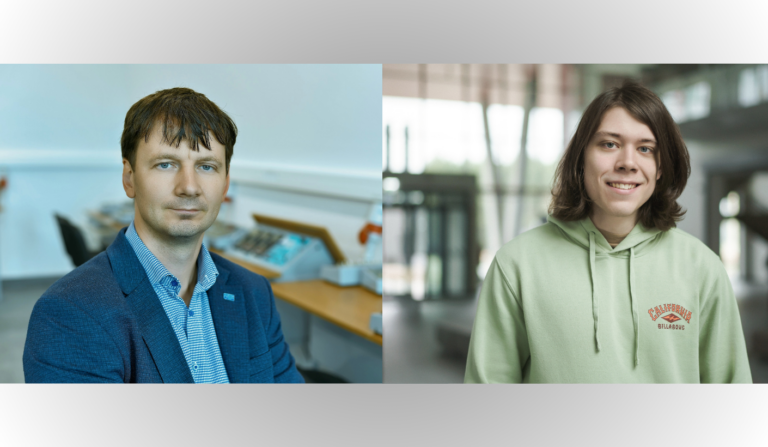
How does the role of a university change when viewed from two different perspectives: that of a former student who has now become a lecturer, and that of a current student just beginning their academic journey? How does university appear to someone who started there as a student and today teaches others, and how is it perceived by a student only taking one’s first independent steps in life? Representatives of the VILNIUS TECH Faculty of Electronics - Prof. Dr. Andrius Katkevicius from the Department of Electronic Systems and electronics engineering student Nojus Balciunas - are two different generations taking a fresh look at today's university and its future. Prof. Dr. Andrius Katkevicius, Department of Electronic Systems, Faculty of Electronics How has your view of the university changed from your student years to now as a lecturer? My perspective has changed significantly over time. When I studied electronics engineering at the Faculty of Electronics, I only saw a small part of university activity - mostly the teaching process. At that time, the university was associated with lectures, laboratory work, practical classes, and exams. During my bachelor's studies, I naively believed that successfully passing all exams was enough to secure a future in engineering career. Practice showed that in order to become a professional in your field, it is necessary to do extra work and actively participate in the chosen area of electronics, deepen your knowledge independently, and continuously improve yourself. Only during my master's studies did I begin to clearly understand that active scientific work is also carried out at the university. Today, after completing all stages of higher education and gaining pedagogical and scientific experience, I see the university as a multifaceted institution encompassing a wide range of activities and opportunities - from educating first-year bachelor's students to carrying out scientific and commissioned projects with local as well as international partners. How are student generations and their relationship with learning changing? Today's students are more focused on practical benefits and quick results. They have much broader and faster access to information, so they are increasingly less limited to material presented during lectures. At the same time, however, they face challenges related to information overload and evaluating information quality, especially when many answers can be obtained through artificial intelligence. There is a growing need for practical learning, understanding how knowledge is applied in real contexts, and seeing the value of studies in future professional activities. Students' expectations toward lecturers are also changing - dialogue, feedback, and a clearly structured learning process are increasingly valued. Although some students lack patience for long-term and consistent work, they are also more open to new technologies, digital tools, and flexible forms of learning. This encourages lecturers to constantly review and update their teaching methods. If you could compare the university from your student years with the current one, what has changed the most? One of the most noticeable changes is the study and research environment. A few years ago, after moving into new facilities, a modern and well-designed infrastructure was created, which clearly focused on study quality, scientific research, and collaboration. This environment not only improved technical possibilities but also changed the academic culture and daily work at the university. Fundamentally, the understanding of the university's role has changed - from an institution mostly focused on the study process, the university has become a much more active center for science, innovation, and project-based activities. Today, the university creates opportunities for students to participate in scientific, applied, and international projects, something that was previously less visible or accessible. Another important change is the advancement of learning tools and technologies related to digitalization as well as the application of artificial intelligence. Today, students have access to advanced digital learning platforms, virtual laboratories, simulation tools, and AI-based support systems that can help analyze, model, and deepen their knowledge. This fundamentally changes the learning process - from passive absorption of information to active, independent, and individualized learning. What should universities do differently today to better prepare students for the future? Universities should enhance the connection between studies and real practical experience even more, so that students can more clearly understand how acquired knowledge will be applied in professional activities. This includes closer cooperation with businesses and scientific partners, project-based learning, and involving students in applied and scientific projects as early as possible. It is important to develop not only subject-specific competencies but also general abilities - critical thinking, independence, responsibility for the learning process, and the ability to adapt to constantly changing technologies. Universities should encourage students to learn throughout life, experiment, make mistakes, and learn from experience, while also providing a suitable academic environment, which encourages that.   Nojus Balciunas, 3rd-year Electronics Engineering Student, Faculty of Electronics How would you describe the university and the significance of studies? For me, the university is first and foremost a community. Members of the VILNIUS TECH community are very warm and supportive people who constantly encourage participation in various activities organized both within and outside the university. Studies at VILNIUS TECH are an extremely significant stage of life. I can acquire not only academic knowledge but also practical skills, while developing critical thinking, independence, and responsibility. Of course, it is also a kind of transition into adult life, but even more importantly, it is a stage of growth, self-improvement, and self-discovery. I believe this is one of the most important periods in life. What expectations do you currently have for the university, and are they different from what you imagined before starting your studies? When I started studying at the university, I expected to gain more practical experience during lectures, but I soon realized that opportunities to gain such experience are provided beyond lectures. The university offers various additional activities, programs, and internships that students can join to deepen their knowledge and become more involved in practical activities. These opportunities are one of the university's greatest advantages - it provides space to grow, improve, and shape your own study path. What experiences or skills gained during studies are the most valuable? I believe the most important acquired skills are the so-called soft skills: being proactive, the ability to present your work and ideas, adapt to new environments, and respond quickly to changing situations. How do you imagine the university of the future - what should be different there compared to today? It is difficult to imagine the university of the future being very different from what it is now. Of course, laboratories and the equipment in them will become even more modern over time, but even today it is clear that VILNIUS TECH is constantly updating, expanding, and implementing the latest technologies. However, I believe that in the future laboratories will become even more open, giving students more opportunities to independently work on projects and implement their ideas outside of study hours. What motivates you the most today to study and improve yourself? What motivates me the most is my love for electronics and the desire to understand things I do not yet understand. And there are still very many such things.
More
Photography Exhibition "Leaving My Body" by Ieva Mizgeraitė
We invite you to visit the photographic exhibition "Leaving My Body" by VILNIUS TECH alumna Ieva Mizgeraitė. This collection is a journey through a woman's inner world – through the body, emotions, self-discovery, and the attempt to look at oneself from the outside. In her work, the photographer explores a body that does not always conform to society's expectations, situations beyond our control, the masks we see around us and sometimes put on ourselves, as well as the constant demand to be strong, equal, and always ready. “Each project was born from a specific emotion – from the noise and dialogue in my mind that arose at that moment. Searching for answers, I left my body and looked at everything from the outside – through the states of my models, their poses, gazes, and bodies. I understood that when you look at yourself from the outside, emotions become temporary. Inner dilemmas that once seemed permanent begin to dissolve,” the photographer says about the concept behind the exhibition. The exhibition brings together anger, resistance, masks, expectations, and freedom. These are not merely personal themes – they are experiences familiar to many women. The photographer says that she captures not faces, but psychological states. For her, photography has become a way of self-discovery and self-reflection – a form of meditation that helps her step away from the noise of the outside world and better understand what truly matters. The author works predominantly in black and white. She has been professionally active in photography since 2025. The exhibition "Leaving My Body" is an introduction to a deeper journey, which is planned to be presented in Gallery A of the library in November 2026.   The exhibition is on display in the foyer on the second floor of the Central Library.
More