University of the future: dialogue between the past and the present
How does the role of a university change when viewed from two different perspectives: that of a former student who has now become a lecturer, and that of a current student just beginning their academic journey? How does university appear to someone who started there as a student and today teaches others, and how is it perceived by a student only taking one’s first independent steps in life?
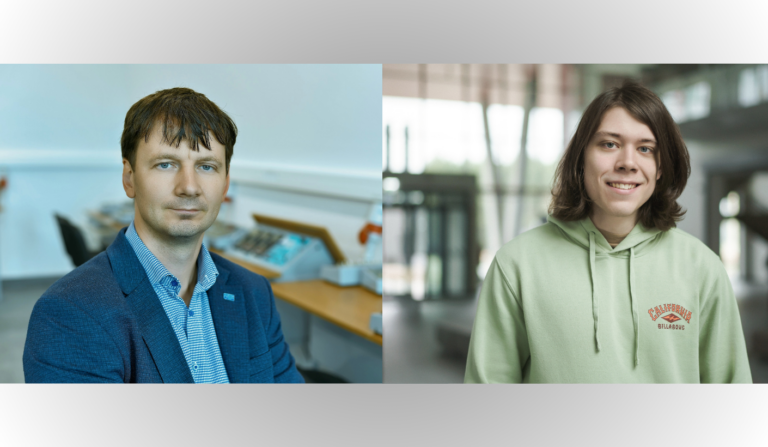
Representatives of the VILNIUS TECH Faculty of Electronics - Prof. Dr. Andrius Katkevicius from the Department of Electronic Systems and electronics engineering student Nojus Balciunas - are two different generations taking a fresh look at today's university and its future.
Prof. Dr. Andrius Katkevicius, Department of Electronic Systems, Faculty of Electronics
How has your view of the university changed from your student years to now as a lecturer?
My perspective has changed significantly over time. When I studied electronics engineering at the Faculty of Electronics, I only saw a small part of university activity - mostly the teaching process. At that time, the university was associated with lectures, laboratory work, practical classes, and exams. During my bachelor's studies, I naively believed that successfully passing all exams was enough to secure a future in engineering career. Practice showed that in order to become a professional in your field, it is necessary to do extra work and actively participate in the chosen area of electronics, deepen your knowledge independently, and continuously improve yourself. Only during my master's studies did I begin to clearly understand that active scientific work is also carried out at the university.
Today, after completing all stages of higher education and gaining pedagogical and scientific experience, I see the university as a multifaceted institution encompassing a wide range of activities and opportunities - from educating first-year bachelor's students to carrying out scientific and commissioned projects with local as well as international partners.
How are student generations and their relationship with learning changing?
Today's students are more focused on practical benefits and quick results. They have much broader and faster access to information, so they are increasingly less limited to material presented during lectures. At the same time, however, they face challenges related to information overload and evaluating information quality, especially when many answers can be obtained through artificial intelligence. There is a growing need for practical learning, understanding how knowledge is applied in real contexts, and seeing the value of studies in future professional activities. Students' expectations toward lecturers are also changing - dialogue, feedback, and a clearly structured learning process are increasingly valued. Although some students lack patience for long-term and consistent work, they are also more open to new technologies, digital tools, and flexible forms of learning. This encourages lecturers to constantly review and update their teaching methods.
If you could compare the university from your student years with the current one, what has changed the most?
One of the most noticeable changes is the study and research environment. A few years ago, after moving into new facilities, a modern and well-designed infrastructure was created, which clearly focused on study quality, scientific research, and collaboration. This environment not only improved technical possibilities but also changed the academic culture and daily work at the university. Fundamentally, the understanding of the university's role has changed - from an institution mostly focused on the study process, the university has become a much more active center for science, innovation, and project-based activities. Today, the university creates opportunities for students to participate in scientific, applied, and international projects, something that was previously less visible or accessible.
Another important change is the advancement of learning tools and technologies related to digitalization as well as the application of artificial intelligence. Today, students have access to advanced digital learning platforms, virtual laboratories, simulation tools, and AI-based support systems that can help analyze, model, and deepen their knowledge. This fundamentally changes the learning process - from passive absorption of information to active, independent, and individualized learning.
What should universities do differently today to better prepare students for the future?
Universities should enhance the connection between studies and real practical experience even more, so that students can more clearly understand how acquired knowledge will be applied in professional activities. This includes closer cooperation with businesses and scientific partners, project-based learning, and involving students in applied and scientific projects as early as possible.
It is important to develop not only subject-specific competencies but also general abilities - critical thinking, independence, responsibility for the learning process, and the ability to adapt to constantly changing technologies. Universities should encourage students to learn throughout life, experiment, make mistakes, and learn from experience, while also providing a suitable academic environment, which encourages that.
Nojus Balciunas, 3rd-year Electronics Engineering Student, Faculty of Electronics
How would you describe the university and the significance of studies?
For me, the university is first and foremost a community. Members of the VILNIUS TECH community are very warm and supportive people who constantly encourage participation in various activities organized both within and outside the university.
Studies at VILNIUS TECH are an extremely significant stage of life. I can acquire not only academic knowledge but also practical skills, while developing critical thinking, independence, and responsibility. Of course, it is also a kind of transition into adult life, but even more importantly, it is a stage of growth, self-improvement, and self-discovery. I believe this is one of the most important periods in life.
What expectations do you currently have for the university, and are they different from what you imagined before starting your studies?
When I started studying at the university, I expected to gain more practical experience during lectures, but I soon realized that opportunities to gain such experience are provided beyond lectures. The university offers various additional activities, programs, and internships that students can join to deepen their knowledge and become more involved in practical activities. These opportunities are one of the university's greatest advantages - it provides space to grow, improve, and shape your own study path.
What experiences or skills gained during studies are the most valuable?
I believe the most important acquired skills are the so-called soft skills: being proactive, the ability to present your work and ideas, adapt to new environments, and respond quickly to changing situations.
How do you imagine the university of the future - what should be different there compared to today?
It is difficult to imagine the university of the future being very different from what it is now. Of course, laboratories and the equipment in them will become even more modern over time, but even today it is clear that VILNIUS TECH is constantly updating, expanding, and implementing the latest technologies.
However, I believe that in the future laboratories will become even more open, giving students more opportunities to independently work on projects and implement their ideas outside of study hours.
What motivates you the most today to study and improve yourself?
What motivates me the most is my love for electronics and the desire to understand things I do not yet understand. And there are still very many such things.
More